First Direct Customer Sales in Korea
Labor-Management Win-Win Council Instead of Labor Union
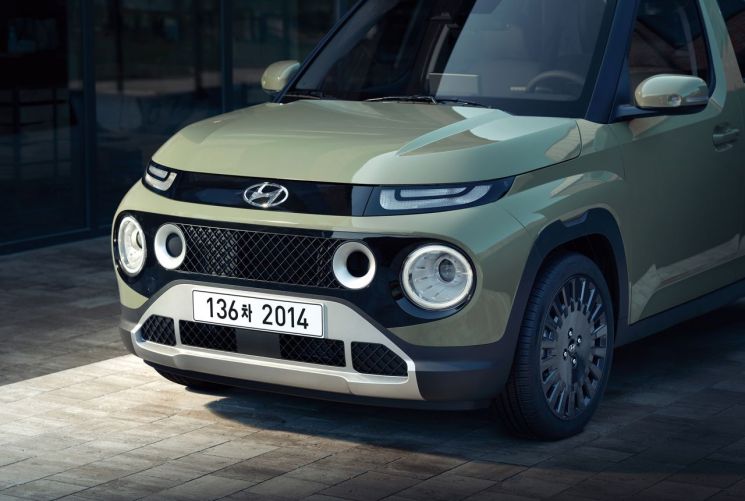
[Asia Economy Reporters Jehoon Yoo and Haeyoung Kwon] The first mass production model produced by Gwangju Global Motors (GGM), Korea’s first win-win job creation project, the Hyundai Casper, recorded sales of about 19,000 units on the first day of online pre-orders. As GGM, which has set significant milestones in the complete vehicle industry such as non-union management and Korea’s first direct online sales (D2C), successfully launched its first production car, attention is focused on how it will impact the domestic automobile industry and the confrontational labor-management culture.
On the morning of the 15th, GGM held a ceremony to commemorate the production of the first mass-produced Hyundai entry-level sport utility vehicle (SUV), the Casper, at its assembly plant located in the Bitgreen Industrial Complex, Gwangsan-gu, Gwangju Metropolitan City. The ceremony was attended by Im Seo-jung, Senior Secretary for Jobs at the Presidential Office, Lee Yong-seop, Mayor of Gwangju, Gong Young-woon, President of Hyundai Motor Company, and Park Kwang-tae, CEO of GGM.
GGM is a joint venture funded by the Gwangju Green Car Promotion Agency (21%), Hyundai Motor Company (19%), and others. It is the first automobile production plant to appear in Korea in 23 years since Renault Samsung Motors’ Busan plant. The production capacity is about 100,000 units per year, and 908 workers will be hired by next year. Hyundai Motor Company is responsible for vehicle development and sales, while GGM handles contract manufacturing.
The first model is the Casper, a compact car that Hyundai is releasing for the first time in 19 years. With an engine displacement of 1000cc, a length of 3595mm, width of 1595mm, and height of 1575mm, the Casper meets the compact car standards and is equipped with various advanced driver assistance systems (ADAS), earning high marks for its excellent product competitiveness. GGM plans to produce 12,000 units of the Casper this year and expand production to about 70,000 units starting next year.
19,000 Units on First Day of Pre-orders... Online Sales Unachieved by Hyundai and Kia
According to Hyundai Motor Company, the number of pre-orders for the Casper on the first day (the 14th) of mass production reached 18,940 units. This surpassed the record of 17,294 units set by the sixth-generation Grandeur facelift model released in 2019, marking the highest record among Hyundai’s internal combustion engine models to date.
Industry insiders cite online sales as the biggest factor behind Casper’s success alongside its product competitiveness. Unlike the existing complete vehicle industry, which has not attempted online sales due to opposition from sales unions, Hyundai and GGM sell the Casper exclusively online through a direct-to-customer (D2C) method, similar to overseas automobile industries.
A Hyundai Motor Company official stated, "It is due to the versatile product competitiveness that combines the economy, design, safety, and spaciousness of an entry-level SUV," adding, "Especially, the D2C method, the first of its kind among Korean automobile brands, provided customers with convenience in purchasing, which was effective."
Non-union, Fair Wages, Youth Employment... A New Model for Korea’s Complete Vehicle Industry?
Along with online sales, GGM is also significant as the first case to break the chronic high wages, confrontational culture, and generational conflicts that have characterized labor-management relations in the existing complete vehicle industry.
Of particular interest to the industry is the ‘non-union’ aspect. Instead of a union, GGM has established a labor-management win-win council and agreed to maintain the current wage and welfare levels until the cumulative production reaches 350,000 units. This means no wage-related disputes will occur for several years, choosing a different path from the annual summer strikes common in the existing industry.
GGM has also reached a compromise on the chronic high wage issue in the existing industry. The average starting salary of GGM workers, who are paid hourly wages, is 35 million KRW, which is less than half of Hyundai Motor and Kia’s average wages (88 million KRW and 91 million KRW, respectively). Instead, GGM workers receive performance bonuses based on sales volume increases.
GGM has also shown a new turning point in the generational and regional (metropolitan vs. non-metropolitan) conflicts caused by job reductions due to electrification. Among GGM’s total workforce, 79% (397 people) are young workers in their 20s and 30s, and 93% (470 people) are local talents. This contrasts with Hyundai and Kia, where the average length of service is 18.8 to 22.1 years and workers in their 40s and 50s form the core.
Jung Manki, Chairman of the Korea Automobile Manufacturers Association (KAMA), said, "While Korea’s complete vehicle industry has lost much of its price competitiveness due to chronic high costs and labor-management conflicts, GGM is the first experiment attempting non-unionism, fair wages, and online sales," adding, "It is necessary to closely watch whether this model can successfully establish itself domestically."
© The Asia Business Daily(www.asiae.co.kr). All rights reserved.
![Clutching a Stolen Dior Bag, Saying "I Hate Being Poor but Real"... The Grotesque Con of a "Human Knockoff" [Slate]](https://cwcontent.asiae.co.kr/asiaresize/183/2026021902243444107_1771435474.jpg)















