Extension of COVID Loan Maturity and Repayment Deferral Extended Until March Next Year
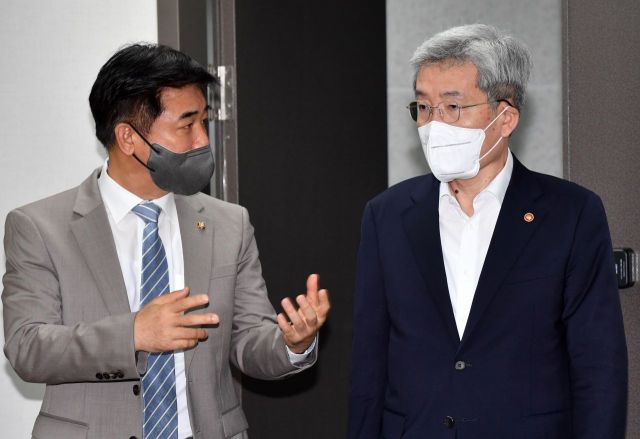 Financial Services Commission Chairman Ko Seung-beom is attending the government-party consultation on financial support for small and medium-sized enterprises and small business owners held at the National Assembly on the 15th, talking with Assemblyman Kim Byung-wook. Photo by Yoon Dong-joo doso7@
[Asia Economy Reporter Park Sun-mi] Concerns are growing that the extension of COVID-19 loan maturity extensions and repayment deferrals until March next year will further increase potential non-performing loans. The COVID-19 financial support, which began in April last year, has been extended for the third time. Experts pointed out that if the relief measures continue, the repayment burden on long-term deferred borrowers will increase, and the timing of revealing non-performing loans will only be postponed.
On the 15th, Ko Seung-beom, Chairman of the Financial Services Commission, announced at a government-party meeting on financial support for small and medium-sized enterprises (SMEs) and small business owners that "Self-employed and small business owners are facing ongoing business difficulties as the spread of COVID-19 worsens again, and they are desperately requesting an extension of financial support." He stated that the loan maturity extension and interest repayment deferral measures will be extended by six months until March next year. Financial institutions found it difficult to oppose the re-extension due to the accelerated spread of COVID-19 and record-breaking performance. However, some financial institutions and experts opposed the interest repayment deferral, citing concerns about delaying the recognition of non-performing loans.
The financial sector agrees that while the maturity extension and repayment deferral measures are being further extended considering the spread of COVID-19, it is crucial to implement complementary measures for an orderly normalization. Chairman Ko also mentioned at the meeting that "Considering the accumulation of borrowers' repayment burdens, opinions were presented within the financial sector that preparation for a phased normalization is necessary," indicating concerns about side effects from the extension of the measures.
The financial authorities decided to solidify soft-landing measures such as granting grace periods and extending repayment periods to ensure that borrowers under repayment deferral do not face excessive repayment burdens when the deferral ends. To reduce the debt burden of borrowers who have difficulty repaying, they plan to improve the bank sector's pre-workout system and the Credit Counseling & Recovery Service's credit recovery system by expanding support targets and strengthening support such as interest reductions. These are complementary measures introduced to address concerns about side effects from the extension. Along with this extension, the financial authorities will supply about 4 trillion won in liquidity through policy financial institutions.
From April last year to July this year, the maturity extension and repayment deferral measures have supported a total of 222 trillion won, including 209.7 trillion won in maturity extensions, 12.1 trillion won in principal repayment deferrals, and 200 billion won in interest repayment deferrals. Although the non-performing loan ratio of domestic banks recorded a historic low of 0.54% as of the end of June due to continued principal and interest repayment deferrals, the market largely views this as a visual illusion.
A senior executive in charge of corporate loans at a commercial bank said, "Even considering the COVID-19 situation, the fact that SMEs and small business owners cannot even pay interest means that when the measures end, it will lead to bank non-performing loans." Another bank official emphasized, "While we agree on the need for COVID-19 loan support, instead of deferring interest repayment, it is right to liquidate SMEs and small business owners who cannot recover."
Experts also expressed concerns about the re-extension of interest deferrals. Professor Seo Ji-yong of Sangmyung University’s Department of Business Administration said, "If extensions continue, borrowers may lose the will to repay," advising, "Activating refinancing loans to allow short-term loans to be repaid in installments over the long term or providing services that enable switching to lower interest rates is a way to achieve a soft landing." Oh Jung-geun, Chairman of the Korea Financial ICT Convergence Society, also pointed out, "More than 200 trillion won has been extended and deferred, but if they cannot even pay interest, they are already zombie companies."
© The Asia Business Daily(www.asiae.co.kr). All rights reserved.
![Clutching a Stolen Dior Bag, Saying "I Hate Being Poor but Real"... The Grotesque Con of a "Human Knockoff" [Slate]](https://cwcontent.asiae.co.kr/asiaresize/183/2026021902243444107_1771435474.jpg)
















