Hankyung Research Institute Analyzes 'Foreigners' Stock Trading Behavior and Implications'
[Asia Economy Reporter Kim Heung-soon] Foreign investors, who drive the domestic stock market indices, consider corporate growth potential as the most important criterion when making investment decisions in the stock market. Therefore, there is a claim that policy support is needed to enhance this growth potential.
The Korea Economic Research Institute (KERI), under the Federation of Korean Industries, announced on the 14th that an analysis of the impact of first-quarter business performance on the net purchase ratio of foreign investors in KOSPI-listed companies showed that the better the corporate growth potential, the more foreign investors net purchase the stocks of those companies, whereas improved stability leads to a reduction in net purchases.
Specifically, it was found that when the total asset growth rate, an indicator of growth potential, increases by 1 percentage point, the net purchase ratio of foreign stocks increases by 0.026 percentage points. Conversely, when the equity ratio, an indicator of stability, increases by 1 percentage point, the net purchase ratio of foreign stocks decreases by 0.078 percentage points.
KERI added that an analysis of whether foreign net purchase indicators (net purchase ratio and net purchase amount) affect the KOSPI and its volatility confirmed that the foreign net purchase ratio and KOSPI influence each other, and that the foreign net purchase amount affects KOSPI volatility.
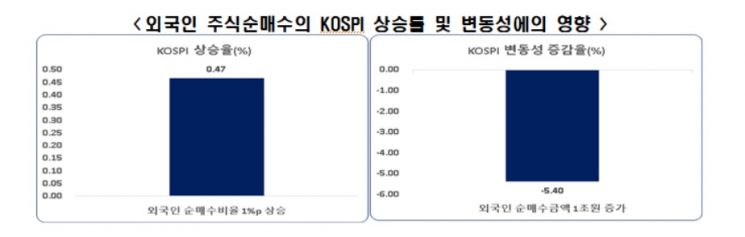
Based on these results, an analysis of the extent to which foreign net purchase indicators affect the KOSPI and its volatility showed that a 1 percentage point increase in the foreign net purchase ratio leads to a 0.5% rise in the KOSPI, and a 1 trillion won increase in foreign net purchase amount results in a 5.4% decrease in KOSPI volatility.
KERI interpreted this as meaning that foreign investors’ net stock purchases are linked to stock price increases and reductions in price volatility, thereby having a positive effect on the stock market.
KERI also argued that the recent continued selling pressure by foreign investors on the domestic stock market has prevented the market from recovering, raising concerns that this will negatively impact not only individual investors but also corporate financing through direct capital markets.
In the securities market this year, the participation ratio of foreign investors based on market capitalization decreased from 36.6% on January 4 (opening day) to 32.6% on August 31. Based on the number of shares, it declined from 19.2% to 18.3% during the same period.
Choo Kwang-ho, Director of Economic Policy at KERI, emphasized, "Through this research, we confirmed that ensuring corporate growth potential is paramount to expanding foreign participation in the domestic stock market. This is why it is necessary to improve corporate regulations and strengthen tax support so that companies can actively engage in management activities."
© The Asia Business Daily(www.asiae.co.kr). All rights reserved.
![Clutching a Stolen Dior Bag, Saying "I Hate Being Poor but Real"... The Grotesque Con of a "Human Knockoff" [Slate]](https://cwcontent.asiae.co.kr/asiaresize/183/2026021902243444107_1771435474.jpg)















