Relaxed Capacity Limit from 49 to 99... But 'No Dining' Condition Imposed
Financial Losses Persist Due to 'Minimum Guarantee' Requirement
Experts Say "Government and Local Authorities Are Inactive Amid Conflicts Between Engaged Couples and Wedding Venues"
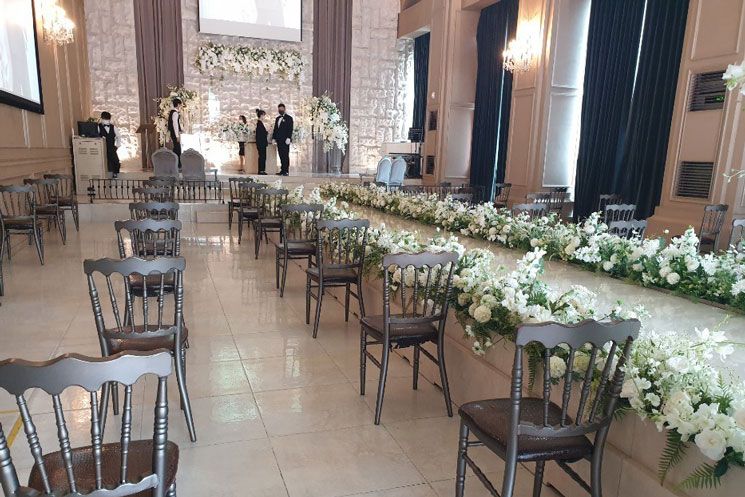 An empty wedding hall. The government has relaxed the attendance limit to allow up to 99 people even in social distancing level 3 and 4 areas if no meals are provided at the wedding venue, but engaged couples are opposing it, calling the policy ineffective. Photo by Yonhap News
[Asia Economy Reporter Kang Juhee] Concerns and complaints among couples preparing for weddings amid the COVID-19 situation are intensifying. Although the government relaxed the attendance limit to allow up to 99 people at wedding venues in social distancing levels 3 and 4 areas if meals are not provided, criticism is pouring in that this is merely a case of "Josam-mosa" (a futile change that results in no real difference).
Since wedding halls generally require a 'minimum guaranteed number of guests' of 200 to 300, couples must pay for the meals of the minimum guaranteed number even if meals are not provided. Therefore, the financial burden on couples remains largely unchanged. Experts emphasize that the government and local authorities must actively intervene to effectively resolve disputes.
Office worker Lee (29), who planned to marry last July but postponed the wedding to next year due to the implementation of social distancing level 4, said she still feels stressed recalling conflicts arising from contracts with the wedding hall. Lee found it extremely unreasonable to pay for the meals of guests who could not attend due to the minimum guaranteed number condition, so she accepted the penalty and postponed the wedding to next year.
Lee explained, "The wedding hall said they could not refund the meal costs for the minimum guaranteed 150 guests even though only 49 people would attend and neither the bride nor groom would see the rest. They said they would replace the meal costs for about 100 guests beyond the 49 with return gifts, but we couldn't even choose those gifts. Most were red ginseng or wine, which were far inferior in quality compared to the meal cost calculated at 46,000 KRW per person."
She added, "The relaxation of the attendance limit to 99 people is not a big help for couples. Even if 99 people come and do not eat, the meal costs must be paid as per the contract. Moreover, if guests do not come, the remaining return gifts must all be taken by the bride and groom. It's unfair no matter how you look at it," she lamented.
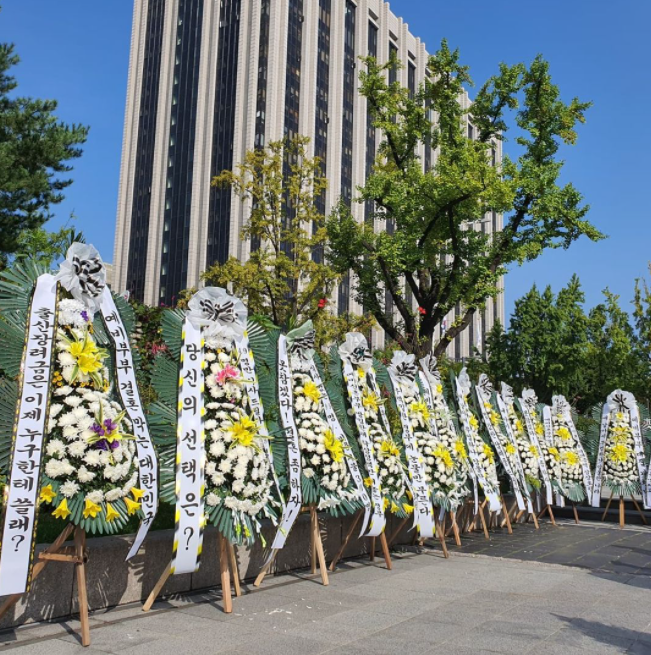 A wreath installed by the National Newlywed Association on the morning of the 9th in front of the Government Seoul Office in Jongno-gu, Seoul, demanding improvements to wedding quarantine guidelines is displayed. Photo by National Newlywed Association Instagram
On the 3rd, the quarantine authorities extended social distancing level 4 in the metropolitan area and allowed up to 99 people to attend weddings. However, this guideline was announced with the condition that meals are not provided. The attendance limit remains 49 people if meals are served, as before.
The ambiguous government measures further fueled the anger of couples preparing for weddings. The National Newlywed Couples Association, which gathered about 4,500 couples, held a 'wreath protest' on the 9th in front of the Government Seoul Office in Jongno-gu, Seoul. The wreaths bore slogans such as "Can't stand it! Let us get married," "The financial damage to couples is beyond imagination," and "What's the point of having children in such a bleak country?"
In a statement released on the 7th, the association criticized the government's quarantine guidelines, saying, "They were drafted without any understanding of reality and have not improved at all," and "They did not consider the financial damage to couples who must pay for the meals of guests who do not eat due to the minimum guaranteed number."
They continued, "Since the Fair Trade Commission's (FTC) sanctions are only recommendations, many wedding halls do not comply. If the government limits the number of attendees at weddings according to social distancing, it should have also reasonably limited the minimum guaranteed number accordingly," they raised their voices.
Earlier, the FTC issued consumer dispute resolution standards allowing couples to postpone weddings without penalty and adjust the minimum guaranteed number to change contract terms amid escalating conflicts between couples and wedding halls. However, this standard is merely a 'recommendation,' and its effectiveness has been continuously questioned.
Accordingly, the association urged ▲ adjusting the number of wedding hall attendees based on area and scale like other multi-use facilities ▲ applying vaccine incentives ▲ issuing administrative orders to align actual attendance with the wedding hall's guaranteed number ▲ establishing consumer protection policies against forced sales of low-quality return gifts by wedding halls.
Experts emphasized that the government and local authorities should actively intervene in consumer dispute resolution and prepare alternatives.
Professor Lee Eunhee of Inha University's Department of Consumer Studies said, "Even though the FTC recommends it, no one follows the consumer dispute resolution standards, and consumer damage continues. In fact, the government and local authorities are essentially doing nothing about these conflicts," adding, "At minimum, quarantine guidelines should be implemented fairly, just like other multi-use facilities. Also, the dispute resolution standards need to be revised so that businesses can comply. If businesses resist, alternative measures such as subsidies should be used to find a resolution acceptable to both consumers and businesses."
© The Asia Business Daily(www.asiae.co.kr). All rights reserved.


















