Domestic Stock Fractional Trading from Second Half of Next Year
Allows Small Investments in High-Priced Stocks, but Trading at Desired Price Timing Not Possible
Capital Market Research Institute: "Funds and ETFs More Effective for Diversified Investment than Fractional Trading"
[Asia Economy Reporter Ji Yeon-jin] From the second half of next year, fractional trading of domestic stocks will be allowed. While this is seen as an expansion of stock investment opportunities since it enables investment in high-priced blue-chip stocks with small amounts, concerns have been raised that real-time trading will be impossible as multiple individual investors split one share to invest, and that demand for diversified investment in high-priced stocks may be lower than expected.
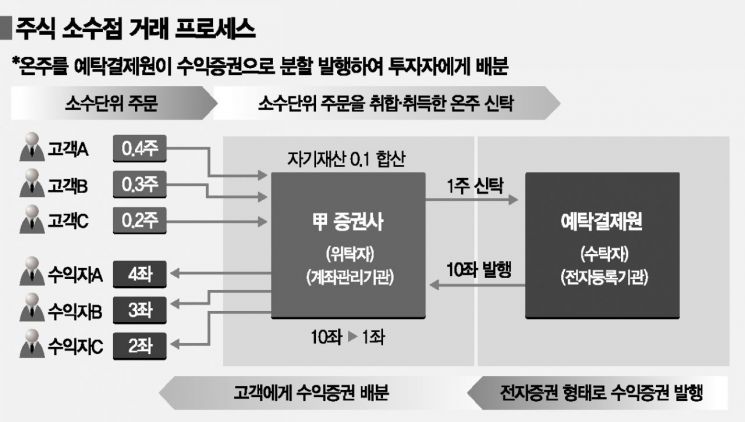
From the second half of next year, fractional trading of domestic stocks will be allowed. While this is seen as an expansion of stock investment opportunities since it enables investment in high-priced blue-chip stocks with small amounts, concerns have been raised that real-time trading will be impossible as multiple individual investors split one share to invest, and that demand for diversified investment in high-priced stocks may be lower than expected.
According to the ‘Plan to Allow Fractional Trading of Domestic and Overseas Stocks’ announced by the Financial Services Commission on the 13th, currently, domestic stocks are traded in units of one share, but from the third quarter of next year, they will be traded in fractional units.
Currently, Article 329 of the Commercial Act defines stocks as a uniform unit called ‘one share’ and stipulates the ‘principle of indivisibility of stocks,’ which means that one unit cannot be further subdivided. Also, the Korea Securities Depository (KSD) operates by receiving whole shares from securities firms in trust and issuing beneficiary certificates, which investors acquire according to their order quantity, making fractional trading of domestic stocks impossible. However, fractional trading of overseas stocks has been allowed since 2019 through the designation of innovative financial services. The Financial Services Commission has decided to expand fractional trading to domestic stocks along with overseas stocks.
The Financial Services Commission explains that with the expansion of fractional trading, investors will be able to invest in high-priced blue-chip stocks with small funds and diversify their investments. For example, investing in the 10th largest market capitalization stock in the KOSPI 200 currently requires about 30 million KRW, but with trading possible in 0.01 share units, it will be possible with 300,000 KRW.
However, there are significant concerns about side effects. The fractional trading of domestic stocks allowed by the Financial Services Commission involves securities firms first signing a trust contract with the KSD, and when customers place orders in fractional units, the securities firms trade whole shares on the exchange and issue beneficiary certificates to investors. All trading processes are completed by registering in the KSD’s account book and recording in the securities firms’ ledgers and beneficiary registers. Since the securities firms must ‘aggregate orders’ first, real-time trading is difficult, and the complex trading process causes time lags, which may result in differences between the price at which investors place orders and the actual transaction price. For this reason, the U.S. Securities and Exchange Commission (SEC), which allows fractional trading, has warned investors that liquidity guaranteeing the ability to buy and sell stocks at desired prices and times is not ensured, marking it as a risk factor.
Accordingly, there are concerns that demand for investing in diversified portfolios using fractional trading may be lower than expected. Kim Min-ki of the Korea Capital Market Institute pointed out, “When individual investors invest in multiple stocks, the cost of managing and rebalancing many investment stocks may outweigh the benefits of portfolio investment, so it may be more effective to use alternatives such as funds or ETFs that invest in the desired portfolio.”
While the preference of individual investors for low-priced stocks has made access to high-priced stocks difficult, it is also pointed out that this stems from excessive expectations of returns on stock investments, which may lead to an increase in unnecessary transactions due to short-term investments.
Furthermore, since domestic and overseas fractional trading services are not subject to unified regulations, the investment targets available vary by securities firm providing the service, and the handling of services related to dividends and corporate decisions (such as exercising voting rights and stock splits) may differ, potentially increasing confusion among investors.
© The Asia Business Daily(www.asiae.co.kr). All rights reserved.
![Clutching a Stolen Dior Bag, Saying "I Hate Being Poor but Real"... The Grotesque Con of a "Human Knockoff" [Slate]](https://cwcontent.asiae.co.kr/asiaresize/183/2026021902243444107_1771435474.jpg)















