End of Paid Employment Retention Support Fund This Month
Half Wage Support When Switching to Unpaid Leave
Government Authorities to Decide Extension This Week
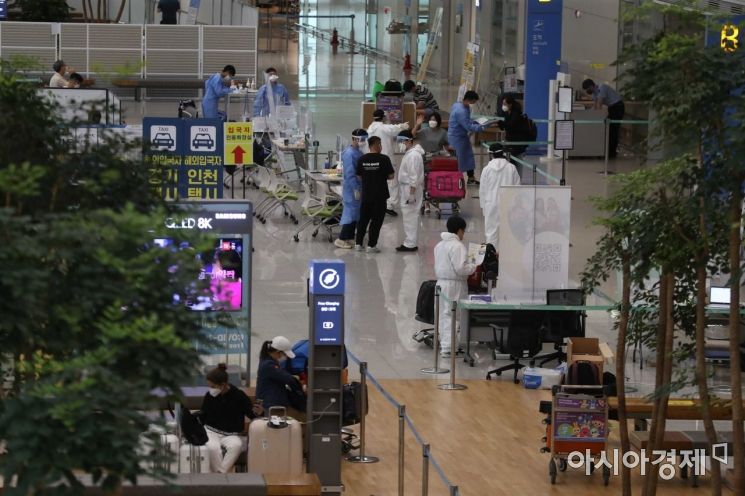 On the 13th, overseas arrivals were waiting for transportation guidance at the arrival hall of Terminal 2, Incheon International Airport. The Korea Disease Control and Prevention Agency's Central Disease Control Headquarters announced that as of midnight, the total number of confirmed domestic cases increased by 1,990 to 220,182. There were 1,913 locally transmitted cases and 77 imported cases. Photo by Mo Honam munonam@
[Asia Economy Reporter Dongwoo Lee] As the government employment retention support fund for the aviation industry is set to expire at the end of this month, a decision on whether to extend it is expected this week. The industry insists that an extension is crucial due to the prolonged impact of the COVID-19 Delta variant and delayed business normalization, while the government is reviewing the possibility of support, keeping the option open contrary to its initial stance.
According to the aviation industry on the 12th, major domestic listed LCCs such as Jeju Air, Jin Air, T'way Air, and Air Busan each submitted applications for unpaid leave to the Ministry of Employment and Labor from the end of last month to early this month for October. To receive government support for unpaid leave, applications must be submitted one month prior to the leave.
The employment retention support fund is a system where the government supports part of the wages for business closures or leaves to help companies maintain employment during unavoidable employment adjustments. In the case of paid leave, the government and the company each cover 90% and 10%, respectively, of the leave allowance, which amounts to 70% of the average wage.
However, when switching to unpaid leave, the support amount workers can receive from the government is capped at 50% of their monthly wage, with a maximum of 1.98 million KRW. For an average wage of 3 million KRW, the actual support amount is 1.5 million KRW, which is below this year's monthly minimum wage (1,822,480 KRW based on 209 working hours).
Jeju Air and Jin Air obtained employee consent for unpaid leave conversion by the end of last month and submitted department-wise leave applications, while T'way Air recently completed adjustments for leave personnel. Air Busan has finalized plans for four months of unpaid leave from early next month to early February next year and will implement department-wise rotational work.
Korean Air and Asiana Airlines are in a relatively better position. Korean Air plans to maintain paid leave until December this year by paying allowances independently even after the government employment retention support fund ends. Asiana Airlines will make a final decision on self-payment of allowances and conversion to unpaid leave depending on the government's decision.
Given these circumstances, the aviation industry, especially LCCs, argues that government support fund extensions are necessary to alleviate employment insecurity until international flight demand recovers. In fact, the Korea Air Transport Association recently officially requested extensions of the employment retention support fund from the Ministry of Land, Infrastructure and Transport and the Ministry of Employment and Labor.
There are concerns that entering unpaid leave could accelerate the departure of idle personnel, making rapid response during the industry's recovery period difficult. Due to support amounts below the minimum wage, there is an increasing trend of low-tenure employees and IT staff leaving for better conditions.
According to the Financial Supervisory Service, the number of employees in listed LCCs in the first half of this year decreased by an average of 6-7% compared to the first half of 2019 before COVID-19. Jeju Air's staff decreased by 6.7% from 3,260 to 3,041 during this period, Jin Air by 7.5%, and Air Busan by 6.1% respectively.
Government authorities are sympathetic to extending support periods for employment stability, especially in the aviation and travel industries affected by the prolonged COVID-19 situation. However, there are concerns about the depletion of funds for the employment retention support fund, as it is financed by the employment insurance fund, limiting the available support.
An industry official said, "If the government's employment retention support fund ends, more people will consider changing jobs to find better conditions immediately," adding, "Active government support is necessary."
© The Asia Business Daily(www.asiae.co.kr). All rights reserved.
![Clutching a Stolen Dior Bag, Saying "I Hate Being Poor but Real"... The Grotesque Con of a "Human Knockoff" [Slate]](https://cwcontent.asiae.co.kr/asiaresize/183/2026021902243444107_1771435474.jpg)















