Outstanding Mortgage Loans Reach 49.8 Trillion Won... 'Balloon Effect' Due to Rising House Prices
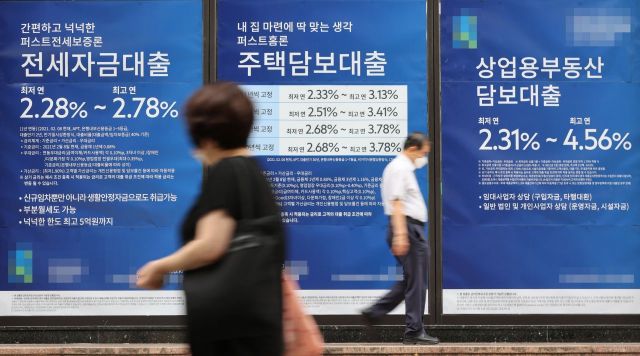
[Asia Economy Reporter Kwangho Lee] It has been revealed that housing mortgage loans by insurance companies have surged due to rising house prices. This is interpreted as a 'balloon effect' where loans have shifted from the primary financial sector (banks) to the secondary financial sector (insurance, credit cards, savings banks) due to tightening of bank loans by financial authorities.
According to the "Status of Insurance Company Loan Claims as of the End of June 2021" released by the Financial Supervisory Service on the 7th, the outstanding loan claims of insurance companies in the second quarter of this year amounted to 260.3 trillion KRW, an increase of 5.2 trillion KRW compared to the previous quarter.
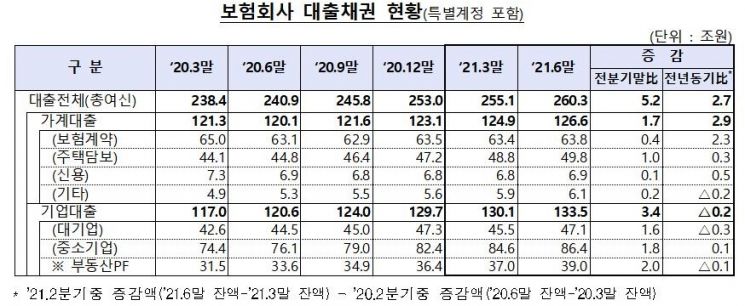
The outstanding household loans increased by 1.7 trillion KRW from the previous quarter to 126.6 trillion KRW. Compared to the same period last year, it rose by 2.9 trillion KRW.
In particular, housing mortgage loans increased significantly due to the rapid rise in house prices. It is said that homebuyers pulled together loans from banks and insurance companies alike, engaging in "Yeongkkeul" (borrowing to the fullest extent, even to the soul).
The outstanding housing mortgage loans in the second quarter were 49.8 trillion KRW, an increase of 1 trillion KRW from the previous quarter. Meanwhile, insurance policy loans increased by only 400 billion KRW compared to the previous quarter. Credit loans stood at 6.9 trillion KRW, up 100 billion KRW from the previous quarter.
The insurance industry views this as a balloon effect where demand for housing loans has shifted to the insurance market as financial authorities tightened loans in the primary financial sector to prevent overheating of the real estate market.
An insurance industry official said, "Housing sales demand continued in the second quarter following the first quarter," adding, "There also seemed to be demand to secure loans in advance before interest rate hikes."
The outstanding corporate loans reached 133.5 trillion KRW, an increase of 3.4 trillion KRW from the previous quarter. Loans to large corporations increased by 1.6 trillion KRW to 47.1 trillion KRW, while loans to small and medium-sized enterprises rose by 1.8 trillion KRW to 86.4 trillion KRW.
Loan delinquency rates and non-performing loan ratios decreased. As of the second quarter, the delinquency rate (principal and interest overdue by more than one month) for insurance company loans was 0.17%, down 0.01 percentage points from the previous quarter. Household loan delinquency was 0.29%, and corporate loan delinquency was 0.10%, decreasing by 0.05 and 0.01 percentage points respectively.
A Financial Supervisory Service official emphasized, "We will strengthen inspections on the implementation status of household loan management by insurance companies and continuously monitor loan soundness indicators such as delinquency rates," adding, "In response to the ongoing COVID-19 situation, we plan to encourage strengthening loss absorption capacity through sufficient provisioning for loan losses."
© The Asia Business Daily(www.asiae.co.kr). All rights reserved.
![Clutching a Stolen Dior Bag, Saying "I Hate Being Poor but Real"... The Grotesque Con of a "Human Knockoff" [Slate]](https://cwcontent.asiae.co.kr/asiaresize/183/2026021902243444107_1771435474.jpg)
















