KB Financial Publishes 'ESG and Eco-Friendly Consumer Behavior Seen by Consumers'
Consumers Identify 'Air Pollution' and 'Climate Change & Global Warming' as Most Serious Environmental Issues
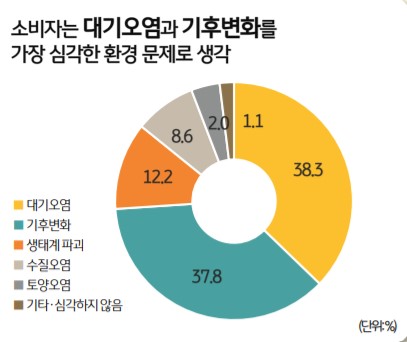
[Asia Economy Reporter Park Sun-mi] The majority of domestic consumers consider air pollution and climate change as the most serious environmental issues, and about half are willing to pay up to an additional 10% for eco-friendly products.
According to the 'KB Trend Report: ESG (Environment, Social, Governance) and Eco-friendly Consumption Behavior from the Consumer's Perspective' published by KB Financial Group on the 5th, a mobile survey was conducted targeting 1,000 KB Kookmin Card customers aged 20 and above. 76% of respondents regarded air pollution (38.3%) and climate change and global warming (37.8%) as the most serious environmental problems. This was followed by ecosystem destruction (12.2%), water pollution (8.6%), and soil pollution (2.0%).
One in two people practiced eco-friendly behaviors in daily life, such as using reusable shopping bags and efforts to save electricity. The most frequently practiced eco-friendly actions in daily life were using reusable shopping bags (63.7%), efforts to save electricity (54.4%), using personal cups (49.6%), and efforts to save water (48.1%).
The most difficult eco-friendly behavior to practice daily was 'refusing disposable items when ordering delivery food,' at 21.6%. The rate of practicing refusal of disposable items was also low at 28.3%, which is interpreted as consumers having the intention to practice but feeling guilty for not acting on it. By generation, Generation Z and Baby Boomers were found to practice these behaviors better than Millennials and Generation X.
Among the fields of consumption, transportation, education, housing, and workplace, 50% of respondents, regardless of generation, chose ‘consumption’ as the area where eco-friendly behavior is easiest to practice. Additionally, one-third of respondents said they consider a company’s eco-friendly activities when purchasing products, and 54% said they are willing to pay up to an additional 10% for eco-friendly products.
Sixty percent of respondents said they “agree on the necessity of zero waste (eliminating trash) but are unable to practice it.” With the increase in delivery and shipping services due to COVID-19, plastic and other recyclable waste have surged. When asked about the environmental impact of delivery and shipping services, 70.9% of all respondents answered that there is an impact. Only 3.8% said there is no impact.
A representative from KB Financial Group’s Management Research Institute said, “Consumers have recently felt the physical risks of climate change in their daily lives, changing their awareness of the environment compared to the past,” and added, “In the future, eco-friendly activities by companies will become an essential requirement for management to gain consumers’ choices.”
© The Asia Business Daily(www.asiae.co.kr). All rights reserved.
![Clutching a Stolen Dior Bag, Saying "I Hate Being Poor but Real"... The Grotesque Con of a "Human Knockoff" [Slate]](https://cwcontent.asiae.co.kr/asiaresize/183/2026021902243444107_1771435474.jpg)















