[Asia Economy Reporter Jang Hyowon] KPS, a company specializing in ultra-precision organic light-emitting diode (OLED) process equipment, is accelerating the acquisition of 'next-generation' panel manufacturing technology. This is because major display companies such as Samsung and LG are rushing to transition small and medium-sized OLED panel manufacturing technology, which had remained at the existing 6th generation, to the 8th generation.
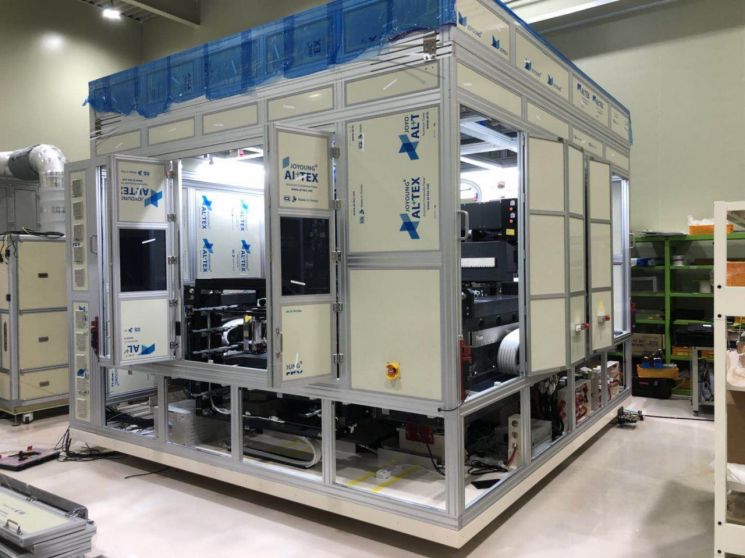
On the 1st, KPS announced that it has completed patent applications for the 'FMM (Fine Metal Mask) tension device' and 'FMM assembly manufacturing method' to be applied to 8th generation OLED panels. This patent is an invention related to the method and device for accurately aligning and fixing the position of medium to large size FMM, and it is a core technology for the commercialization and mass production of next-generation OLED panel equipment in the future.
Previously, in February last year, a patent was registered for the IT (Information Technology) 'deposition mask and manufacturing method and mask assembly for organic light-emitting display device.' In July of the same year, the company developed FMM manufacturing equipment applying the patented technology and produced prototypes.
The FMM under development is a method of assembling 'cell'-unit masks one by one to complete a 'full' mask. The company explains that applying this method can solve the problems of mask surface wrinkles and difficulties in manufacturing for large screens, which were issues with existing IT deposition masks. KPS plans to produce a 15-inch notebook mask using this method and complete the final deposition test by the end of this year.
FMM is an indispensable material in the OLED panel manufacturing process. OLED expresses images by depositing the light-emitting material (organic material) needed to create R (red), G (green), and B (blue) pixels onto the substrate. FMM has so far been used in manufacturing relatively small-sized display panels such as smartphones.
Kim Jeongho, head of the OLED business division, said, "As the market expands, it is necessary to develop precise equipment capable of producing medium-sized or larger OLED panels such as tablet PCs and notebooks. In the case of IT deposition masks, more precise manufacturing technology is required because sagging and wrinkles are expected to be more severe during stretching compared to the 6th generation for smartphones."
In fact, major display companies such as Samsung and LG are preparing to transition OLED panel manufacturing technology to the 8th generation. LG Display has decided to invest 3.3 trillion KRW in OLED expansion by the end of March 2024, and Samsung Display is known to plan to supply OLED for iPads to Apple (early 2023).
In the display industry, 'generation' refers to the size of the glass substrate (mother glass). Transitioning to the 8th generation is essential not only for cost reduction but also for mass supply. The 6th generation glass substrate size is 1500 mm wide and 1850 mm long, while the 8th generation is 2200 mm by 2500 mm.
Kim Hayong, CEO of KPS, said, "We will proactively conduct research and development on core 8th generation OLED technologies," adding, "To secure market leadership, we have started full-scale investment along with patent applications."
Meanwhile, as of the end of the first half of this year, KPS has 19 domestic patent registrations and 3 patent applications. In October last year, the company registered a patent in the United States for 'mask frame assembly device (tensioner) and its method for vertical deposition equipment.'
© The Asia Business Daily(www.asiae.co.kr). All rights reserved.
![Clutching a Stolen Dior Bag, Saying "I Hate Being Poor but Real"... The Grotesque Con of a "Human Knockoff" [Slate]](https://cwcontent.asiae.co.kr/asiaresize/183/2026021902243444107_1771435474.jpg)
















