France, Germany, Sweden, and Japan See Birth Rates Drop Then Rebound
Focus on in-kind support such as childcare, education, and care rather than cash support
[Asia Economy Reporter Kim Eunbyeol] Major OECD countries where birth rates fell and then recovered are focusing more on in-kind support such as childcare, education, and care rather than cash support.
According to the 'NABO Projections & Tax Issues' report by the National Assembly Budget Office on the 1st, four countries including France, Germany, Sweden, and Japan implemented cash support policies that provide money upon childbirth during periods of declining birth rates in the past, but are increasingly shifting to a system where society supports child-rearing (in-kind support). Cash support refers to policies that provide money, such as child-rearing expenses or parental leave benefits. In-kind support refers to policies that provide childcare services to socialize the burden of child-rearing and encourage women's economic activities.
In France, the proportion of cash support, which reached 78.96% during the 1980s and 1990s when birth rates were declining, dropped to the 51% range after the mid-1990s. Similarly, in Germany, the proportion of cash support was 65.79% during the early 2000s when birth rates were falling, but has steadily decreased to 55.81%, then 46.35%. Germany changed its family policy goal from "alleviating the economic burden of families" to "supporting work-family balance" after the 2000s.
In Sweden, cash and in-kind support proportions were similar in the past, but as public family expenditure was reduced, the proportion of cash support fell to the 40% range. Representative in-kind support measures since the 2000s include free education for children aged 4-5, provision of childcare costs when operating private daycare centers, and free pre-school education for 6-year-old children. Japan established the Childcare Headquarters under the Cabinet Office in 2015 and expanded in-kind support such as childcare and care services.
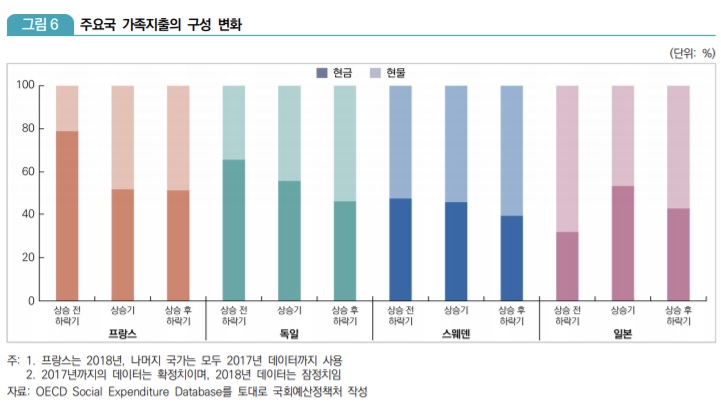
Looking closely at the in-kind support policies of the four countries, all major countries had the highest proportion in 'Early Childhood Education and Care (ECEC)'. ECEC, a representative child care support system, provides services for infants and young children from birth until entering elementary school.
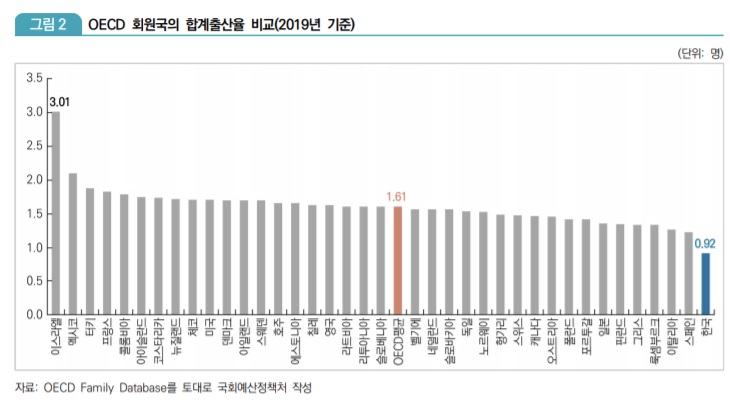
In Korea as well, advice is emerging that to recover the birth rate, support policies should shift from cash support to solving childcare and care issues. Last year, the number of births in Korea was 272,300, a decrease of 33,000 (10%) from the previous year. The total fertility rate was 0.84, with both the number of births and fertility rate hitting record lows every year. Korea’s total fertility rate ranks overwhelmingly last among the 38 OECD member countries. In a paper published last month in Women’s Economic Research titled "Successful Cases of Birth Rate Rebound and Analysis of Factors Affecting Birth Rates," Professor Choi Sookhee of Hanyang Cyber University pointed out, "Countries where birth rates fell and then rebounded share common factors such as activation of paternity leave, improvement of female employment rates, maintenance of work-family balance, and expansion of part-time jobs." Ha Tae-kyung, a presidential candidate from the People Power Party, pledged on the 19th to abolish birth incentives and increase the child welfare budget, stating, "Forcing people to have children by giving money is violence."
© The Asia Business Daily(www.asiae.co.kr). All rights reserved.
![Clutching a Stolen Dior Bag, Saying "I Hate Being Poor but Real"... The Grotesque Con of a "Human Knockoff" [Slate]](https://cwcontent.asiae.co.kr/asiaresize/183/2026021902243444107_1771435474.jpg)

















