Scheduled for physical exhibition at Germany's '2021 IAA Mobility' from next month 7-12
Motional's first commercial fully unmanned autonomous vehicle
Planned supply to ride-sharing company Lyft in 2023
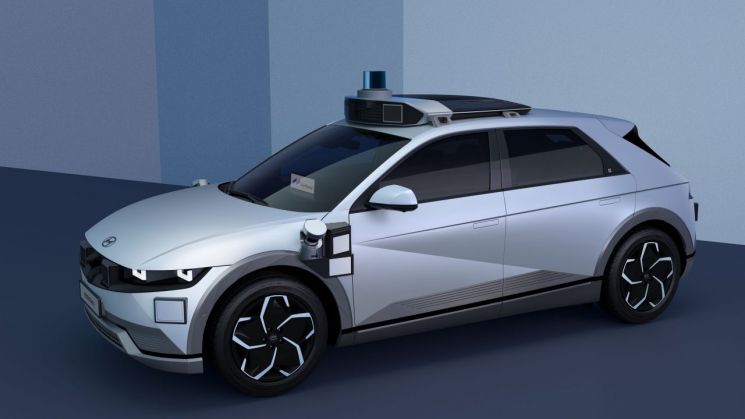
[Asia Economy Reporter Ki-min Lee] Hyundai Motor Group has unveiled the world's first robo-taxi developed based on the Ioniq 5, an electric vehicle model exclusive to Hyundai Motor Company.
On the 31st, Hyundai Motor Group revealed the design of the Ioniq 5 robo-taxi and announced that the actual vehicle will be exhibited at the '2021 IAA Mobility' event held in Munich, Germany, from November 7 to 12.
To develop the Ioniq 5 robo-taxi, Hyundai Motor Group applied autonomous driving technology created in collaboration with Motional, a joint venture with the U.S. autonomous driving technology company Aptiv. Hyundai Motor Group explained that the autonomous driving technology applied to the Ioniq 5 robo-taxi is being developed to Level 4 according to the standards of the Society of Automotive Engineers (SAE) in the United States. Level 4 means that the vehicle's automated system can perceive and judge situations to drive, and in emergencies, the vehicle can respond independently without driver intervention.
Accordingly, the Ioniq 5 robo-taxi is scheduled to be deployed in the United States in 2023 for ride-hailing services that transport passengers to their desired destinations. Earlier, Motional announced in April that it had selected the Ioniq 5 as the next-generation robo-taxi vehicle platform and plans to supply a large number of fully autonomous vehicles to the ride-sharing company Lyft in 2023.
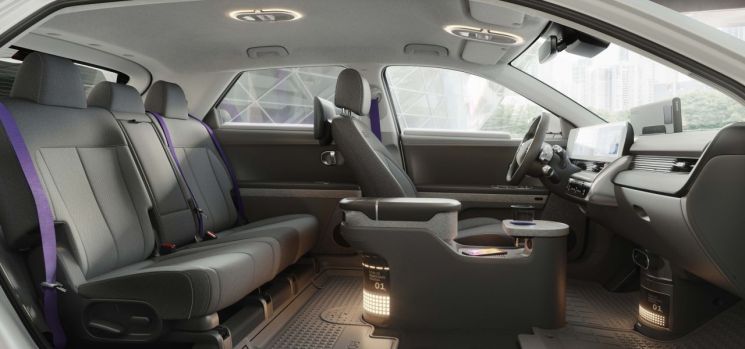
The design of the Ioniq 5 robo-taxi was completed based on the Ioniq brand's direction of 'advancement in electrification experience.' The most noticeable feature on the exterior is the blue cylindrical LiDAR mounted on the roof, supported by cameras, radars, and other autonomous driving sensors. Additionally, about 30 sensors are installed on the roof, front and rear bumpers, and left and right fenders. The autonomous driving sensors equipped on the Ioniq 5 robo-taxi can recognize the vehicle's surroundings and acquire spatial information, as well as detect road conditions up to an ultra-long distance of 300 meters. This allows passengers to immediately recognize the vehicle as a robo-taxi. The interior space enhances mobility convenience through a flat floor enabled by the electric vehicle-exclusive platform E-GMP and a long wheelbase.
The Ioniq 5 robo-taxi, a fully unmanned autonomous vehicle, incorporates Human Machine Interface (HMI) technology throughout to facilitate free communication between the vehicle and passengers on behalf of the driver. First, an external display attached to the top of the front dashboard allows customers to communicate via text. This function was developed to display the service ID of customers waiting for the vehicle during unmanned autonomous driving on the vehicle display, enabling customers to confirm their ID without confusion before boarding. An LED strip that changes color according to the vehicle's status is also applied below the door windows. Customers can intuitively understand the vehicle's status from a distance through the LED colors.
Redundancy, which duplicates key vehicle systems such as steering, braking, power, and communication, has been applied. Redundancy is a system that helps maintain smooth and safe vehicle operation by substituting auxiliary devices if the primary function fails. Through this, the Ioniq 5 robo-taxi has strengthened dual safety systems to ensure passengers can safely reach their destinations.
Additionally, the vehicle is equipped with Remote Vehicle Assistance (RVA) technology to drive stably even in unexpected road situations. This technology allows the control center to immediately connect to the robo-taxi's autonomous driving system in cases such as passing through construction zones or flooded roads, providing new routes or necessary support promptly.
Functions to assist passenger convenience on behalf of the driver are also applied. A camera sensor inside the vehicle checks whether passengers are wearing seat belts and detects passenger behavior to send alerts if necessary. Furthermore, a display for passengers is installed behind the driver's seat. Through this, passengers can check the vehicle's route in real time or set additional intermediate stops besides the scheduled destination. Moreover, a call button, speaker, and microphone are installed in the center of the interior roof to connect with the autonomous driving control center when assistance is needed during driving.
Jang Woong-jun, Executive Director of Hyundai Motor Group's Autonomous Driving Division, said, "The Ioniq 5-based robo-taxi, born through close cooperation with Motional, will be an important milestone for the commercialization of robo-taxis in 2023."
© The Asia Business Daily(www.asiae.co.kr). All rights reserved.
![Clutching a Stolen Dior Bag, Saying "I Hate Being Poor but Real"... The Grotesque Con of a "Human Knockoff" [Slate]](https://cwcontent.asiae.co.kr/asiaresize/183/2026021902243444107_1771435474.jpg)

















