China Manufacturing PMI Hits 18-Month Low... 50-Point Threshold 'Shaken'
Concerns Over Economic Slowdown Highlighted, Investor Sentiment Weakens
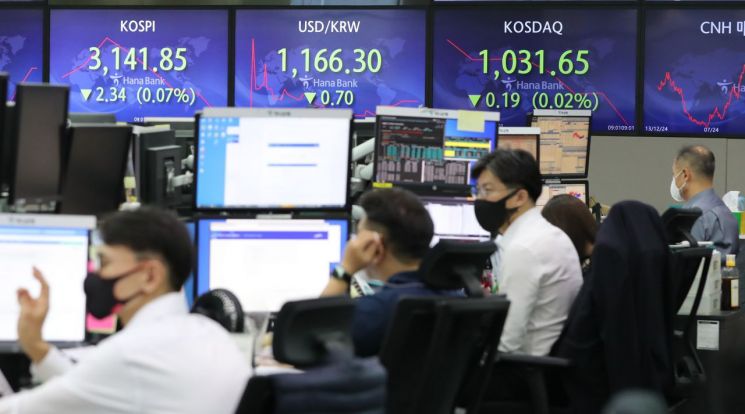 On the 31st, employees are working in the dealing room at the Myeongdong Hana Bank headquarters in Jung-gu, Seoul.
 [Photo by Yonhap News]
[Asia Economy Reporter Minwoo Lee] The KOSPI, which had risen to 3350 at one point in the morning, fell to the 3130 level as the decline widened. Concerns about an economic slowdown resurfaced as China's economic indicators were released lower than expected, dampening investor sentiment.
As of 11:14 a.m. on the 31st, the KOSPI recorded 3135.70, down 0.27% from the previous day. After a firm start in the 3140s, it rose to 3150.16 by 10 a.m., but fell again as China's economic indicators fell short of expectations.
According to the National Bureau of Statistics of China on the 31st, China's manufacturing PMI for August recorded 50.1, lower than July's 50.4. This is the lowest level in 18 months since February last year, when the economic shock from COVID-19 was severe. The manufacturing PMI, based on surveys of business officials, shows trends in the related sector's economy. A reading above 50 indicates an expansion phase, while below 50 indicates contraction. The non-manufacturing PMI, reflecting service sector trends, plunged sharply below the baseline of 50 to 47.5, down from 53.3 the previous month.
Park Kwangnam, head of the Digital Research Team at Mirae Asset Securities, explained, "The index decline has been widening around the time the China PMI is released. Although uncertainties about tapering (asset purchase reduction) were eased through the U.S. Jackson Hole meeting, concerns about an economic slowdown have resurfaced as China's manufacturing indicators fell short of expectations."
Regarding supply and demand by market participants, foreigners and institutions continued net selling, while individuals continued net buying. Foreigners and institutions sold a net 73.9 billion KRW and 188.2 billion KRW respectively, whereas individuals bought a net 257.6 billion KRW.
Most sectors declined. The largest drops were in Medical Precision (-2.47%), Paper & Wood (-1.64%), Securities (-1.34%), and Transportation & Warehousing (-1.01%). Pharmaceuticals (0.75%) and Construction (0.71%) rose.
At the same time, the KOSDAQ also fell 0.35% to 1028.20. It also rose to 1033.34 by 10 a.m. before heading downward.
Similar to the KOSPI market, foreigners and institutions continued selling in the KOSDAQ market. In fact, foreigners' net selling was larger at 164.3 billion KRW. Institutions sold 17.2 billion KRW. Meanwhile, individuals bought a net 190.9 billion KRW.
Most sectors showed a downward trend. The Transportation Equipment & Parts sector had the largest drop at -5.69%, followed by Digital Content (-3.00%), IT S/W & SVC (-1.55%), and Textiles & Apparel (-1.41%). IT Components (1.78%) and General Electric & Electronics (1.57%) rose.
© The Asia Business Daily(www.asiae.co.kr). All rights reserved.
![Clutching a Stolen Dior Bag, Saying "I Hate Being Poor but Real"... The Grotesque Con of a "Human Knockoff" [Slate]](https://cwcontent.asiae.co.kr/asiaresize/183/2026021902243444107_1771435474.jpg)















