Reallocation of Previously Assigned Quotas Unavoidable... Competition Rate Skyrockets
Ministry of Land Plans to Establish Youth Policy Division... Directive from Office for Government Policy Coordination
[Asia Economy Reporters Kangwook Cho and Mune Won] "Are you saying that for people in their 40s and 50s without homes, who are burdened by private education expenses while raising children, it is more important for unmarried youth to secure their own homes?" (A, a homeowner in their 40s)
The government’s plan to include unmarried youth as beneficiaries of special housing subscription allocations is intensifying conflicts both within and between generations regarding the housing subscription system. The controversy centers on granting special housing subscription opportunities to unmarried youth, which would require reallocating existing quotas, raising concerns about reverse discrimination. This has sparked debates even within the ruling party. The Ministry of Land, Infrastructure and Transport, the main government agency in charge, is planning to establish a new organization dedicated to youth housing tailored policies, prompting criticism from some quarters that the government’s policy is overly focused on winning votes.
According to the Ministry of Land, Infrastructure and Transport on the 28th, the ruling party and government are currently reviewing specific plans to introduce a special housing subscription system that allocates a certain percentage of new apartment units to youth groups such as unmarried one- or two-person households and newlywed couples without children. The government explains that there is an actual blind spot of about 30% in special supply coverage for single-person households and similar groups.
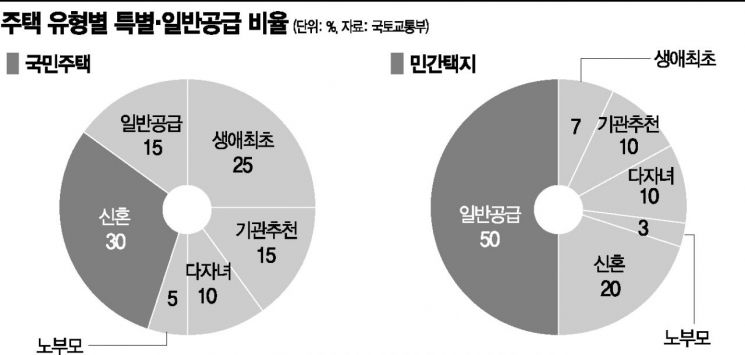
Under the current subscription system, the proportion of ‘special supply’ already far exceeds that of general supply. For national housing, various special supply categories such as first-time homebuyers, newlyweds, elderly parents’ caregivers, multi-child families, and institutional recommendations account for 85%. In public land private housing, 58% is allocated as special supply, and even in private land apartments where the special supply ratio is relatively low, general supply accounts for only half.
Therefore, if unmarried individuals or newlywed couples without children are added to the special supply category, the quota for other applicants must be reduced in some way. If the general supply quota is reduced accordingly, it could provoke backlash from the 40s and 50s age group. This is because the cutoff score for the point-based general supply system would rise sharply, and the chances of winning in the lottery system would inevitably decrease. The same applies even if the ratio is adjusted within the special supply quota. Since a significant portion of the 1- and 2-person households, which make up 60% of all households, would be newly entering the subscription market, competition rates would skyrocket.
Experts point out that this is a zero-sum game where one party’s gain is another’s loss, and criticize it as an excessive populist policy ahead of the presidential election. Professor Shim Gyo-eon of Konkuk University’s Department of Real Estate said, "In the current situation of severe supply shortage, concentrating benefits on youth inevitably causes reverse discrimination against other groups," adding, "It seems the government will continue to increase benefits for youth, which will further deepen intergenerational conflicts."
Meanwhile, the Ministry of Land, Infrastructure and Transport has decided to establish a Youth Policy Division to oversee youth housing-related tasks and announced the ‘Amendment to the Enforcement Rules of the Ministry of Land, Infrastructure and Transport and Its Affiliated Agencies Organization Act’ for public comment yesterday. The Youth Policy Division will be responsible for drafting youth housing policies, establishing mid- to long-term plans, assessing youth housing conditions, and supporting housing for single-person youth households. A ministry official said, "There was no dedicated organization for youth policy before, so it was difficult to develop policies reflecting youth needs," adding, "With the establishment of a dedicated organization, we can create more proactive and tailored measures."
© The Asia Business Daily(www.asiae.co.kr). All rights reserved.
![Clutching a Stolen Dior Bag, Saying "I Hate Being Poor but Real"... The Grotesque Con of a "Human Knockoff" [Slate]](https://cwcontent.asiae.co.kr/asiaresize/183/2026021902243444107_1771435474.jpg)















