Institute for Basic Science, Climate Prediction Results with Increased Carbon Dioxide Concentration
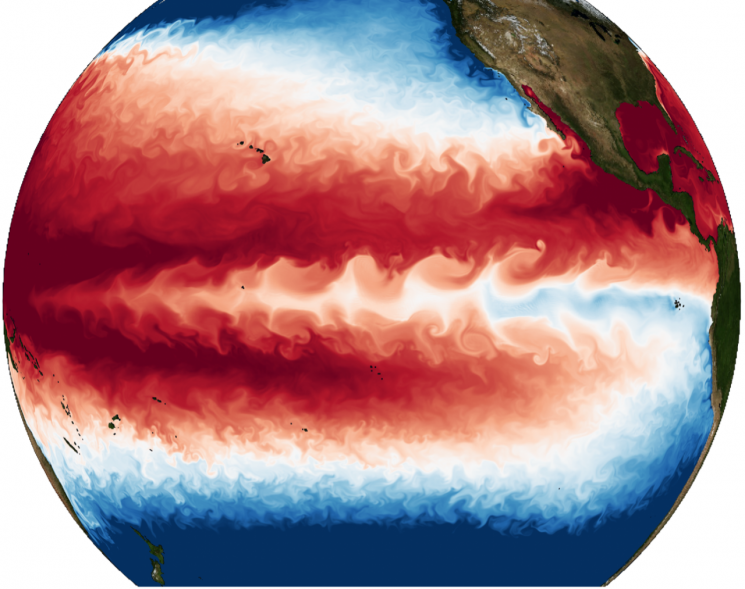 Sea surface temperature simulated in an unprecedented high-resolution atmosphere-ocean coupled model. The Institute for Basic Science (IBS) confirmed through simulations that climate phenomena such as La Ni?a and El Ni?o weaken if carbon dioxide concentrations continue to increase.
[Asia Economy Reporter Kim Bong-su] A study has found that natural climate variability phenomena such as El Ni?o and La Ni?a could disappear if global warming accelerates in the future.
The Institute for Basic Science (IBS) Climate Physics Research Group, in collaboration with the Max Planck Institute for Meteorology in Germany and the University of Hawaii in the United States, announced on the 27th that they reached this conclusion after predicting future variability of the El Ni?o-Southern Oscillation due to increased atmospheric carbon dioxide concentrations.
The El Ni?o-Southern Oscillation (ENSO) refers to the cycle between El Ni?o, when sea surface temperatures in the equatorial eastern Pacific are higher than average, and La Ni?a, when they are lower. It is a powerful natural climate variability phenomenon that has continued uninterrupted for the past 11,000 years.
The research team conducted simulations using IBS’s supercomputer Aleph with unprecedented spatial resolutions of 10 km for the ocean and 25 km for the atmosphere. This resolution is about four times higher (atmosphere basis) than the 100 km resolution used in previous studies, allowing detailed simulation of small-scale meteorological and climate phenomena occurring in the atmosphere and ocean. In particular, it enabled simulation of tropical cyclones in the atmosphere and tropical instability waves in the equatorial Pacific, which play important roles in the development and termination of El Ni?o and La Ni?a events.
The team performed global warming simulations by doubling and quadrupling atmospheric carbon dioxide concentrations compared to the current climate. Researcher Lee Soon-sun, who led the experiments, explained, “The supercomputer ran continuously for over a year to obtain future climate simulation data spanning more than 100 years. The generated data alone could fill 2,000 1TB hard drives, representing an enormous volume.”
The results confirmed that as atmospheric carbon dioxide concentrations increase, the temperature variability of future El Ni?o-Southern Oscillation weakens. Christian Wengler, a researcher at the Max Planck Institute for Meteorology, explained, “When carbon dioxide concentrations doubled, ENSO variability weakened by 6% compared to the current climate, and when quadrupled, it weakened by 31%.”
The team identified the main cause of the weakening ENSO variability by tracking heat transport within the equatorial Pacific. In a global warming climate, increased temperatures lead to increased evaporation, which strengthens the ‘negative feedback’ on ENSO, thereby weakening El Ni?o development. At the same time, the temperature difference between the eastern and western equatorial Pacific decreases due to warming, which weakens the ‘positive feedback’ and further reduces ENSO variability.
ENSO variability is determined by the combination of ‘positive feedback’ that amplifies the phenomenon and ‘negative feedback’ that weakens it. In a warming climate, the negative feedback becomes stronger, meaning that El Ni?o and La Ni?a events cannot develop strongly under global warming conditions.
The study also clarified that tropical instability waves play an important role in the ENSO system. According to the team’s analysis, tropical instability waves weaken under global warming, which helps mitigate the weakening of ENSO variability.
Director Axel Timmermann stated, “This study shows that continued warming could suppress the strongest natural climate variability that has persisted for thousands of years. We plan to conduct follow-up research on the potential impacts of this scenario on the global climate system and ecosystems.”
The study was published in the international journal Nature Climate Change (IF 20.893) on the same day.
© The Asia Business Daily(www.asiae.co.kr). All rights reserved.
![Clutching a Stolen Dior Bag, Saying "I Hate Being Poor but Real"... The Grotesque Con of a "Human Knockoff" [Slate]](https://cwcontent.asiae.co.kr/asiaresize/183/2026021902243444107_1771435474.jpg)















