Worst Times for Theaters Amid COVID-19... Screen Quota Adds to Woes
Korean Films Drastically Reduced, Failing to Meet Quota... Only Hollywood Blockbusters Line Up
Calls Grow for Exceptions Due to Pandemic... When Will the 'Spring of Theaters' Come...?
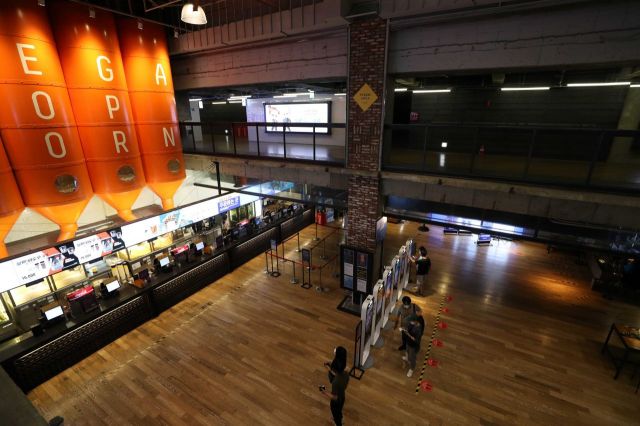 On the 11th, a day before the implementation of Level 4 social distancing in the Seoul metropolitan area, a movie theater in downtown Seoul is quiet. Photo by Honam Moon munonam@
The dictionary definition of screen quota is the allocation of the number of screens. The practical concept is the mandatory screening of certain films according to specific criteria. It regulates theaters to screen domestic films for a certain period of time. It is a kind of protective measure. Korean films have grown steadily and reduced their dependence. Since 2015, they have consistently surpassed foreign films in box office revenue share. Starting with 51.3% (about 879.7 billion KRW) in 2015, they have maintained a share in the low 50% range and sales exceeding 900 billion KRW every year. Last year, due to the spread of COVID-19, Hollywood films from the U.S. were subdued, causing the share to soar to 68.7%. However, the box office revenue dropped to 350.4 billion KRW, about one-third of the previous year. As audiences thinned out, there was an emergency in pushing for releases. Most postponed or canceled releases, and some shifted to online video services (OTT).
The drought worsened this year. The three multiplex chains (CGV, Lotte Cinema, Megabox) even introduced unprecedented incentives. For the currently screening films ‘Mogadishu’ and ‘Sinkhole,’ all box office revenue goes to the distributor and production company until 50% of the production cost (including promotional marketing expenses) is recovered. However, as of the 24th, the box office revenue share of Korean films this year is only 32.3% (102.9 billion KRW).
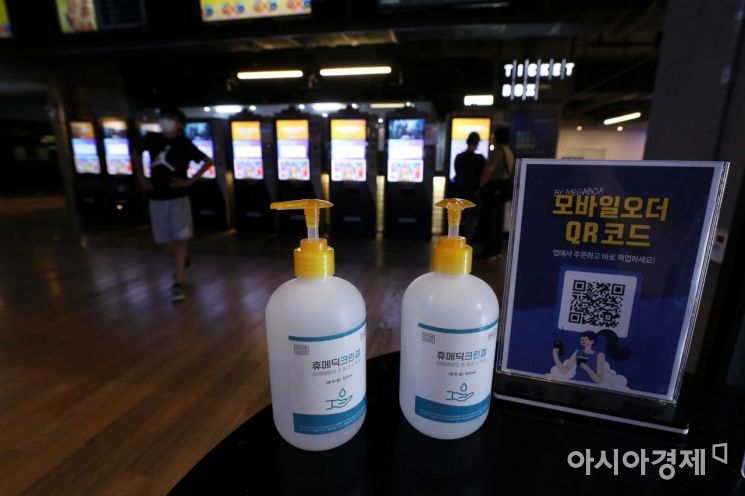 On the 11th, one day before the implementation of Level 4 social distancing in the Seoul metropolitan area, a movie theater in downtown Seoul is quiet. Photo by Mun Ho-nam munonam@
Unlike Hollywood films, a significant number still postpone their releases. This can be seen even from statistics during the peak season of July to September. In 2019, there were eight Korean films with a net production cost of over 10 billion KRW, including ‘Naratmalssami (1.3 billion KRW),’ ‘Saja (1.47 billion KRW),’ ‘Exit (1.3 billion KRW),’ and ‘The Battle of Bongodong (1.9 billion KRW).’ Last year, there were only three: ‘Peninsula (1.9 billion KRW),’ ‘Steel Rain 2: Summit (1.54 billion KRW),’ and ‘Deliver Us from Evil (1.5 billion KRW).’ This year, besides ‘Mogadishu (2.2 billion KRW)’ and ‘Sinkhole (1.45 billion KRW),’ there are no additional films.
Expanding the scope to films costing over 5 billion KRW does not change the situation. There were eleven such films in 2019 and nine last year. This year, including ‘Miracle’ and ‘Voice,’ which will be released next month, there are only six. One producer said, "Most films are delaying their releases and dragging out post-production," adding, "Editing directors even complain about a lack of storage space on their computers."
The plight of movie theaters goes without saying. Korean film box office revenue, which reached 636.3 billion KRW (as of August 24) in 2019, dropped to 273.6 billion KRW last year. This year, it has decreased to less than half of that. It is even difficult to meet the screen quota. Article 19 of the Enforcement Decree of the Act on the Promotion of Films and Video states, "The operator of a movie theater shall screen Korean films for at least one-fifth of the total annual screening days from January 1 to December 31 each year." If the required number of days (73 days) is not met, business operations may be suspended or the theater's registration canceled.
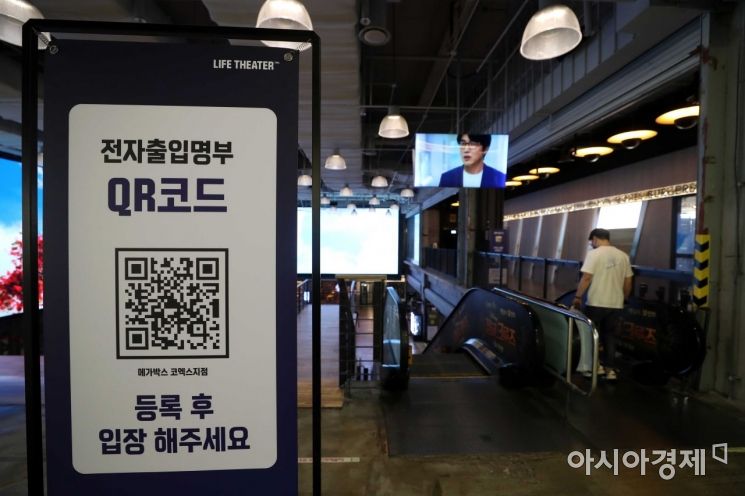 A movie theater in downtown Seoul is quiet on the 11th, one day before the implementation of Level 4 social distancing measures in the metropolitan area. Photo by Moon Honam munonam@
Many theaters are in crisis. According to the screening industry, only about 30% of all screening rooms meet the required number of days (47 days as of the 24th). For major multiplex branches, CGV Yongsan I'Park Mall has thirteen out of eighteen screens meeting the quota, Lotte Cinema World Tower has fifteen out of eighteen, and Megabox COEX has ten out of nineteen. The situation is similar for non-major corporate chains. CineQ Jeonju Film Street has five out of ten screens meeting the quota, Daehan Theater has six out of eleven, and Busan Cinema Center has three out of four. A Lotte Cinema official said, "60% of all branches failed to meet the required number of days," adding, "The scarcity of Korean film releases inevitably disrupts operations."
News of Korean film releases in the second half of the year is also scarce. All are hesitant to screen films as social distancing measures have been raised to levels 3-4. Even ‘Emergency Declaration,’ which was unveiled at last month’s Cannes International Film Festival, is still deliberating despite preparing for a release within the year. In contrast, Hollywood blockbusters are lined up through December. These include ‘Shang-Chi and the Legend of the Ten Rings (October 1),’ ‘Candyman (October 22),’ ‘Venom 2: Let There Be Carnage (October 13),’ ‘007 No Time to Die,’ ‘The Last Duel,’ ‘Dune’ in October, ‘Eternals’ in November, and ‘Spider-Man: No Way Home’ and ‘West Side Story’ in December.
A theater official A said, "If the current trend continues, a laughable farce will occur where Marvel Studio films are given up in special theaters optimized for blockbusters like IMAX and Dolby, and Korean independent films are screened instead." Another theater official B emphasized, "Special theaters like 4DX are worse off than regular screening rooms if they cannot function properly," adding, "They should have been excluded from the screen quota from the start."
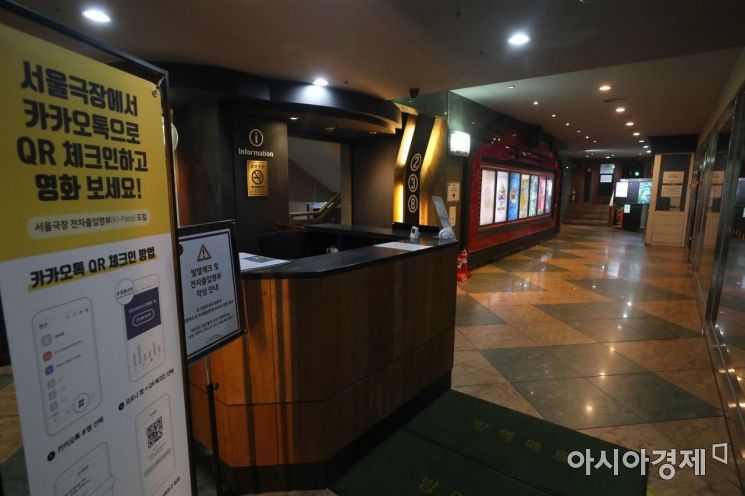 Seoul Theater, disappearing into history after 42 years, bids farewell to its audience with a "Thank You Screening." Ahead of its closure on the 31st, Seoul Theater is offering free tickets on a first-come, first-served basis to 100 people on weekdays and 200 people on weekends for three weeks starting today (the 11th). A view of Seoul Theater on this day. Photo by Mun Honam munonam@
Screen quota is a system with complex interests intertwined. Even before the Film Act was enacted in 1962, the government protected the domestic film industry by imposing an admission tax of up to 115% on foreign films. Measures such as strengthening foreign film import quotas, price ceiling restrictions, and limiting foreigners’ involvement in the domestic film industry were also taken. Even in the 1980s, when import and distribution doors were fully opened, regulations on screenings remained to minimize damage caused by market liberalization.
However, this time, many distributors and producers acknowledge the need for exceptions to the screen quota. They worry that the collapse of the screening industry could spread to the entire film industry. Yet discussions on temporary measures such as postponements or exceptions have not even begun. A representative from the Korean Film Council said, "We sympathize with the difficult situation of theaters," but added, "Sufficient review through gathering opinions from the Ministry of Culture, Sports and Tourism and various sectors is necessary." Meanwhile, as time drags on, theaters’ deficits continue to accumulate. It is truly a desperate situation.
© The Asia Business Daily(www.asiae.co.kr). All rights reserved.
![Clutching a Stolen Dior Bag, Saying "I Hate Being Poor but Real"... The Grotesque Con of a "Human Knockoff" [Slate]](https://cwcontent.asiae.co.kr/asiaresize/183/2026021902243444107_1771435474.jpg)


















