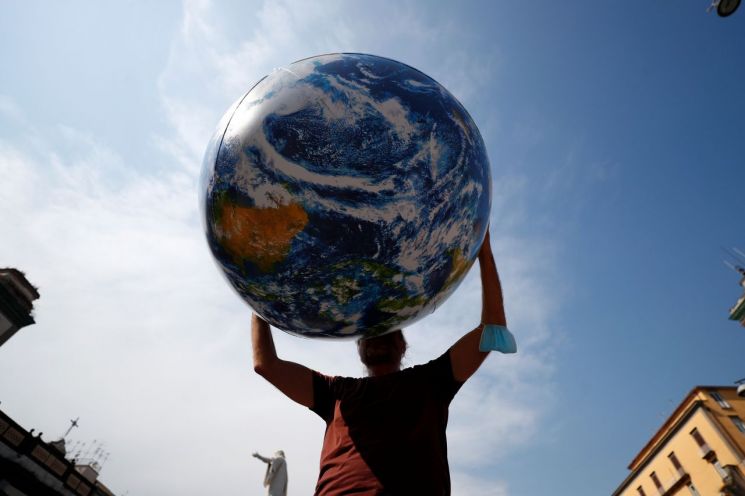
 On the 22nd of last month (local time), during the second day of the G20 Climate and Environment Ministers' Meeting in Naples, Italy, a protester is holding a globe balloon urging action on climate change. [Image source=Yonhap News]
[Asia Economy Reporter Kim Soyoung] Due to climate change, extreme abnormal phenomena are occurring around the globe. While regions such as the Middle East are experiencing water shortages, a climate change research organization announced last month that the likelihood of flood disasters like the recent European floods has increased up to ninefold.
On the 22nd (local time), the US CNN broadcast reported experts' warnings that climate change is intensifying the water shortage problem in the Middle East, making it more difficult to resolve.
Currently, Iran is suffering from severe water shortages and water outages due to a drought not seen in 50 years. Lake Urmia in Iran has rapidly evaporated, shrinking from 5,400㎢ in the 1990s to 2,500㎢ today, halving in 30 years. Iran's Ministry of Energy analyzed that climate change accounts for more than 30% of the factors causing the lake to disappear.
The problem is that water shortages negatively affect water quality and even food supply. As Lake Urmia shrinks, salinity levels have risen drastically, and using this water for irrigation inevitably damages crops.
In Jordan, another water-scarce country, citizens are already accustomed to living with limited water. In some areas, groundwater levels are dropping by more than 1 meter annually.
The academic journal Proceedings of the National Academy of Sciences (PNAS) analyzed that by the end of the 21st century, per capita water use in Jordan must be halved. Low-income Jordanians must live on 40 liters per day for drinking and washing combined. This is only about one-tenth of the current average per capita water use in the United States.
This is not just a problem for Iran and Jordan. It is known that many countries in the Middle East are struggling with water shortages. Charles Iceland, Director of Water Resources at the World Resources Institute (WRI), said that decreased rainfall combined with increased water demand is causing rivers and lakes to dry up.
The United Nations Intergovernmental Panel on Climate Change (IPCC) forecasted in a report released earlier this month that under global warming, winters in the Middle East will become drier and summers wetter, but this will be offset by intense heat waves.
Meanwhile, contrary to the situation in the Middle East, Europe experienced severe floods last month, with daily rainfall reaching up to 93mm near the Ahr and Erft rivers in Germany, and 106mm over two days around the Meuse River in Belgium.
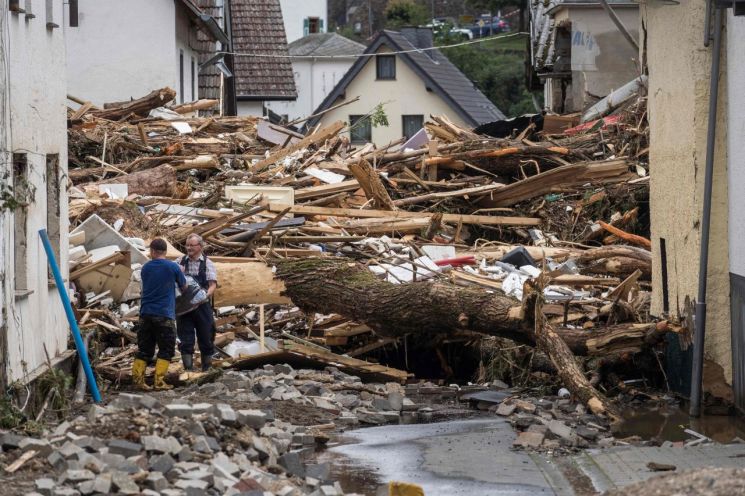 In Schult, western Germany, where flooding occurred due to heavy rain in Western Europe, disaster victims were collecting household items from the debris of collapsed houses on the 15th (local time).
 [Image source=Yonhap News]
According to AFP, the World Weather Attribution (WWA) research team, which studies climate change, published a report on the 23rd (local time) analyzing the impact of climate change on rainfall.
The researchers compared today’s climate, with a temperature increase of 1.2 degrees Celsius, to the pre-warming past using computer simulations, finding that not only has the likelihood of flood disasters increased, but their intensity has also grown.
Under today’s climate conditions, the probability of floods has increased from 1.2 times up to nine times, and rainfall itself has increased by 3 to 19%. However, the researchers calculated that the chance of a repeat of the recent Western European floods is once every 400 years.
Martijn van Aalst, a researcher involved in the study, emphasized, "As this study revealed an increased flood risk, flood risk management, preparedness, and early warning systems must be managed."
Mansour Almazroui, Director of the Climate Change Research Center at King Abdulaziz University in Saudi Arabia, pointed out, "The problem is that even if it rains when the overall temperature rises, the water evaporates." He added, "Conversely, another problem is that this rain is not necessarily normal rain but can manifest as heavy rain and floods like those currently experienced in China or Germany, which will be a major issue for the Middle East."
© The Asia Business Daily(www.asiae.co.kr). All rights reserved.
![Clutching a Stolen Dior Bag, Saying "I Hate Being Poor but Real"... The Grotesque Con of a "Human Knockoff" [Slate]](https://cwcontent.asiae.co.kr/asiaresize/183/2026021902243444107_1771435474.jpg)
















