China Likely to Launch Extensive Inspections of Public Officials and Local Bureaucrats
Interpretation of President Xi's Efforts to Consolidate Political Power Ahead of Potential Third Term
[Asia Economy Beijing=Special Correspondent Jo Young-shin] China has established the Inspector Law, which will be applied from January 1 next year.
This law appears to have been introduced to rectify corruption among public officials and bureaucrats, and is interpreted as a follow-up measure to achieve President Xi Jinping's de facto next political slogan, "Common Prosperity." Depending on the perspective, it can also be seen as a kind of reign of terror by President Xi, who is considering a third term, to consolidate his power base. When President Xi was appointed General Secretary of the Party in 2012, a crackdown on corruption was also underway. This became the foundation of Xi's power.
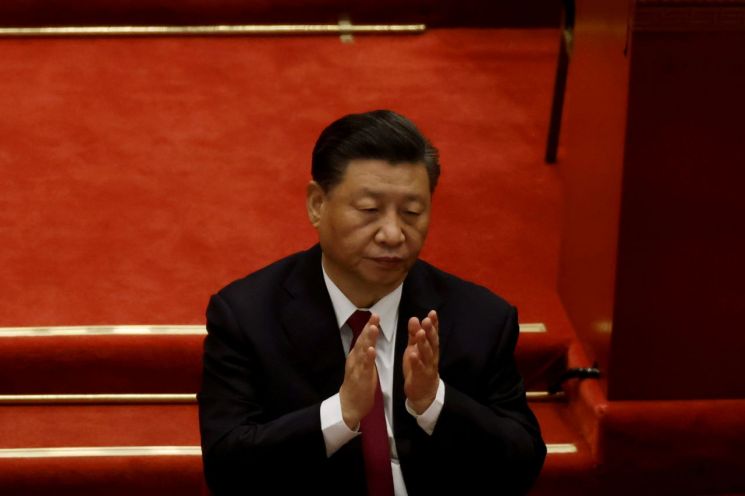
The People's Daily, the official newspaper of the Chinese Communist Party, reported on the 24th that the Standing Committee of the National People's Congress (NPC) held its 30th meeting on the 20th and passed the "Inspector Law of the People's Republic of China."
Composed of a total of 9 chapters and 68 articles, the general provisions of this law specify the qualifications of inspectors. It stipulates that inspectors must be loyal and clean officials who uphold Marxism-Leninism, Mao Zedong Thought, Deng Xiaoping Theory, Jiang Zemin’s Important Thought, Hu Jintao’s Scientific Outlook on Development, and President Xi’s Thought on Socialism with Chinese Characteristics for a New Era. It also emphasizes that inspectors must be armed with loyalty and responsibility and serve as role models against corruption.
The law then lists the duties of inspectors: ▲ Integrity education for public officials ▲ Supervision and inspection of public officials’ compliance with laws, fair use of authority, honest work performance, and moral guidance ▲ Submission of opinions on disciplinary actions regarding inspection matters ▲ Conducting international cooperation on anti-corruption ▲ Performing other duties prescribed by law.
The director (chairman) of the National Supervisory Commission is elected by the National People's Congress (NPC), while the deputy directors and members are appointed by the NPC Standing Committee. Additionally, the directors, deputy directors, and members of local supervisory commissions are elected by the respective local NPCs. This means inspectors will be appointed in all 31 provinces (municipalities) across China.
Since President Xi mentioned the term "Common Prosperity" at the 10th Central Financial and Economic Affairs Commission meeting held on the 17th, there is an analysis that Chinese society has entered a phase of anti-corruption enforcement. Common Prosperity means "everyone eating and living well together," implying redistribution.
Inside and outside China, there are also claims that Common Prosperity is a political slogan for President Xi’s third term. It is seen as a political strategy in preparation for the 20th National Congress of the Chinese Communist Party, expected around October next year. It also implies that corruption is the enemy blocking redistribution.
On the other hand, some interpret this as a kind of reign of terror to consolidate President Xi’s power. When Xi rose to General Secretary at the 2012 Party Congress, the Chinese leadership waged a large-scale war against corruption. At that time, many of Xi’s political rivals, such as Bo Xilai, were purged.
In fact, former Chinese President Hu Jintao pointed out corruption as the greatest enemy of the Party at the opening ceremony of the 18th Party Congress of the Chinese Communist Party held at the Great Hall of the People in Beijing on November 8, 2012, stating, "If corruption is not eradicated, the Party and the country could collapse." For this reason, the introduction of the Inspector Law is being called a d?j? vu of the 2012 Chinese political landscape.
© The Asia Business Daily(www.asiae.co.kr). All rights reserved.

















