'Daegunjubo', 'Jegojibo', 'Chikmyeongjibo', and 'Daewonsubo' Returned from the US and Japan
Reflecting the Joseon Royal Family and Korean Empire's Concerns in Responding to International Affairs
'Seoul Yeongguksaji Excavated Ritual Offering Set' and 'Suunjapbang' Also Designated as Treasures
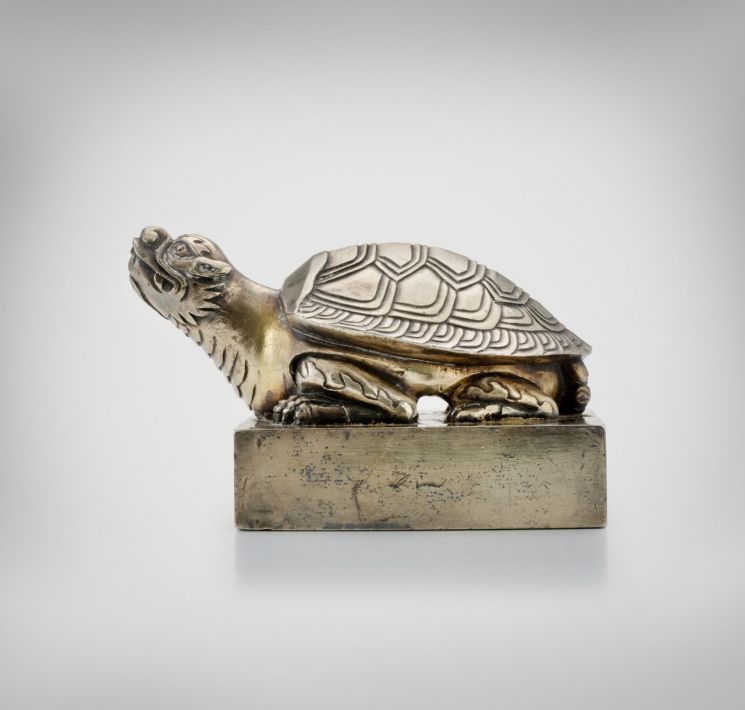
Four royal seals (Guksae) of King Gojong of the late Joseon Dynasty (reigned 1863?1907), which had been smuggled to the United States and Japan and later returned, were simultaneously elevated to the status of national treasures. On the 24th, the Cultural Heritage Administration announced that it had designated the 'Guksae Daegunjubo (Great Monarch Seal)', 'Guksae Jegojibo (Imperial Edict Seal)', 'Guksae Chikmyeongjibo (Imperial Command Seal)', and 'Guksae Daewonsubo (Grand Marshal Seal)', donated by a Korean-American in December 2019, as nationally designated cultural treasures.
The Guksae is a practical seal symbolizing national sovereignty. It was used on official documents such as diplomatic and administrative papers. It differs from the royal ceremonial seals called Eobo, which symbolized royal authority. Previously designated national treasures among Guksae include 'Guksae Hwangjejeebo (Emperor's Seal)', 'Guksae Yuseojibo (Royal Edict Seal)', 'Guksae Junmyeongjibo (Seal of Bright Command)', and 'Daehan Jeguk Gojong Hwangje Osae (Great Korean Empire Emperor Gojong's Imperial Seal)'.
The Guksae Daegunjubo, held by the National Palace Museum, was made on July 1, 1882. It features a silver turtle-shaped handle and seal body. The script is Gucheopjeon (Nine-fold Seal Script), a type of seal script with strokes bent multiple times. It is inscribed with '大君主寶 (Daegunjubo)', meaning 'Great Monarch of the Great Joseon Nation.' It was used on diplomatic documents, high-ranking official commissions, orders, and laws promulgated in the name of the Great Monarch.
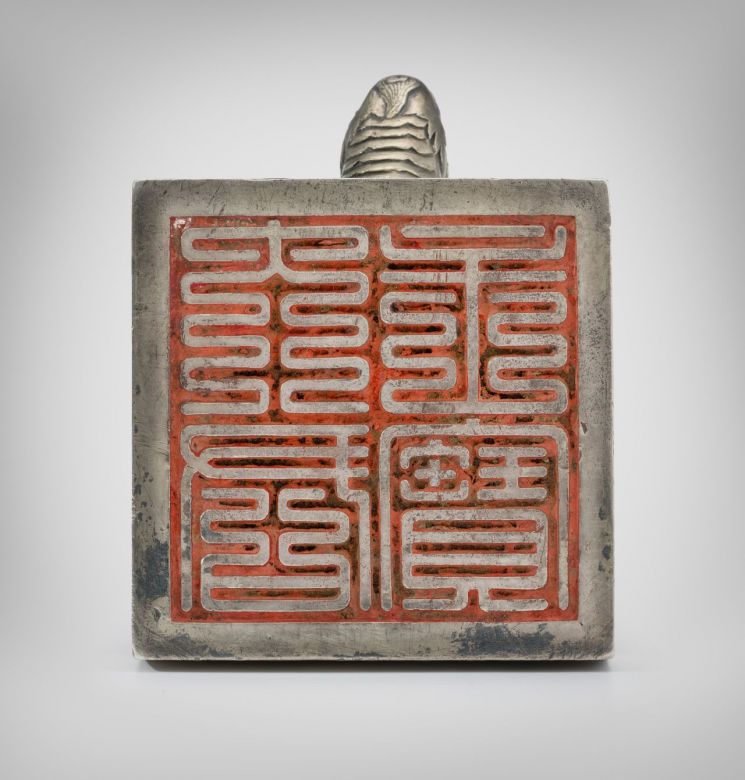
This Guksae reflects the Joseon royal court's concerns in response to rapidly changing international circumstances. King Gojong ordered the production of the Daegunjubo to be stamped on the national letter (Gukseo) ahead of the Korea-US Treaty of Amity and Commerce. The Muwiyeong (Military Guard) received budget support from the Hojo (Ministry of Taxation) to produce six seals, but the whereabouts of the other artifacts are unknown. The Cultural Heritage Administration explained, "It has sufficient preservation value as it provides information on the script, form, material, and casting method of Guksae made before the Korean Empire."
The Guksae Jegojibo, Guksae Chikmyeongjibo, and Guksae Daewonsubo were all made during the Korean Empire period. Their production was entrusted to royal seal craftsmen such as Jeon Heung-gil, who was responsible for royal seals. They were used to announce the emperor's orders to the people or to appoint officials. In March 1911, about six months after the Japan-Korea Annexation Treaty, the Japanese government handed over the three seals to the Imperial Household Agency managing the Japanese royal family. They were repatriated by the U.S. military government on August 15, 1946, after liberation, passed through the Ministry of General Affairs, and were transferred to the National Museum of Korea.
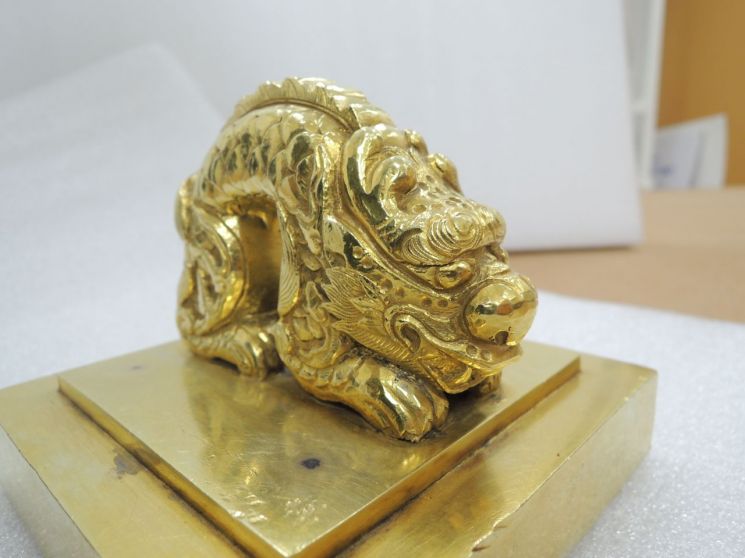
Among the three seals, the Jegojibo was completed earliest on September 19, 1897. 'Jegojibo' means an imperial edict issued by the monarch. This indicates it was used only during the Korean Empire, not the Joseon royal court. The Jegojibo is also distinguished from the Joseon royal Eobo by its shape. The handle animal is a dragon, not a turtle. It has a pedestal below, and the seal face (Bomyun) used for stamping is about 2 cm larger on each side. The script is Xiaozhuan (Small Seal Script), which has thin strokes and a neat calligraphic style, unlike Gucheopjeon. Notable external features include dotted patterns on the dragon's crown and horns on its head. The nose is engraved with cloud patterns, and the mouth holds a Yeouiju (a mythical orb), which is also distinctive. The gilding remains intact, preserving its golden hue.
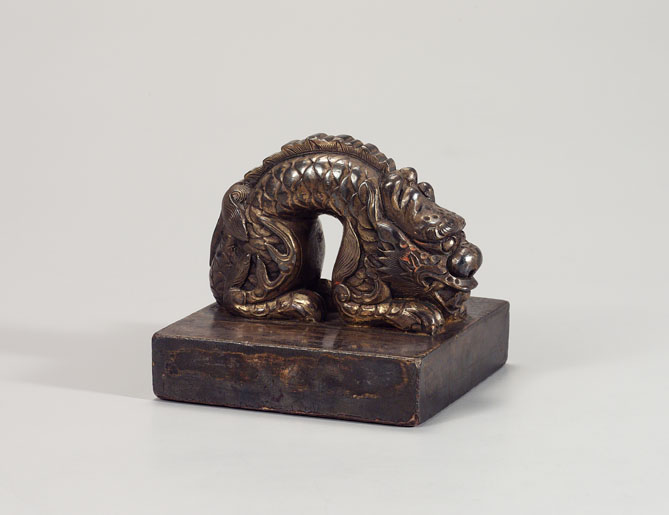
The Chikmyeongjibo was made in 1898 when King Gojong ascended as emperor for use on documents. It is slightly smaller than the identically named seal made in 1897. 'Chikmyeong' means an imperial command issued by the emperor to officials. In the royal court, it was called 'Wangji' or 'Gyoji.' The handle animal is a crouching dragon, like the Jegojibo. The scale patterns covering the body, the horns on the head, and the auspicious aura emanating from the face enhance the monarch's dignity.
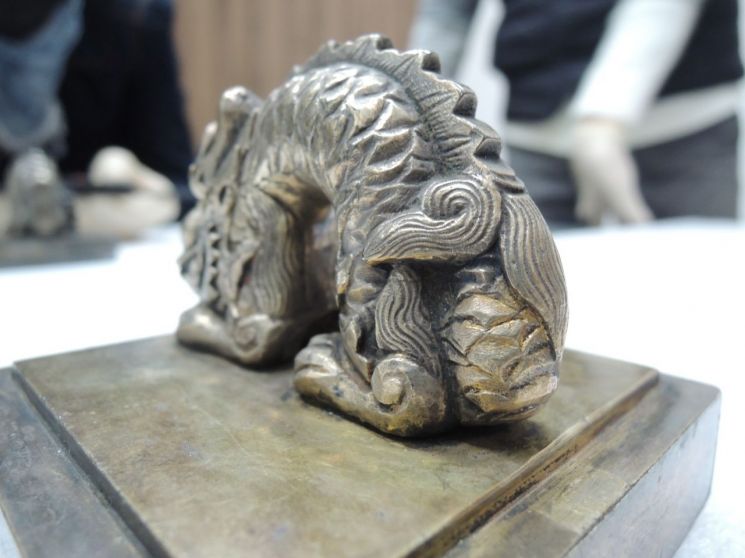
The Daewonsubo is one of three seals made when the Korean Empire established the Wonsubu (Marshal Office) on June 22, 1899, to command the army and navy. It was used to stamp military appointment documents. The Daewonsu was the head of the Wonsubu and the highest military commander. This seal also has a dragon-shaped handle. The script is Xiaozhuan, neat and orderly. Although some color has changed, the overall original form remains well preserved. The Cultural Heritage Administration stated, "The Jegojibo, Chikmyeongjibo, and Daewonsubo are detailed in historical records such as the Daerye Uigwe (Grand Ritual Records), including their form and materials, and many cases of actual use have been confirmed. They are rare historical symbols that reveal the nation's turbulent fate and suffering."
Meanwhile, on the same day, the Cultural Heritage Administration also designated the 'Ritual Offering Implements Excavated from Yeongguksa Site in Seoul (Seoul Yeongguksa-ji Chulto Uisik Gongyanggu Ilgwal)', 'Suwunjapbang (Suwun Miscellaneous Prescriptions)', and 'Yenyeommita Doryangchambeop Volumes 1?5 (Yenyeommita Dojang Chanbeop Vol. 1?5)' as national treasures. The ritual offering implements excavated from the Yeongguksa site in Seoul collectively refer to ten Goryeo Buddhist artifacts unearthed in 2012 at the site where Dobong Seowon once stood. Further investigation revealed that the site was once home to Yeongguksa Temple during the Goryeo period.
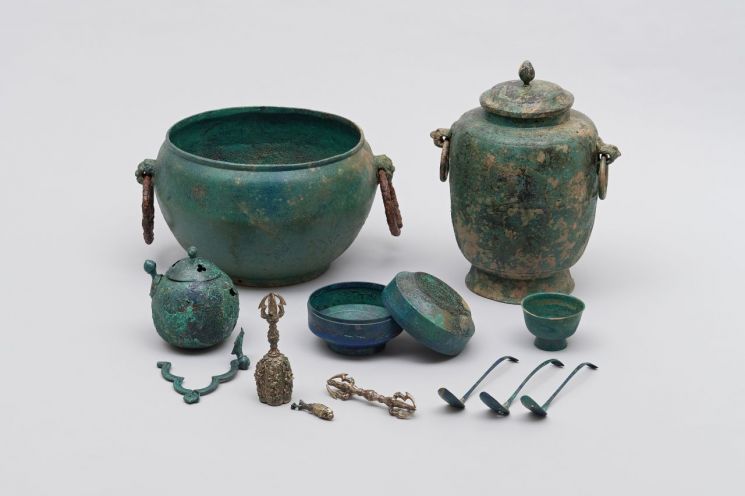
The cultural properties managed as national treasures include one gilt-bronze Vajra scepter, one gilt-bronze bell, one bronze incense burner, one bronze incense container, one bronze footed vessel, one bronze lidded jar, one bronze water container, and three bronze spoons. The Vajra scepter, resembling a club, was a weapon used in ancient India. In Buddhism, it is used as a ritual object or a tool for practice to ward off evil forces. The bell is a Buddhist ritual instrument used to summon bodhisattvas and awaken sentient beings, and the lidded jar refers to a jar with a lid. The Cultural Heritage Administration noted, "The usage information of these artifacts is understood through inscriptions, and their preservation state is good. They are expected to contribute to the study of esoteric Buddhist ritual implements." They added, "They comprehensively demonstrate high-level metalcraft techniques and diverse metal artifacts, which are significant not only in Korean craft history but also in Buddhist historical studies."
Suwunjapbang is a handwritten Chinese manuscript cookbook authored by three generations of the Andong Confucian scholar family: Kim Yu (1491?1555) and his grandson Kim Yeong (1577?1641). It is the first cookbook to be designated as a national treasure. The title 'Suwun' derives from the I Ching and means to host and enjoy a banquet. The book introduces a total of 114 dishes: 57 types of alcoholic beverages, 14 types of pickled vegetables and kimchi, 9 types of sauces, 7 methods of sowing and storing vegetables and fruits, and 5 types of sweets and candies.
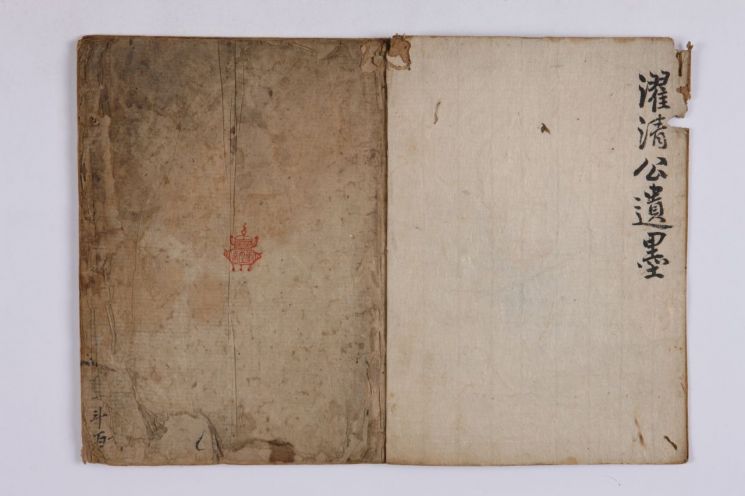
Although parts of the book reference other cookbooks from China and Joseon, it also includes recipes for dishes made by noble families in the Andong region. The Cultural Heritage Administration stated, "Cookbooks from the early Joseon period are extremely rare," and emphasized, "We focused on its unique originality capturing the food culture of the time and its significance as the origin of contemporary Korean food culture."
The Yenyeommita Doryangchambeop Volumes 1?5, held at Gobulsa Temple in Busan, is a royal edition Buddhist scripture commissioned by Queen Jeonghui, wife of King Sejo. 'Yenyeommita Doryangchambeop' is a book for worshiping Amitabha Buddha, performing repentance, and praying for rebirth in the Western Paradise. The oldest known edition in Korea is said to have been published in 1376 by the Goryeo monk Hyerang.
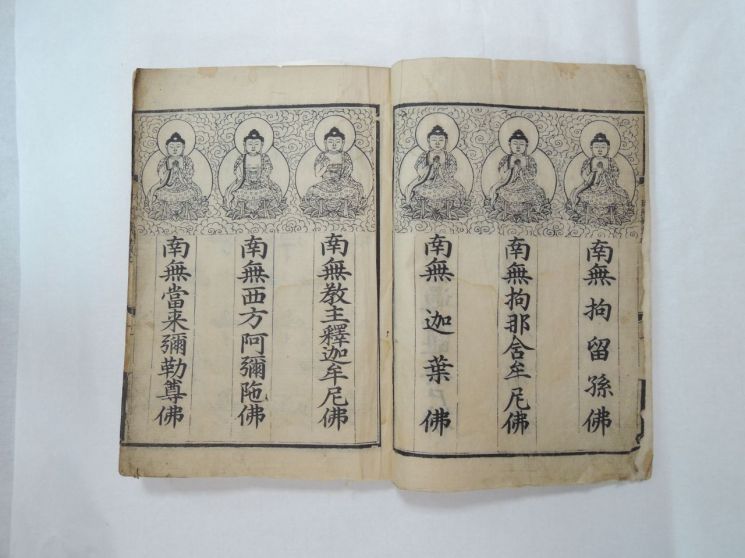
The Gobulsa edition designated this time is estimated to have been produced in 1474. The Cultural Heritage Administration explained, "It is clear that royal figures such as Queen Insu and Queen Inhye, as well as royal family members like Wolsan Daegun and eminent monks like Shinmi, participated in its production," adding, "It confirms the national Buddhist scripture publication project centered on the royal court in early Joseon." They further noted, "The triad Buddha iconography at the front of the book was painted by Baek Jong-rin and Lee Jang-son. As an early Joseon woodblock print with a confirmed date and artists, it holds great significance for Buddhist, printing, and art history research."
© The Asia Business Daily(www.asiae.co.kr). All rights reserved.
![Clutching a Stolen Dior Bag, Saying "I Hate Being Poor but Real"... The Grotesque Con of a "Human Knockoff" [Slate]](https://cwcontent.asiae.co.kr/asiaresize/183/2026021902243444107_1771435474.jpg)

















