Ministry of Education Announces Phased Implementation Plan for Full Enforcement of 'High School Credit System' in 2025
Class Hours Unit Changed to Credits... About 2 Periods Reduced per Week
Supplementary Instruction for Below Minimum Achievement in Korean, English, Math; Non-Completion System from 2025
2022 Curriculum and Future-Oriented College Admission System to be Established by 2024
[Asia Economy Reporter Han Jinju] Starting from 2023, when current 8th graders become high school freshmen, the high school credit system will be gradually applied to general high schools. The number of class hours per week will be reduced by about two periods by converting completion units into credits. Supplementary courses will also be provided for students who fall below the minimum academic achievement level in core subjects such as Korean, English, and Math.
On the 23rd, the Ministry of Education held a meeting of the High School Education Innovation Promotion Team and announced the "Step-by-step Implementation Plan for the Full Application of the High School Credit System by 2025."
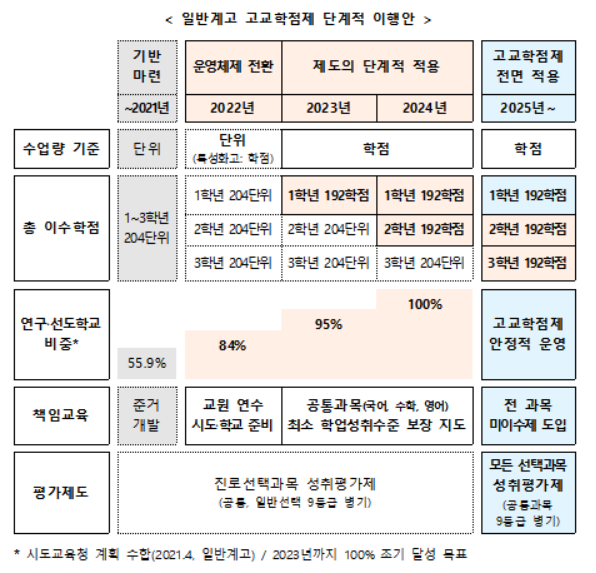
The high school credit system refers to a system where students take various subjects according to their career paths and are recognized for graduation if their accumulated credits meet the criteria. Before applying it to all high schools in 2025, it will be gradually applied to general high schools from 2022 to 2024. The Ministry of Education plans to revise the laws and guidelines related to the high school credit system starting next year and promote the transition to an operational system for the high school credit system by establishing a promotion system at the metropolitan/provincial education offices and school levels.
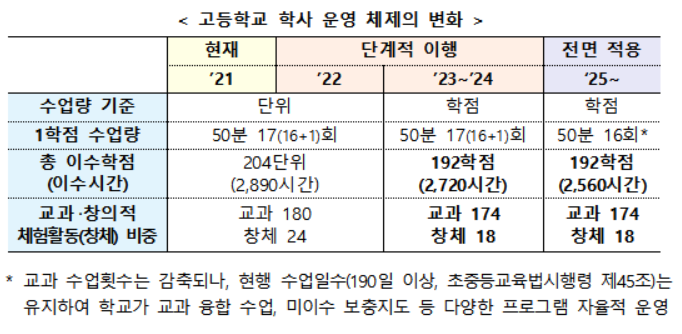
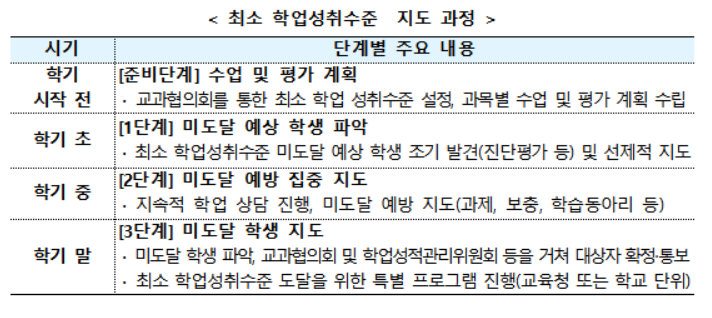
From 2023, starting with high school freshmen, the number of class units will change from 204 units to 192 credits. Among the core subjects, Korean, English, and Math students who fall below the minimum academic achievement level will receive supplementary instruction. This is a preparatory process for applying the non-completion system and achievement evaluation system for elective subjects starting in 2025.
As the class volume standard changes to "credits," the weekly class hours will be reduced by about two periods. Credits for subjects and creative experiential activities will be adjusted to 174 credits and 18 credits, respectively. A Ministry of Education official explained, "Based on 204 units, if there were seven periods of classes from Monday to Friday and only one day had six periods, changing to 192 credits means that about three days a week will end with six periods of classes."
From 2023, guidance to ensure the minimum academic achievement level will be implemented in all schools. From the full implementation in 2025, students must meet academic achievement levels (grades A to E) to graduate, but the supplementary course for students who do not reach the minimum academic achievement rate of 40% will be applied two years earlier.
Starting in 2025, the "non-completion system" will be introduced. If the achievement rate is below 40%, students will receive an I (Incomplete) grade and must earn credits through supplementary completion (assignments, online courses, etc.). The non-completion system means that credits are recognized only if both attendance rate (two-thirds or more) and academic achievement rate (40% or more) are met. For elective subjects other than core subjects (Korean, English, Math, Social Studies, Science), only achievement levels will be indicated.
A Ministry of Education official explained, "Separate guidance will be provided to students who do not reach the achievement level in their first year of high school," adding, "Along with support for students lacking basic academic skills, since elective subjects are taken after general elective education leading to the College Scholastic Ability Test (CSAT), it will be advantageous for students to acquire future competencies based on basic literacy."
There are concerns that students entering high school before the full implementation of the high school credit system may experience confusion due to changes in the college entrance system. Even though the high school credit system will be applied step-by-step from next year, the Ministry of Education's policy is to maintain the current internal evaluation system for current 7th and 8th graders.
The Ministry of Education explained, "The point at which the internal evaluation system changes, such as applying the achievement evaluation system to all elective subjects, will be from the first year of high school in 2025 when the high school credit system is fully applied. During the phased implementation period, the achievement evaluation system (without ranking into nine grades) will only apply to career elective subjects."
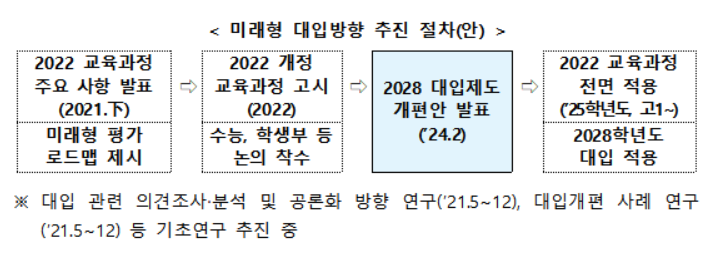
The Ministry of Education plans to prepare the 2022 curriculum and future-oriented college entrance system compatible with the high school credit system by 2024. Prior to that, major points of the 2022 revised curriculum, such as subject restructuring and fostering basic literacy, will be announced in the second half of this year.
Additionally, the teacher supply plan applied in 2023 will adopt new teacher supply standards reflecting the demand for teachers related to the high school credit system, such as an increase in offered subjects, academic planning, and guidance for non-completion.
Starting next year, the Ministry of Education will assign secondary school teachers by region to allow schools to designate and operate dedicated teachers for the high school credit system. To ensure subject selection is guaranteed even in schools with poor conditions such as rural areas, the Ministry is also considering additional teacher placements, such as subject itinerant teachers affiliated with education support offices or dual appointments of middle and high school teachers.
Deputy Prime Minister and Minister of Education Yoo Eun-hye stated, "The high school credit system is a policy that concretizes a student-customized curriculum respecting student choice and will be a major turning point in our education. It was introduced in Meister high schools in 2020, specialized high schools in 2022, and will be introduced in general high schools in 2025. Since general high schools account for the largest scale, we will systematically prepare for the school field based on today's plan until 2024."
© The Asia Business Daily(www.asiae.co.kr). All rights reserved.
![Clutching a Stolen Dior Bag, Saying "I Hate Being Poor but Real"... The Grotesque Con of a "Human Knockoff" [Slate]](https://cwcontent.asiae.co.kr/asiaresize/183/2026021902243444107_1771435474.jpg)


















