Ministry of Science and ICT-Daejeon City Launch 'Olleve' Pilot Operation in Daedeok Innopolis
Second Demonstration Following 2013 Gumi, General Routes Expected in 2 Years
Noted as a Solution to Electric Vehicle Limits of 'Long Charging, Short Driving'
Wireless Charging Possible During Driving and Stopping
Attention on Whether High Cost and Frequent Malfunctions Have Been Resolved
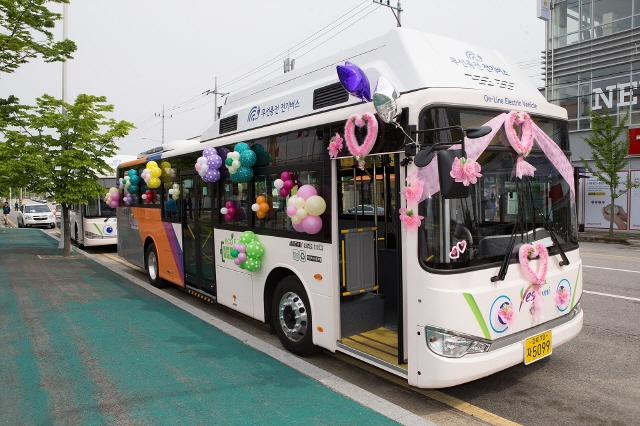
[Asia Economy Reporter Kim Bong-su] Electric vehicles, hailed as the epitome of future technologies such as eco-friendliness and autonomous driving, unfortunately still face the challenge of short driving ranges compared to their long charging times due to current battery technology limitations. However, the scenario changes if wireless charging, similar to that used in smartphones, allows charging during driving or stops. Especially for city buses operating on fixed routes, charging can occur whenever the bus arrives at a stop or when the driver takes a short break at the terminal, eliminating wasted time and ensuring driving range. An electric bus adopting this wireless charging method has been developed domestically and is entering a pilot operation phase ahead of commercialization, drawing attention. It offers advantages such as the ability to charge multiple buses simultaneously, safety due to buried power lines, and extended battery life. Interest is focused on whether the issues of high cost and frequent breakdowns revealed in the first trial operation have been resolved to enable deployment on regular routes and commercialization.
On the afternoon of the 23rd, the Ministry of Science and ICT held an opening ceremony for the pilot operation of the future eco-friendly electric bus 'Olev (On-Line Electronic Vehicle)' equipped with wireless charging technology at the Korea Advanced Institute of Science and Technology (KAIST) campus in the Daedeok Research and Development Special Zone, Daejeon. This bus will be deployed on regular routes after two years of pilot operation.
◇ What is the wireless charging method?
The wireless charging technology applied to Olev is a magnetic resonance method developed independently by KAIST. A core structure made of ferrite material with high permeability (a property determining the strength of the magnetic field) is placed beneath the power line to form a magnetic field directed only upwards, enabling charging with a high efficiency of 90%. This means large amounts of electrical energy can be safely transmitted wirelessly. The electric bus is equipped with a wireless charging device (receiver), and wireless chargers (transmitters) are embedded under bus stops. Wireless charging occurs at an 85kHz frequency band while the bus enters, stops, and leaves the bus stop. Developed in May 2017 using 53 proprietary technologies held by Professor Cho Dong-ho’s KAIST team, the venture company 'WiPowerOne' was established within the university to proceed with demonstration and commercialization. Daejeon City, KAIST, and the Research and Development Special Zone Foundation have signed a business agreement to promote demonstration and commercialization. Government funding of 170 million KRW was invested, and after passing the government’s regulatory sandbox review in September last year, experimental services became possible, receiving full support. A WiPowerOne official explained, "Charging efficiency is about 90%, similar to the efficiency of general plug-in electric charging (in the low 90% range). Although charging time is one hour, charging during the driver’s 20-minute rest after completing the route can increase the battery charge up to 60%."
◇ Overcoming electric vehicle limitations
Driving wireless charging, which allows battery charging even while the electric vehicle is in operation, can dramatically increase the driving range, a major limitation of electric vehicles. Maintaining the battery charge at a certain level improves battery efficiency and lifespan. Naturally, the number of battery replacements decreases, enhancing economic feasibility. Since the power supply cables are buried underground, there is no risk of electric shock, ensuring safety. Wireless charging uses a pickup system for charging, allowing the use of all wireless charging power supply infrastructure, and multiple vehicles can be charged at a single facility without installing separate chargers or additional connectors. The wireless charging electric bus in operation can charge 150 kW in one hour and travel 150 km. However, on the Daedeok Special Zone circular route, the bus charges 50 kW during the driver’s 20-minute break, enabling it to travel 23.5 km.
◇ Have the drawbacks been fixed?
KAIST began trial operation of six wireless charging electric buses in Gumi City, Gyeongbuk Province, in 2013. However, frequent battery replacements and expensive battery replacement costs caused frequent service interruptions, earning criticism as a 'white elephant.' At that time, the price of the first buses introduced reached 650 million KRW each, much more expensive than regular buses. Additionally, over two years, there were more than 60 frequent breakdowns, and the battery alone cost between 100 million and 150 million KRW, with repair costs exceeding 4 million KRW, leading to criticism that the cost of maintenance was greater than the value of the battery itself.
◇ How will the pilot route operate?
Starting from the 24th, this bus will operate on a two-year pilot basis on the Daedeok Special Zone circular route connecting KAIST, Daedeok Special Zone research institutes, DCC, and urban railway stations (Wolpyeong, Yuseong Oncheon, Guam). The first bus departs at 6 a.m., and the last at 10 p.m., with fares matching regular city buses at 1,250 KRW (750 KRW for youths, 350 KRW for children). Only transportation cards are accepted. The bus has 38 seats, with 17 actual seats. It can fully charge a 150 kW battery in one hour and travel up to 150 km. Even with air conditioning and heating fully operating, it can travel up to 93 km, which is 60% of the maximum range. Charging for just 20 minutes during the driver’s break adds 50 kW, allowing a maximum travel distance of 50 km and a minimum of 30?40 km, sufficient to complete the 23.5 km route. The bus dispatch interval is 40 minutes.
At the opening ceremony, Minister Lim Hye-sook of the Ministry of Science and ICT said, "The demonstration of wireless charging bus technology is a bold challenge toward the 2050 carbon-neutral future, and it marks the beginning of science and technology being felt in the daily lives of citizens and improving quality of life. We will spare no policy support, including investment in technology development, to accelerate the transition to a carbon-neutral society through science and technology."
© The Asia Business Daily(www.asiae.co.kr). All rights reserved.
![Clutching a Stolen Dior Bag, Saying "I Hate Being Poor but Real"... The Grotesque Con of a "Human Knockoff" [Slate]](https://cwcontent.asiae.co.kr/asiaresize/183/2026021902243444107_1771435474.jpg)















