Federation of Korean Industries Analyzes 30 Years of Korea-China Diplomatic Relations
China Surpasses Korea in GDP and Trade Volume
China Also Overtakes Korea in National and Manufacturing Competitiveness
"Need to Curb China's Rapid Growth and Enhance Korea's Potential Growth Rate"
[Asia Economy Reporter Su-yeon Woo] As China's economy has repeatedly experienced explosive growth over the 30 years since the establishment of diplomatic relations between Korea and China, it has surpassed Korea in most economic indicators. To counter the rapidly growing Chinese economy since its opening to the outside world, there is advice that Korea should actively discover new growth engines and strive to improve its potential growth rate.
On the 23rd, the Federation of Korean Industries (FKI) announced the results of a comparative analysis of the economic and competitiveness gaps between Korea and China over the past 30 years, marking the 29th anniversary of Korea-China diplomatic relations. Over the past 30 years, China has caught up with Korea in terms of gross domestic product (GDP), export-import trade volume, national competitiveness, manufacturing, and corporate competitiveness.
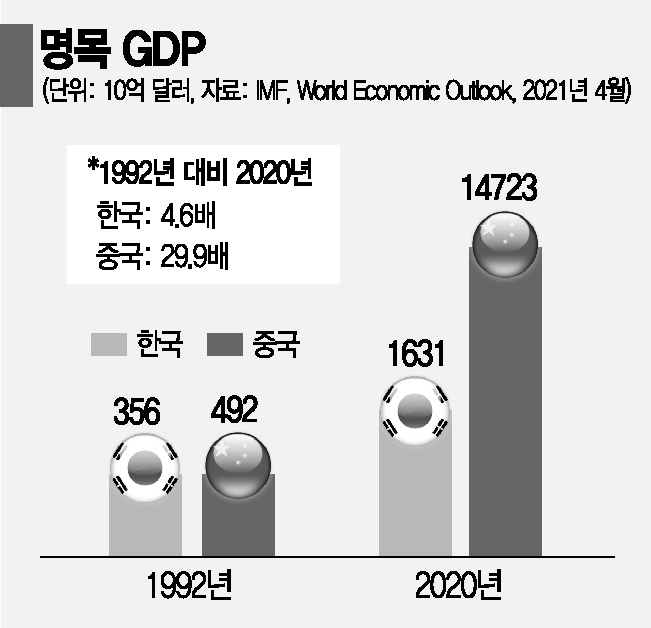
◆ China Surpasses Korea in GDP and Trade Volume = First, China significantly outpaced Korea in various macroeconomic indicators such as GDP and foreign trade volume. In nominal GDP, Korea grew 4.6 times from $356 billion in 1992 to $1.631 trillion in 2020, whereas China surged about 30 times from $492 billion to $14.723 trillion during the same period. As a result, the nominal GDP gap between Korea and China widened significantly from 1.4 times in 1992 to 9 times in 2020.
In nominal GDP per capita, Korea increased 3.9 times from $8,126 in 1992 to $31,497 in 2020, while China increased 25 times from $420 to $10,484. Until 1992, China's nominal GDP per capita was only 5.2% of Korea's, but last year it caught up to about 33.3%.
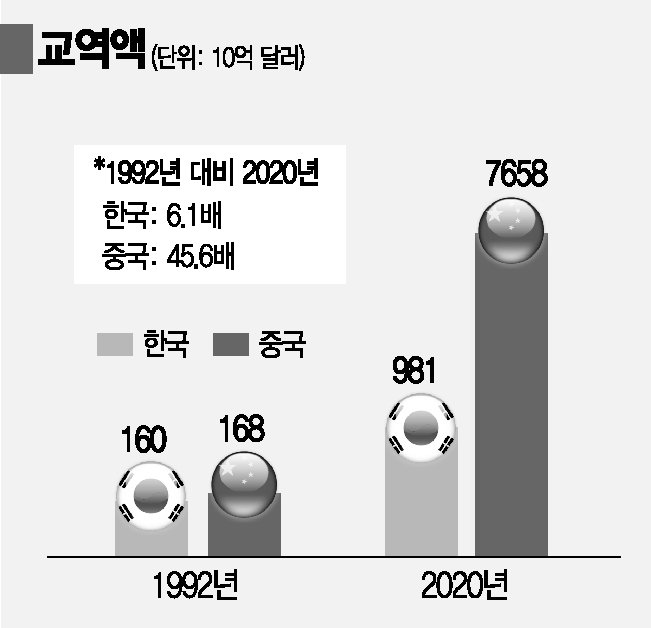
China also dominated Korea in trade indicators representing export-import volume. In 1992, Korea's trade volume was $160 billion and China's was $168 billion, at similar levels, but as of last year, Korea's trade volume was $918 billion, just under $1 trillion, while China's reached $7.658 trillion, growing to 7.8 times Korea's size.
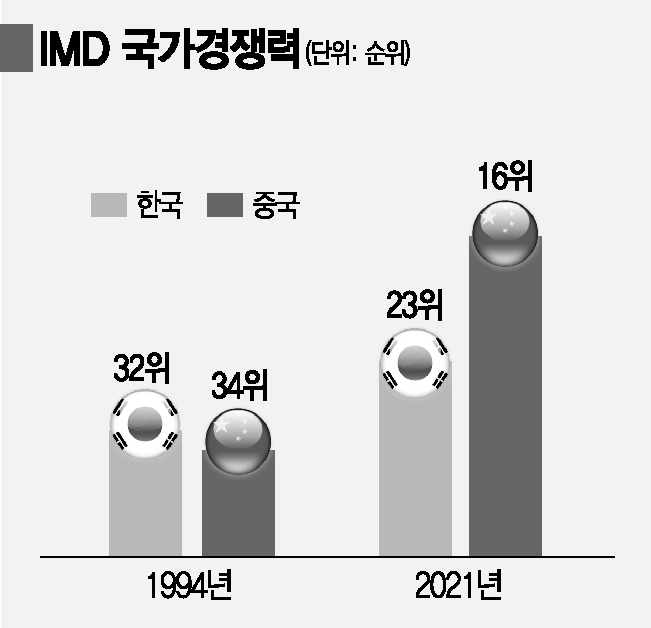
◆ China Surpasses Korea in National and Manufacturing Competitiveness = While it is inevitable that Korea lags behind China in terms of economic scale, a more serious problem is that Korea is gradually falling behind China in potential aspects such as national competitiveness and manufacturing competitiveness. Looking at the rankings of the International Institute for Management Development (IMD) in Switzerland, which comprehensively evaluates national competitiveness by analyzing various fields such as macroeconomics and infrastructure, Korea was ranked 32nd and China 34th in 1994 at similar levels, but this year China overtook Korea by ranking 16th compared to Korea's 23rd.
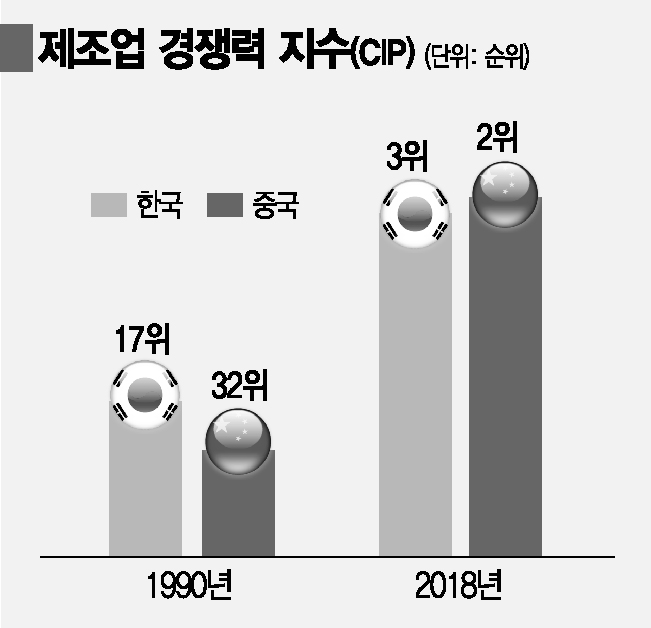
Both Korea and China have recorded remarkable growth in manufacturing competitiveness, which supports their economies, but China's growth was faster. According to the United Nations Industrial Development Organization (UNIDO) Competitive Industrial Performance (CIP) index, which analyzes manufacturing competitiveness and ranks countries, Korea and China were ranked 17th and 32nd respectively in 1990, but in 2018 China ranked 2nd and Korea 3rd, with China surpassing Korea.
◆ Falling Behind in Corporate and Export Product Competitiveness as Well = In terms of corporate and export competitiveness, China has already surpassed Korea. Indicators showing the competitiveness of companies in both countries, such as the number of Fortune Global 500 companies and the number of top-ranked export items in the global market, both show China ahead of Korea.
In 1995, Korea had 8 companies and China (including Hong Kong) had 3 in the Fortune Global 500, with Korea having more, but this year Korea has 15 and China 135, with China far ahead. In terms of the number of items ranked first in global export market share, Korea had 96 items in 1993 and China 322, with Korea at about 29.8% of China's level, but in 2019 Korea had 69 items and China 1,759, with Korea at only about 3.9% of China's level.
Kim Bong-man, head of international cooperation at FKI, said, "Recognizing China's rapid growth, Korea must also strive for sustainable growth through expanded economic exchanges with China and entry into emerging markets," adding, "It is time for the government and companies to work together to improve Korea's potential growth rate by improving regulations that hinder innovative industries, reforming the labor market structure, and actively entering the Fourth Industrial Revolution sectors."
© The Asia Business Daily(www.asiae.co.kr). All rights reserved.
![Clutching a Stolen Dior Bag, Saying "I Hate Being Poor but Real"... The Grotesque Con of a "Human Knockoff" [Slate]](https://cwcontent.asiae.co.kr/asiaresize/183/2026021902243444107_1771435474.jpg)


















