KAIST Research Team Successfully Develops True Random Number Generator Using Stochastic Behavior of Mott Transition Semiconductors
[Asia Economy Reporter Kim Bong-su] Domestic researchers have developed an unhackable encryption system that can be used in smartphones and Internet of Things (IoT) devices. It is notable for being made in the form of a semiconductor chip that can be easily installed in existing devices, operating at high speed, using low power, and functioning even at high temperatures.
The Korea Advanced Institute of Science and Technology (KAIST) announced on the 18th that Professor Kim Kyung-min's research team from the Department of Materials Science and Engineering succeeded in developing a True Random Number generator using the probabilistic behavior of Mott transition semiconductors.
In the metaverse era, where electronic devices are hyper-connected, large amounts of data are exchanged in real-time between devices, requiring more advanced data security and encryption technologies. Currently, most random numbers are generated by software, but such generally generated random numbers can be easily predicted through software decoding, making hacking possible. Especially
Professor Kim Kyung-min's team focused on Mott transition materials to extract unhackable 'true random numbers.' Mott transition materials are known to change their electrical conductivity from insulator to conductor at a specific temperature. When current is applied to heat these materials, a periodic oscillation phenomenon occurs where the state alternates between insulator and conductor. The research team theoretically proved that during this process, the generation and dissipation of heat are unpredictable when the material is periodically heated and cooled.
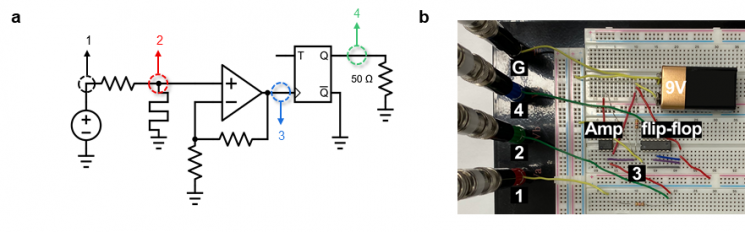
The team designed and fabricated a prototype true random number generator that converts the unpredictable characteristics of Mott transition materials into true random numbers and successfully collected true random numbers. This generator operates more than 2.5 times faster than existing technologies, uses only 1/1800th of the energy, and functions normally even at a high temperature of 300K.
Kim Kwang-min, a master's student in the Department of Materials Science and Engineering at KAIST, said, "One random number can be generated every 25 microseconds (μs) with an energy of 5.22 nanojoules (nJ), which is at least 2.5 times faster than existing technologies and allows low-power operation with 1/1800th the energy. This result proves that Mott transition materials, previously used only in limited fields such as selectors for resistive change memory, are suitable for true random number generators, pioneering a new field of hardware security material development."
This generator is made in the form of a semiconductor chip compatible with existing electronic devices and is expected to be used as encryption hardware for the security of electronic devices such as mobile phones.
The research results were published on May 18 in the international academic journal 'Nature Communications.'
© The Asia Business Daily(www.asiae.co.kr). All rights reserved.
![Clutching a Stolen Dior Bag, Saying "I Hate Being Poor but Real"... The Grotesque Con of a "Human Knockoff" [Slate]](https://cwcontent.asiae.co.kr/asiaresize/183/2026021902243444107_1771435474.jpg)
















