Taliban Reclaims Control of Afghanistan Government
Concerns Over Reversal of Women's Rights Progress Made Over 20 Years

[Asia Economy Reporter Lim Juhyung] "I can't stop crying. We will slowly die."
On the 15th (local time), when the Islamic militant group Taliban captured Kabul, the capital of Afghanistan, and regained control of the government, a video expressing the sorrowful feelings of an Afghan girl was posted on Twitter. The girl tearfully expressed her fear of the Taliban, saying, "No one cares about us just because we were born in Afghanistan."
The video was shared through the account of Iranian human rights activist and journalist Masih Alinejad. Alinejad described the video of this unidentified teenage girl as "the tears of an Afghan girl plunged into despair as her future was shattered by the Taliban's advance," adding, "History will record this."
In the video, the girl sits in a car seat and painfully expresses her feelings, saying, "No one cares about us," and "We will slowly die in history." She eventually breaks down in tears, saying, "I can't stop crying. I have to wipe my tears."
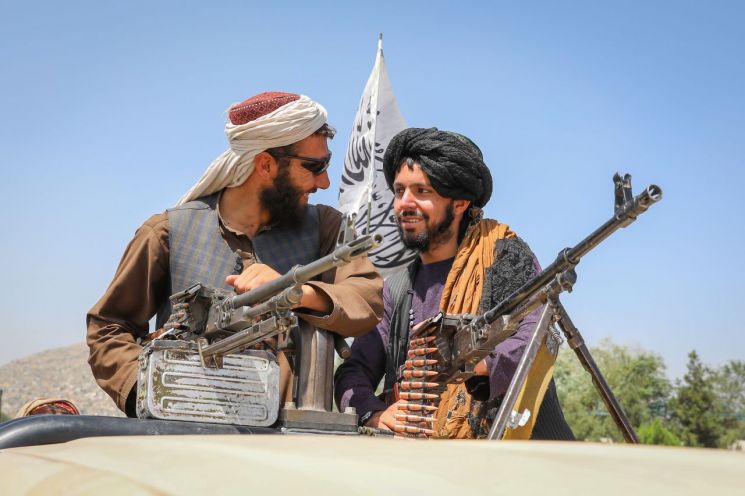 The Islamic militant group Taliban in Afghanistan is patrolling with Taliban flags on their vehicles after taking control of the capital Kabul on the 16th (local time). / Photo by Yonhap News
The video was viewed about 1.73 million times and shared by more than 20,000 people within a day. Among those who shared the video was American author Khaled Hosseini, famous for his novel "The Kite Runner," set in Afghanistan. He said, "My heart is torn. Afghan women and girls have been abandoned," and questioned, "What were their dreams, hopes, and the rights they pursued over the past 20 years?"
On the same day, the Taliban entered Kabul, the capital of Afghanistan. Dozens of Taliban armed fighters took control of the presidential palace, raised the Taliban flag, and declared on local broadcasts, "The war in Afghanistan is over."
Since the fall of Afghanistan, embassies, citizens, and soldiers in Kabul have been rushing to evacuate. International coalition forces, including the United States and the United Kingdom, have sent C-17 transport planes to Kabul International Airport to assist with the withdrawal operation.
The reason local Afghan citizens, especially women, fear the Taliban is because of the harsh policies that violated human rights during their previous rule. The name "Taliban," meaning "students" or "seekers of knowledge" in Pashto, one of the local languages, refers to the group that strictly controlled society under Islamic traditional law, Sharia, during their past governance. They amputated the limbs of thieves, forced women to wear burqas, and deprived them of educational and employment opportunities.
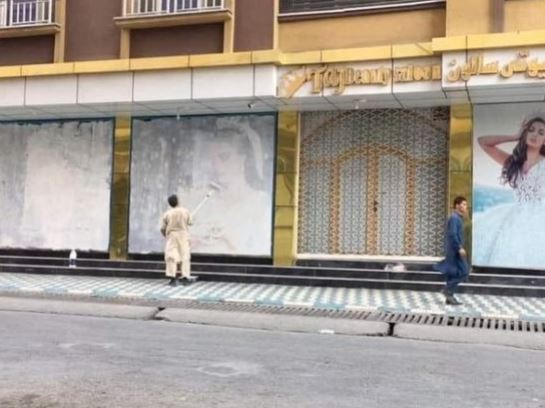 A mural depicting a woman is being erased at a shop in Kabul, the capital of Afghanistan. / Photo by Twitter Capture
During the more than 20 years since the Taliban retreated, women's rights in Afghanistan greatly improved. According to the British media BBC, in 2003, only 3% of Afghan girls were enrolled in middle school, but by 2017, this number had increased significantly to 39%. In 1999, when the Taliban formed the government, there were no female students at all. Additionally, one in five adult women had jobs.
Earlier, Taliban spokesperson Suhail Shaheen stated in interviews with local media that they would guarantee women's rights to education and employment even after the regime change.
However, it has been reported that "watching the Taliban's mood" has already begun locally. Shop owners have been painting over murals of women on the streets with white paint, and women have started wearing burqas (traditional garments covering the entire body). According to the British media "The Guardian," some local men even sneered, saying, "Today will be the last day women appear on the streets."
© The Asia Business Daily(www.asiae.co.kr). All rights reserved.
![Clutching a Stolen Dior Bag, Saying "I Hate Being Poor but Real"... The Grotesque Con of a "Human Knockoff" [Slate]](https://cwcontent.asiae.co.kr/asiaresize/183/2026021902243444107_1771435474.jpg)

















