"Monitoring the Follow-up Effects After the Gwangbokjeol Holiday"
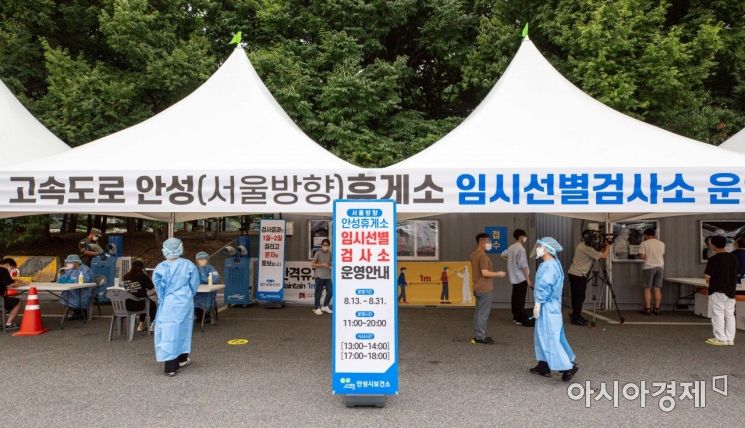 On the 13th, when 1,990 new COVID-19 cases were reported, marking the third consecutive day with numbers around 2,000, travelers visiting the temporary screening clinic set up at the Anseong Rest Area in the Seoul direction, Gyeonggi Province, are undergoing tests.
 Anseong=Photo by Kang Jin-hyung aymsdream@
[Asia Economy Reporter Kim Ji-hee] The domestic COVID-19 outbreak is showing signs of resurgence recently. The government believes it will be difficult to control the spread in the short term and is closely monitoring the situation following the Gwangbokjeol holiday weekend.
On the 15th, Son Young-rae, head of the Social Strategy Division at the Central Disaster and Safety Countermeasure Headquarters (CDSCH), stated at the regular COVID-19 briefing, "The number of patients nationwide has been increasing after the vacation season," adding, "The metropolitan area, where the outbreak had been gradually declining, has shifted back to an increasing trend since last week, and the non-metropolitan areas are also experiencing spread centered around Daejeon, Chungcheong, Busan, Gyeongnam, and Jeju."
He continued, "The strong transmissibility of the Delta variant combined with increased movement during the vacation season is causing a large-scale surge in cases, making it difficult to control the outbreak in the short term," and "This week, additional effects from the Gwangbokjeol holiday may occur, so we are monitoring the situation with heightened vigilance."
Currently, the metropolitan area has been under Level 4, the highest stage of the existing social distancing system, for about a month, while non-metropolitan areas have been under Level 3, one step lower.
However, the outbreak is not being contained. As of the 14th, the average daily number of locally transmitted confirmed cases over the past week reached 1,780.3, a 19.1% increase from the previous week's 1,495.4. The metropolitan area's daily average locally transmitted cases rose from 936.6 to 1,077.1, and the non-metropolitan areas increased from 558.8 to 703.2, an increase of over 100 cases.
The infection reproduction number, an indicator that can gauge the future spread of the outbreak, has also returned to an upward trend. Last week it was 0.99, but this week it rose to 1.1. An infection reproduction number above 1 indicates outbreak expansion, while below 1 indicates containment.
Severe cases and deaths are also increasing. Son said, "The average number of severe cases last week was 377, slightly up from 347 the previous week, and the number of deaths over the week increased to 32 from 21," adding, "However, the fatality rate continues to decline. The current cumulative fatality rate is 0.97."
© The Asia Business Daily(www.asiae.co.kr). All rights reserved.
![Clutching a Stolen Dior Bag, Saying "I Hate Being Poor but Real"... The Grotesque Con of a "Human Knockoff" [Slate]](https://cwcontent.asiae.co.kr/asiaresize/183/2026021902243444107_1771435474.jpg)















