Gap Investment Ratio, Government "52%" vs Private "13%"
Concerns Over Market Disruption Due to Excess Demand
There have been claims that the statistics on apartment gap investments compiled separately by the government and the private sector show significant discrepancies, indicating a need for improvement. It is pointed out that creating statistics that accurately reflect market trends is urgent to reduce confusion in the real estate market.
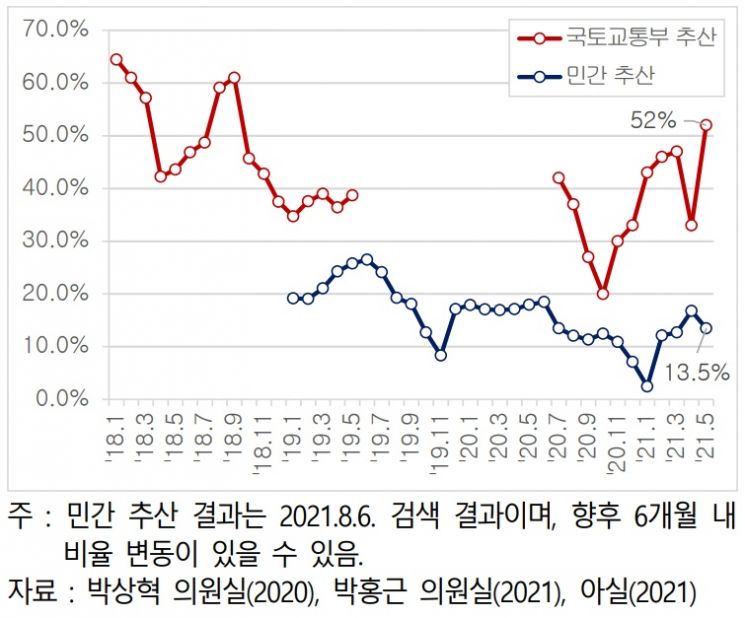
On the 15th, the Korea Research Institute for Construction Industry (KRICI) stated in its recently published Construction Trend Briefing that "the statistics on gap investment ratios show a maximum difference of 3.8 times as of May 2021, with public data at 52% and private data at 13.5%," emphasizing the need for statistical improvement.
According to data provided by the Ministry of Land, Infrastructure and Transport to the National Assembly last May, 4,254 housing sales financing plans were submitted in Seoul that month, of which 2,213 transactions (52.0%) were classified as gap investments.
On the other hand, statistics provided by the real estate platform Asil show that the gap investment ratio among apartment sales contracts in Seoul for the same month was only 13.5%. While government statistics suggest that 5 out of 10 apartment sales transactions are gap investments, the private sector views it as 1 out of 10.
The statistic that "1 out of 2 sales contracts is a gap investment" risks fueling speculative sentiment. Observing soaring housing prices, it can trigger a 'FOMO (Fear Of Missing Out)' mentality, making individuals feel they are being left behind.
The Moon Jae-in administration was the first to define gap investment as 'speculation' and began full-scale sanctions through the June 17, 2020 measures. They raised loan thresholds and included provisions requiring non-homeowners who take out mortgage loans in regulated areas to move in within six months regardless of the house price, aiming to block gap investments at the source.
KRICI explained, "(The government) defines all transactions where rental fees are inherited on the financing plan as gap investments," adding that "there is a possibility that many transactions where the existing lease contract expiration date and the sales transaction date do not coincide are classified as gap investments." They pointed out, "The definition of gap investment is broad, so the actual gap investment ratio is estimated to be lower."
Senior Research Fellow Kim Seong-hwan emphasized, "To reduce market confusion caused by excess demand, it is essential to compile statistics that reflect actual market trends," and added, "It is necessary to present a clear excess demand ratio to accurately diagnose the market and establish countermeasures."
Meanwhile, due to the impact of the Three Lease Laws and others, jeonse (long-term lease) prices have surged significantly, which appears to have stimulated gap investments as well. When the gap between jeonse prices and sale prices narrows due to rising jeonse prices, gap investments?buying a house with jeonse or purchasing move-in ready properties to lease out anew?become rampant.
Jeonse prices, which began rising after the introduction of the rent ceiling system and the right to request contract renewal in early 2020, started to skyrocket from the second half of 2020 when the Housing Lease Protection Act amendments were implemented. In particular, Seoul apartment jeonse prices showed a steep increase, rising up to 15.8% year-on-year in the same month.
Even teenagers are appearing in the gap investment market. From January to May this year, teenagers purchased 69 houses in Seoul for the purpose of deposit succession and leasing, nearly ten times the 7 cases recorded in the same period last year.
However, this is likely the result of gifts or nominee transactions. Even with historically high jeonse rates, it is difficult for teenagers, who have limited accumulated assets, to buy houses through gap investment. It is estimated that they received some money as gifts from their parents and covered the rest with jeonse deposits and other funds.
It can be seen that more parents are gifting part of the house price to their children to enable them to buy through gap investment. While some parents may have prepared housing for their children early, there are also cases where the children’s names are used as proxies.
© The Asia Business Daily(www.asiae.co.kr). All rights reserved.
![Clutching a Stolen Dior Bag, Saying "I Hate Being Poor but Real"... The Grotesque Con of a "Human Knockoff" [Slate]](https://cwcontent.asiae.co.kr/asiaresize/183/2026021902243444107_1771435474.jpg)
















