90s Fashion Brand Sailing Smoothly
Champion Sales Grow 100%
"Fresh Appeal to MZ Generation"
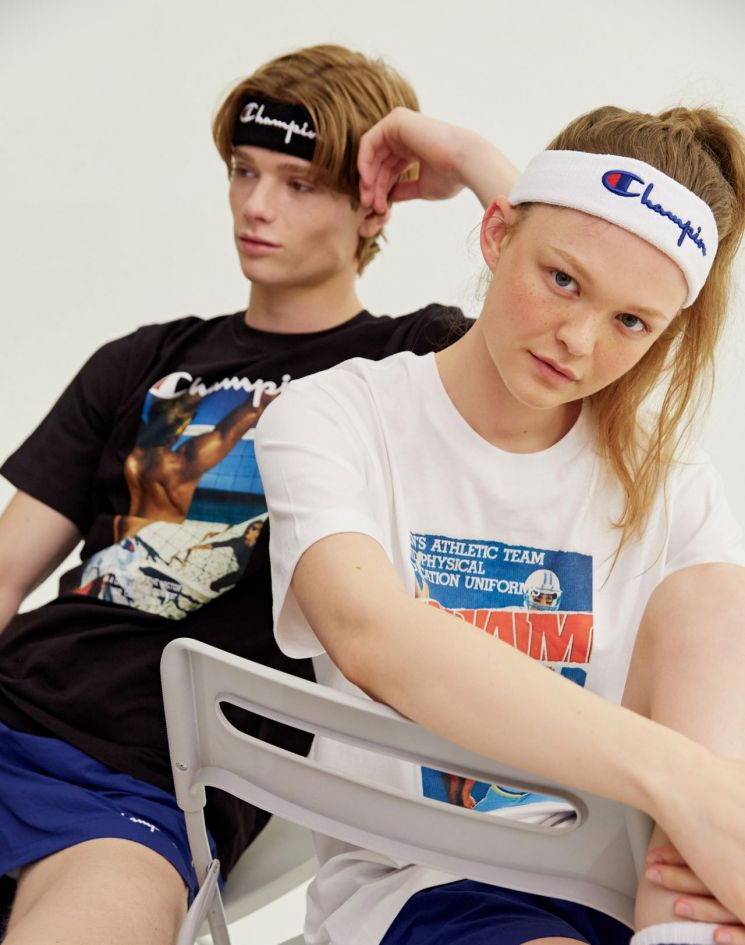
[Asia Economy Reporter Lim Hye-seon] Fashion brands that dominated the 1990s have made a dazzling comeback at the beckoning of the MZ generation (Millennials + Generation Z). Brands forgotten in the public memory are being revived, and products reflecting retro trends are being actively released. This is thanks to the MZ generation, who desire something new, enjoying past content directly and consuming it proactively beyond mere nostalgia.
LF and Shinsegae International Revive Dead Brands
According to the fashion industry on the 12th, LF’s July sales of Champion, which it officially imports domestically, increased by 100% compared to the same period last year. T-shirts prominently featuring the Champion logo are popular items this summer season.
Champion, a sports brand born in the United States in 1919, developed thermal underwear that became the prototype of sweatshirts and was the first in the world to invent the 'reverse weave' fabric knitting method that solved the problem of clothes shrinking after washing. Champion, a must-have for American college students and athletes, was also popular among teenagers and people in their twenties in Korea during the 1990s. However, its popularity waned in the 2000s and it quietly disappeared. Later, Champion transformed into a brand representing street concepts alongside the popularity of hip-hop and gained global attention again. It has been reappraised among teenagers and people in their twenties in Korea as well, and LF has been distributing and selling it since 2019.
Shinsegae International relaunched Nautica this year, which was loved as 'college fashion' in the 1990s when windbreaker jumpers were popular. Nautica was first introduced to Korea in 1992 through Youngchang Industrial and attempted market expansion through a relaunch by a mid-sized fashion company in 2009 but gradually faded away. In 2012, Amanex, operated by Choi Byung-guk, the younger brother of Choi Byung-oh, chairman of Fashion Group Hyungji, tried to re-enter the domestic market as an outdoor brand but had to withdraw again. Shinsegae International positioned Nautica as an online-exclusive casual brand and placed it on online platforms such as Musinsa. Nautica’s sales have exceeded 110% of the target and are progressing smoothly.
Fashion Startups Also Focus on Old Brands
LEE, the iconic 1990s jeans brand, was revived after 16 years through Musinsa by fashion startup Barrels, which obtained the domestic license from the US VF Corporation. Recently, a flagship store was also opened in Hongdae, Seoul. LEE was first introduced by Ssangbangwool in 1985 and disappeared from the domestic market after the contract expired in 2005. According to Musinsa, in a recent live broadcast, LEE brand logo T-shirts and baseball caps sold 150 million KRW worth within an hour. About 34,000 people watched the broadcast, and the purchase conversion rate, which is the ratio of viewers who buy during the broadcast, reached 14%. The average purchase conversion rate for live commerce broadcasts on online fashion malls is known to be around 5-8%.
Premium denim brand True Religion, popular in the late 2000s, will also be relaunched this fall. Apparel wholesaler Starcollabo secured the domestic license and plans to sell products mainly through online channels this month.
A fashion industry official explained, "Due to the impact of COVID-19, consumer psychology reflects a desire to return to happier past daily lives, and fashion from the 1990s to 2000s, which the MZ generation has not directly experienced, is rather fresh and attractive to them. As a result, the popularity of retro fashion among them is increasing even more."
© The Asia Business Daily(www.asiae.co.kr). All rights reserved.
![Clutching a Stolen Dior Bag, Saying "I Hate Being Poor but Real"... The Grotesque Con of a "Human Knockoff" [Slate]](https://cwcontent.asiae.co.kr/asiaresize/183/2026021902243444107_1771435474.jpg)
















