Used Only for Overtaking... 40,000 KRW Fine for Violations
Ambiguous Enforcement Criteria
Police Seek Improvement Measures Through Research Contract
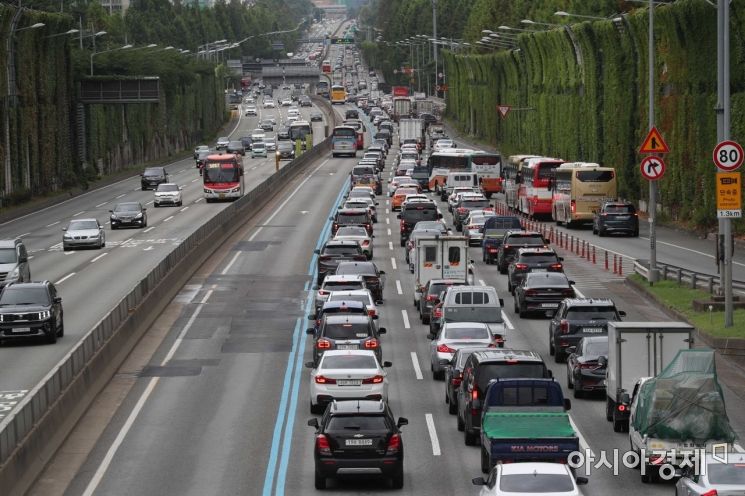 On the 2nd, during the summer vacation season, vehicles are moving in a line on the southbound lanes of the Gyeongbu Expressway near Jamwon IC in Seocho-gu, Seoul. Photo by Mun Ho-nam munonam@
[Asia Economy Reporter Lee Gwan-joo] The operation method and enforcement criteria for the 'passing lane' on highways are changing. The police have decided to carefully examine drivers' perceptions of the passing lane and its actual impact on traffic safety before preparing alternatives.
According to the National Police Agency on the 12th, under the current designated lane system stipulated in the Road Traffic Act Enforcement Rules, the leftmost lane (lane 1) on highways is designated as the passing lane. The passing lane can be used by vehicles intending to overtake, but continuous driving in this lane is generally prohibited. However, as an exception, continuous driving in the passing lane is allowed only when the driving speed is below 80 km/h due to increased traffic volume. Violating this rule results in a penalty of 10 demerit points and a fine of 40,000 KRW (for passenger cars).
However, there is controversy regarding the passing lane. If the regulations are strictly applied, drivers should enter lane 1 only briefly to overtake the vehicle ahead and then immediately return to lane 2 after overtaking. The problem arises on two-lane one-way highways. Representative examples of such highways in Korea include the entire section of the Jungbu Naeryuk Expressway (301.7 km) connecting Yangpyeong-gun, Gyeonggi Province to Changwon-si, Gyeongnam Province, the overlapping section of the Gyeongbu Expressway (Dongdaegu JC to Geumho), and the Jungang Expressway excluding sections with variable lane operations. This essentially means that lane 1 on these highways must always be kept clear even if there are no vehicles.
In reality, it is not easy to enforce violations of passing lane usage. There is no clear legal standard on how long continuous driving in the passing lane is considered a violation. In principle, after overtaking a vehicle using the passing lane, drivers should immediately return to their original lane. However, if there is another slow-moving vehicle ahead making it difficult to merge, or if there is a need to overtake again, continuous use of lane 1 makes it ambiguous whether it constitutes a violation.
To improve this situation, the National Police Agency recently commissioned a research project titled "The Impact of Passing Lane on Traffic Safety and Effective Enforcement Measures." The goal is to analyze the impact of the current highway passing lane system on traffic safety and find effective enforcement methods. The police plan to comprehensively analyze domestic and international passing lane operations and conduct a public perception survey. The survey will gather comprehensive opinions on awareness of the passing lane system, compliance rates, appropriateness of current penalties, the need for enforcement method improvements, and future improvement plans. Through this, the police expect to derive optimal alternatives suited to domestic highway conditions and establish enforcement criteria for passing lane violations.
A National Police Agency official explained, "On highways with many lanes like the Gyeongbu Expressway, this is not a major issue, but on some highways with fewer lanes, there is an opinion that the need for passing lane operation is low," adding, "We plan to prepare improvement measures, clear enforcement criteria, and effective enforcement methods."
© The Asia Business Daily(www.asiae.co.kr). All rights reserved.
![Clutching a Stolen Dior Bag, Saying "I Hate Being Poor but Real"... The Grotesque Con of a "Human Knockoff" [Slate]](https://cwcontent.asiae.co.kr/asiaresize/183/2026021902243444107_1771435474.jpg)















