Dr. Nakwon Choi and Jiyoon Kang's KIST Research Team, in Collaboration with Korea University Professors,
Successfully Detect MicroDNA within Exosomes
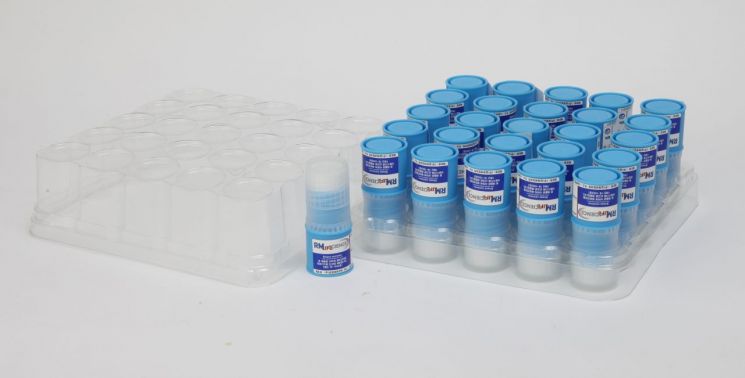
[Asia Economy Reporter Kim Bong-su] Domestic researchers have developed a fundamental technology that can diagnose prostate cancer by collecting only a small amount of urine without drawing blood.
The National Research Foundation of Korea announced on the 12th that a research team led by Dr. Choi Nak-won and Kang Ji-yoon from the Korea Institute of Science and Technology (KIST), in collaboration with Professors Bong Ki-wan, Kang Sung-gu, and Shim Ji-sung from Korea University, developed a technology to detect prostate cancer-related microRNAs (a type of short RNA composed of about 20-25 nucleotides) within exosomes (extracellular vesicles) present in trace amounts in urine.
Exosomes are cell-derived substances that act as intermediaries for constant information exchange between cells or between cells and the external environment. They contain DNA, RNA, and proteins, allowing insight into the state and information of the originating cells, and are found in various bodily fluids such as blood, urine, saliva, and tears.
In the medical field, active research is underway to develop biomarkers more sensitive than the prostate-specific antigen (PSA) test used in existing prostate cancer diagnosis to reduce unnecessary biopsies, surgeries, and radiation therapy. In particular, microRNAs contained in exosomes within bodily fluids have been intensively studied as they are known to be associated with various diseases. However, since the secreted exosomes are few and the concentration of microRNAs within exosomes is also low, there was a need for technology capable of efficiently detecting microRNAs from small samples.
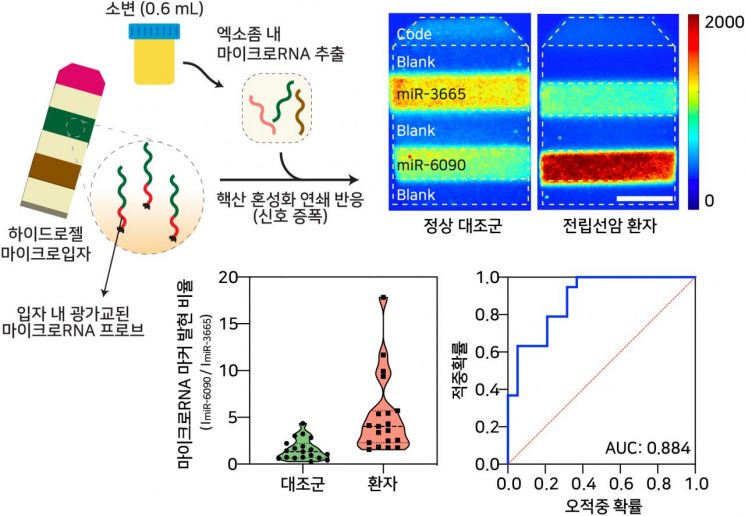
The research team developed a technology that amplifies very small amounts of microRNA signals within a hydrogel for detection. Using this method, they sensitively detected differences in microRNA expression levels from 0.6 ml urine samples of healthy individuals and prostate cancer patients. The existing PSA test has a specificity of 30% at 90% sensitivity, but this new method showed about 68% specificity, approximately 2.2 times higher, and this result was obtained from a sample volume about 67 times smaller than that used in conventional microRNA detection methods.
The research team expects that since microRNAs within exosomes can serve as highly disease-specific biomarkers, the newly developed bodily fluid analysis technology can be used to diagnose various diseases more accurately and sensitively beyond prostate cancer.
Dr. Choi Nak-won said, “In this study, exosomal microRNAs in the urine of 19 prostate cancer patients and 19 healthy individuals were detected, and by expanding the cohort size in the future, we will be able to discover more definitive prostate cancer diagnostic markers.”
The research results were published online on the 16th of last month in the international journal in the biosensor field, 'Biosensors & Bioelectronics.'
© The Asia Business Daily(www.asiae.co.kr). All rights reserved.
![Clutching a Stolen Dior Bag, Saying "I Hate Being Poor but Real"... The Grotesque Con of a "Human Knockoff" [Slate]](https://cwcontent.asiae.co.kr/asiaresize/183/2026021902243444107_1771435474.jpg)
















