High Transmission and Reduced Vaccine Effectiveness
Another Variant Emerges Before Analysis
WHO Closely Monitoring Over 10 Variants
"Vaccination Still the Key to Trust"
Following Alpha, Beta, Gamma, and Delta, now Lambda. The COVID-19 crisis, which seemed to be nearing its end, has faced a new threat with the emergence of multiple variant viruses. These variants are rapidly spreading and establishing themselves as dominant strains, replacing the original virus before their characteristics can be fully analyzed. In particular, some major variants such as Beta and Gamma are raising concerns by threatening the effectiveness of vaccines, which were once considered game-changers in the COVID-19 battle.
The World Health Organization (WHO) currently classifies the Alpha, Beta, Gamma, and Delta variants as "variants of concern." Typically, variants with higher transmissibility, fatality rates, and vaccine resistance compared to the original virus are designated as variants of concern. One level below, the "variants of interest" category includes Lambda, as well as Eta, Iota, and Kappa, totaling four types. WHO has identified 10 variants so far. When the number of variants exceeds 24 and all Greek letters are used, WHO plans to announce a new naming system.
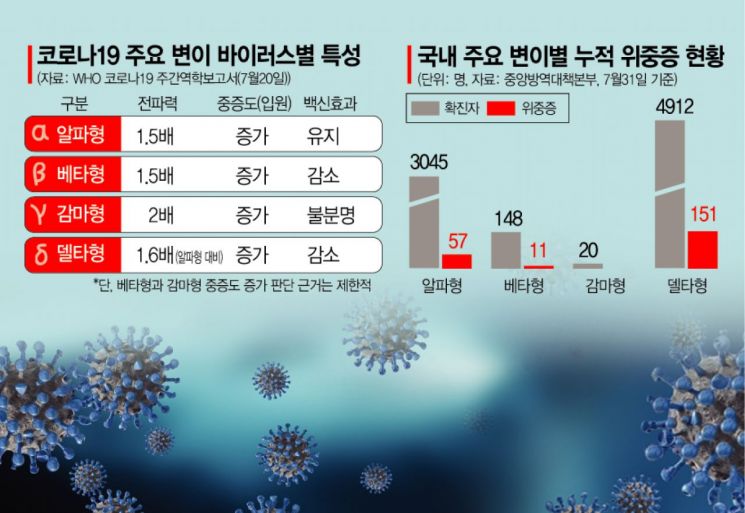
◆Highly transmissible Delta variant... Vaccine effectiveness unclear for Gamma variant= Each variant virus exhibits different characteristics in terms of transmissibility, severity, and vaccine effectiveness. The Delta variant is highly transmissible, while the Beta variant reduces vaccine preventive effects. According to an analysis by the Central Disease Control Headquarters of the WHO’s weekly COVID-19 epidemiological report released on the 20th of last month, the Alpha variant is 1.5 times more transmissible than the original COVID-19 virus and increases secondary infection rates. It also shows higher severity and mortality risk, leading to increased hospitalization rates. However, it is hopeful that the vaccines currently being administered maintain their preventive effectiveness. The Beta and Gamma variants have 1.5 times and 2 times higher transmissibility than the original virus, respectively. Although evidence on severity is limited, the Beta variant is associated with increased in-hospital mortality risk, and the Gamma variant raises concerns about higher hospitalization rates.
The Delta variant, which has become dominant in several countries including South Korea, is the most transmissible. It is 1.6 times more transmissible than the Alpha variant, which itself is 1.5 times more transmissible than the original virus. It also increases secondary infection rates and hospitalization rates. While existing vaccines can prevent severe disease progression, their effectiveness in preventing infection is reduced. Cases of the "Delta Plus" variant, derived from Delta, have also been confirmed domestically.
Although not yet detected in South Korea, the Lambda variant is currently under close observation by WHO. First identified in Peru at the end of last year, it has been spreading mainly in South American countries. According to WHO, 80% of new cases in Peru over two months since April were infections with the Lambda variant. There is currently no precise research on its transmissibility and severity, but WHO has designated it as a variant of interest due to the possibility that it poses a greater risk compared to the original virus.
◆Variants will continue= Many aspects of variant viruses remain uncertain. Among experts domestically and internationally, there is a common assessment that "the current variants will not be the last." While mutations occur in all viruses, RNA viruses like COVID-19 mutate more frequently.
Some variants also present different symptoms. A representative example is the Delta variant. Professor Cheon Eun-mi of the Respiratory Medicine Department at Ewha Mokdong Hospital said, "While the original virus mainly caused fever and cough, the Delta variant rapidly multiplies in the nose, causing symptoms such as headache, sore throat, runny nose, and sneezing first," adding, "Because these symptoms are easily mistaken for the common cold, early detection has become more difficult."
As analyses suggest that variants reduce the effectiveness of existing vaccines, the notion of "vaccine futility" has also surfaced. However, experts still regard vaccines as the most important weapon against COVID-19. Professor Jeong Jae-hoon of the Department of Preventive Medicine at Gachon University Gil Medical Center emphasized, "Vaccination should be approached not as a means to achieve herd immunity, but to reduce the risk of COVID-19 infection and manage transmission to a controllable level." Professor Cheon also stated, "Vaccines are more meaningful for preventing severe disease rather than achieving herd immunity," and added, "Vaccination, mask-wearing, and social distancing must go hand in hand."
© The Asia Business Daily(www.asiae.co.kr). All rights reserved.
![Clutching a Stolen Dior Bag, Saying "I Hate Being Poor but Real"... The Grotesque Con of a "Human Knockoff" [Slate]](https://cwcontent.asiae.co.kr/asiaresize/183/2026021902243444107_1771435474.jpg)
















