Institute for Basic Science Researcher Seungwoo Jo's Team Successfully Cultivates Newborn Brain Tissue up to 8mm in Size
[Asia Economy Reporter Kim Bong-su] A domestic research team has succeeded in creating an artificial mini brain similar to the actual human brain. It is expected to be used for the treatment of intractable brain diseases.
The Institute for Basic Science (IBS) announced on the 5th that the research team led by Seungwoo Cho from the Nanomedicine Research Division developed a "brain organoid culture platform" that replicates an environment similar to the actual human brain and succeeded in producing a "mini brain." It matured to a level close to that of a newborn's brain and was made more than twice as large as before.
"Brain organoids" are attracting attention as an optimal model for brain research and are made by culturing induced pluripotent stem cells. However, existing brain organoids remain at the fetal stage. This is because the commonly used culture scaffolds differ from the brain's protein components and fail to replicate the environment necessary for brain development. Additionally, as organoids grow larger, it becomes difficult to supply oxygen and nutrients to the center, causing cell death.
The research team overcame these limitations using nanotechnology. First, they developed a jelly-like "3D hydrogel" similar to the brain's microenvironment. They created the biochemical and physical environment necessary for brain development by utilizing the decellularized extracellular matrix of the brain. By introducing a "microfluidic chip" composed of fine channels, they precisely controlled the flow of culture medium to effectively supply oxygen and nutrients to the center.
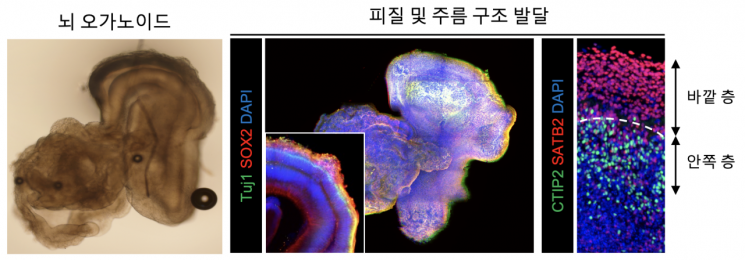
Subsequently, they conducted brain organoid culture experiments using the developed hydrogel. As a result, the neuroepithelium forming the cerebral cortex developed, producing numerous brain folds. Moreover, various brain cells such as neurons, astrocytes, and microglia were expressed more than with previous methods. The brain's structure and function became more mature.
By applying the microfluidic chip, the organoids grew to about 4-5mm, approximately twice the size of conventional brain organoids (2-3mm), and neural functions improved. The research team confirmed that the size could reach up to 8mm depending on the experiment. This enabled the production of artificial brains that are significantly larger and more developed than before.
Researcher Cho said, "We developed a new brain organoid culture platform that overcomes previous limitations using nanotechnology. This can be used as an effective in vitro model for elucidating the mechanisms of intractable brain diseases and developing treatments."
The research results were published online on the same day in the international journal Nature Communications (IF 14.919).
© The Asia Business Daily(www.asiae.co.kr). All rights reserved.
![Clutching a Stolen Dior Bag, Saying "I Hate Being Poor but Real"... The Grotesque Con of a "Human Knockoff" [Slate]](https://cwcontent.asiae.co.kr/asiaresize/183/2026021902243444107_1771435474.jpg)















