Checking Income Decrease and Reviewing Delinquency History
Industry: "The Scale of Defaults Is Not Yet a Cause for Concern"
Will the Financial Support Measures Ending in Late September Be Extended Again?
[Asia Economy Reporter Song Seung-seop] It has been identified that savings banks are confirming the risks associated with loan maturity extensions and principal and interest repayment deferrals. As it has become difficult to identify default risks due to the financial authorities' successive extension and deferral measures, they have started self-management. There are concerns that if financial support policies are extended again, industry uncertainty will reach its peak.
According to the savings bank industry on the 6th, Savings Bank A is currently reviewing income reduction data of customers who applied for extensions and deferrals. This is to understand how many small and medium-sized enterprises (SMEs) and small business owners will be unable to repay properly when the financial support policy ends. Currently, all financial sectors are extending loan maturities and deferring principal and interest repayments for SMEs and small business owners who suffered income losses due to COVID-19.
In the case of Savings Bank B, they are examining the past delinquency records of customers who requested extensions and deferrals. The more delinquency history a customer has, the greater the risk of future defaults. The purpose is to check and prepare for how many risky delinquent customers are among those who utilized the extension and deferral policies. A representative from this savings bank explained, "Since it is a policy of the financial authorities, if the conditions are met, maturity extensions and repayment deferrals are granted," adding, "It is difficult to manage risks, so we are confirming in advance as a precaution."
Fundamentally, there is no way to identify potential defaults of customers who have had their maturities extended or repayments deferred. Typically, the financial sector classifies loans as normal, watch, substandard, doubtful, and estimated loss. Loans with delinquency periods of three months or more are classified as 'substandard.' Substandard and below are considered defaults. Loans with maturity extensions and repayment deferrals due to COVID-19 are classified as 'normal' loans. From the bank's perspective, it is difficult to clearly determine whether borrowers will be able to repay after the financial support measures end.
Even if risk is low, if financial support is extended again, "defaults cannot be guaranteed"
Nevertheless, indirect methods are being used to confirm risks because the maturity extension and repayment deferral policies have been in place for a long time. The Financial Services Commission has been implementing related policies since April last year. Initially, it was planned to operate temporarily for six months, but it was extended twice as the COVID-19 situation continued.
Savings banks that analyzed the risks believe that the risk from extensions is not yet significant. A representative from one savings bank said, "Due to uncertainties, we used various methods to examine the risks," and hinted, "The amount of loan maturity extensions and interest repayment deferrals accounts for a relatively small portion of the total loan amount."
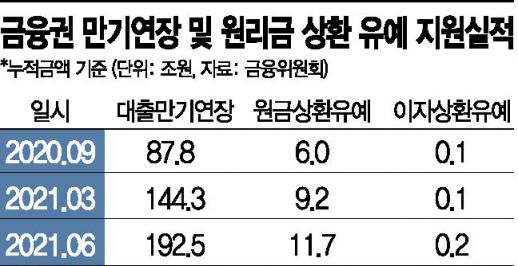
According to the Financial Services Commission, as of June 25, the total amount used for loan maturity extensions and principal and interest repayment deferrals across all financial sectors was approximately KRW 204.4 trillion. KRW 192.5 trillion was used for maturity extensions, and KRW 11.7 trillion and KRW 0.2 trillion were used for principal and interest repayment deferrals, respectively.
However, there are criticisms that it is too early to be reassured without accurately grasping the scale of defaults. Moreover, the government has hinted at the possibility of further extending financial support, which is scheduled to end at the end of September.
Hong Nam-ki, Deputy Prime Minister and Minister of Economy and Finance, stated at the Emergency Economic Central Countermeasures Headquarters meeting held the day before, "We plan to review in September whether to extend financial support measures such as loan maturity extensions and interest repayment deferrals set to expire at the end of September."
Hong's remarks are interpreted as indicating a policy direction toward re-extending loan maturity extensions and interest repayment deferrals in response to the resurgence of COVID-19.
© The Asia Business Daily(www.asiae.co.kr). All rights reserved.
![Clutching a Stolen Dior Bag, Saying "I Hate Being Poor but Real"... The Grotesque Con of a "Human Knockoff" [Slate]](https://cwcontent.asiae.co.kr/asiaresize/183/2026021902243444107_1771435474.jpg)
















