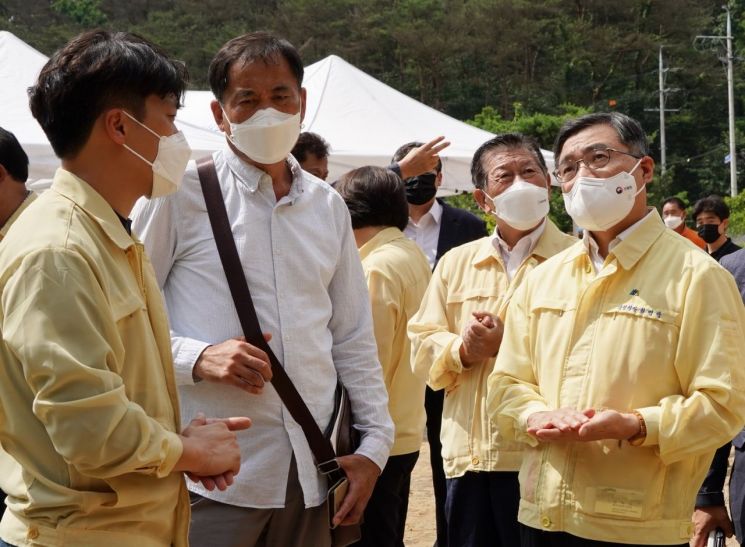
 Choi Byung-am, head of the Korea Forest Service (first on the right), is visiting Deokjeokdo Island in Ongjin-gun, Incheon, discussing measures to control pine moth damage with on-site officials. Photo by Korea Forest Service
[Asia Economy (Daejeon) Reporter Jeong Il-woong] The Korea Forest Service is launching customized pest control measures according to the life cycle stages to minimize damage caused by pine moths (Songchungi).
According to the Korea Forest Service on the 4th, the pine moth is a representative pest of pine trees that mainly feeds on pine needles. It causes defoliation damage during the overwintering larval activity period (April to June) and the hatching larval activity period (August to September), making pest control essential.
Typically, the pine moth undergoes metamorphosis stages as follows: ‘pupa’ in early to mid-July, ‘adult’ from late July to mid-August, and ‘larvae’ from late August to September.
Accordingly, the Korea Forest Service plans to conduct pest control tailored to the characteristics of each life cycle stage of the pine moth, aiming to enhance pest control effectiveness and minimize damage.
Currently, the pine moth is in the pupa stage this month, during which chemical pest control is less effective, so physical control by manually removing the pupae is being promoted.
Also, around mid-month, during the adult stage, pest control operations will be carried out by installing UV lights to attract the pine moths, which are drawn to light. Chemical pest control is also not very effective against adult pine moths.
Then, around the end of this month or early September, ground and aerial pest control will be combined to maximize pest control effectiveness from the early larval stage.
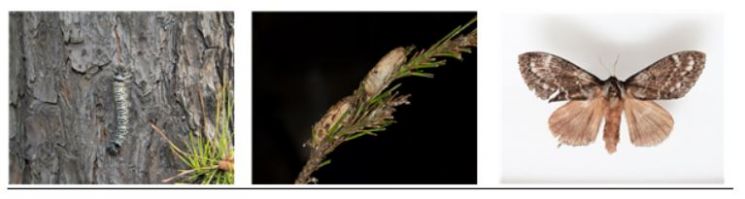 The pine moth undergoes metamorphosis stages including pupa, adult, and larva (from left), and from the larval stage onward, it feeds on pine trees causing defoliation damage. Accordingly, the Korea Forest Service plans to focus on minimizing damage through control activities aligned with the pine moth's metamorphosis stages. Provided by Korea Forest Service
Before practical pest control, a discussion meeting on pine moth damage control measures was held on the 4th at Deokjeokdo, Ongjin-gun, Incheon.
Deokjeokdo experienced more severe pine moth damage than usual last year due to abnormal winter temperatures, warm spring weather, and decreased rainfall.
At that time, defoliation damage was identified in about 504 hectares of pine distribution areas out of the total forest area of approximately 1,800 hectares on Deokjeokdo.
However, the Korea Forest Research Institute assessed that the pine trees affected by defoliation there are unlikely to die.
In line with this, the Korea Forest Service plans to ensure that the pine forests around Deokjeokdo recover from defoliation damage this year and are systematically managed so that the forest ecosystem can be sustainably preserved. The pine forests of Deokjeokdo also serve as a key axis of tourism resources in the area.
Choi Byung-am, Administrator of the Korea Forest Service, said, “Due to external factors such as recent climate change, the occurrence of sudden forest pests and diseases is gradually increasing. The Korea Forest Service will strengthen damage surveys and monitoring of sudden forest pests and diseases, while implementing special pest control measures to reduce the population density of pine moths around Deokjeokdo, focusing on minimizing forest damage caused by pine moths.”
© The Asia Business Daily(www.asiae.co.kr). All rights reserved.
![Clutching a Stolen Dior Bag, Saying "I Hate Being Poor but Real"... The Grotesque Con of a "Human Knockoff" [Slate]](https://cwcontent.asiae.co.kr/asiaresize/183/2026021902243444107_1771435474.jpg)
















