Professor Park Hoon-chul's Team at Konkuk University Uncovers Why Beetles Don't Fall When Hitting Obstacles
Applicable for Space Low-Density Atmosphere Flight, Enemy Territory Infiltration, and Natural Filming for Intelligence Use
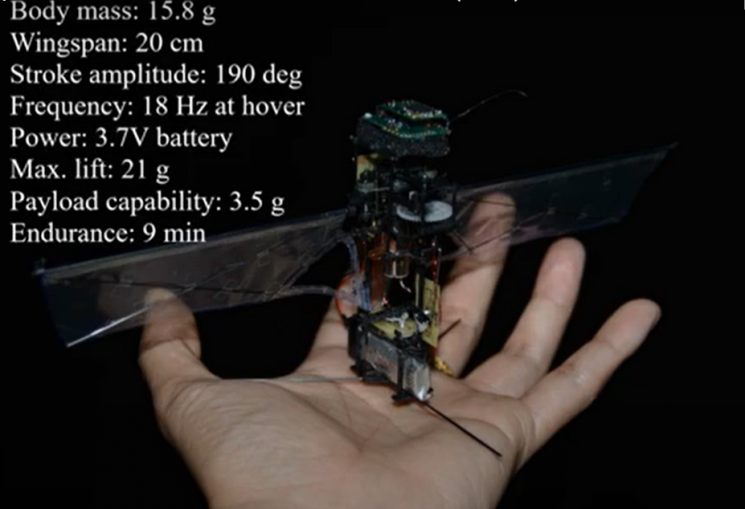
[Asia Economy Reporter Kim Bong-su] Domestic researchers have invented future flying vehicle technology that utilizes the flight principles of beetles that do not crash even when colliding with obstacles.
On the 4th, Professor Park Hoon-chul of the Department of Smart Mobility Engineering at Konkuk University, who was selected as the August recipient of the Scientist of the Month Award by the Ministry of Science and ICT, was the key figure. Professor Park identified the wing and flight principles of the rhinoceros beetle, which does not crash even when colliding with obstacles, and developed a flapping-wing flying robot that mimics these principles. It can be used for military purposes such as natural video shooting or infiltration into enemy territory, and is especially capable of flying in low-density atmospheres in space, laying the foundation for future aerospace technology.
There have been many attempts to develop insect-mimicking robots capable of flying in low atmospheric density. Unlike birds, insects lack tail wings, making their flight methods technically difficult to implement, and there have been few cases of successful long-duration flights. In particular, the rhinoceros beetle, which folds and unfolds its hind wings during flight, can fly stably even after collisions, but the process by which the hind wings fully unfold had not been clearly identified.

Professor Park revealed through high-speed camera footage that the hind wings of the rhinoceros beetle fully unfold due to aerodynamic and inertial forces generated by the initial wing flap. He also confirmed that even if the hind wings fold due to collision with an obstacle during flight, the collision energy is absorbed in the central part, allowing the wings to unfold again within a short time and continue stable flight. Applying this principle, Professor Park developed the insect-mimicking flapping-wing flying robot ‘KU Beetle’ equipped with a collision energy absorption device on its wings. When the wings collide with obstacles, they fold to mitigate the impact and then unfold again, enabling successful flight.
As recent commercial space travel challenges have succeeded one after another, expanding the horizons of space exploration, an insect-mimicking flapping-wing robot capable of performing reconnaissance and exploration missions without crashing even after colliding with obstacles has been created by domestic technology experts.
Professor Park said, "This research is significant in that it identified the collision energy absorption principle of the rhinoceros beetle’s wings and implemented it as an independent technology. We plan to continue research on insect-mimicking flying robots that can fly in low-density atmospheres and have higher flight efficiency."
The results of this research were published online in the international journal Science in December last year.
© The Asia Business Daily(www.asiae.co.kr). All rights reserved.


















