"Prevent Employee Turnover" in Unison
Strike Vote Depends on Next Week's Negotiations
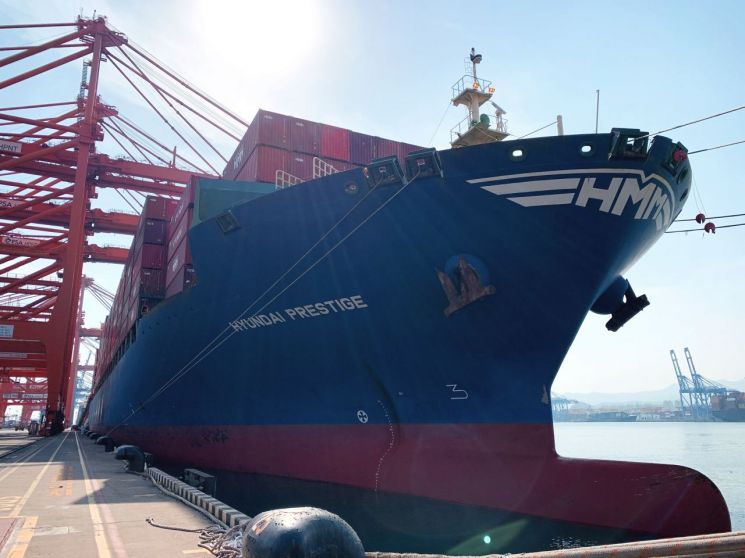 The 5000 TEU-class container ship 'HMM Prestige' is loading cargo from domestic export companies at Busan Port New Port HPNT.
"HMM's wage proportion in total sales is around 2%. Seeing junior employees leave the company because of wages, it seems necessary to normalize wages at a realistic level for morale boosting."
HMM, which is achieving record-high performance, is currently facing a tense standoff between labor and management in recent wage and collective bargaining negotiations, with voices emerging from managerial positions above department head level within the company calling for wage normalization. Concerns are rising that if wage normalization is not achieved this year, employee turnover will accelerate, making normal operations inevitably difficult.
According to the shipping industry on the 4th, HMM's maritime union's third round of wage and collective bargaining negotiations with management ended in failure yesterday afternoon, and they plan to establish a joint front with the land-based union for strike procedures after the final negotiation on the 11th.
Depending on the outcome of next week's final negotiation, the maritime union plans to join the land-based union, which applied for dispute mediation at the Central Labor Relations Commission on the 30th of last month, in strike procedures including a member vote after mediation on the 19th.
HMM's land and maritime unions are demanding a wage increase of about 25% to normalize wages frozen for eight years in this year's wage and collective bargaining. If management accepts the increase rate proposed by the union, the cost is expected to be around 120 billion KRW, about 2.3% of this year's expected operating profit (5.1638 trillion KRW).
The union is reportedly considering suspending overtime work by maritime workers as a priority strike measure if the Central Labor Relations Commission mediation fails. This is a strategy to support their demands by stopping operations that exceed the regulated overtime standards while protecting their legal rights.
Jeon Jeong-geun, chairman of HMM's maritime union, stated, "Due to years of wage freezes, about 100 maritime workers have left within a year, which is a serious level," and added, "Headquarters seafarers receive pay for 209 hours of work and 104 hours of fixed overtime, but actual working hours are longer."
On the other hand, management sympathizes with the demand for wage normalization but is troubled by the steep increase rate.
Although this year marks the highest-ever surplus, the government has injected over 3 trillion KRW in public funds for shipping industry reconstruction after 20 consecutive quarters of losses until the first quarter of last year. Excessive wage increases could become a long-term management burden. Creditors such as KDB Industrial Bank also prioritize strengthening fundamentals to become a global shipping company, including achieving a fleet capacity of 1 million TEU (1 TEU is one 20-foot container).
An HMM official said, "We are carefully reviewing employees' demands for wage normalization and improvements in treatment," and added, "We will do our best to negotiate so that labor and management can reach an amicable agreement."
© The Asia Business Daily(www.asiae.co.kr). All rights reserved.

















