105 Garoju Houses Promoted in Seoul as of June... Increased by Over 40 in One Year
39 in Gangnam 4 Districts with High Reconstruction Demand... Accounting for 38% of Total
Garoju Housing Maintenance Projects Active with Floor Relaxation and Expansion of Project Implementation Area
Supply Shortage Improvement Effect 'Minimal' Due to Low Profitability and General Sale Volume
[Asia Economy Reporter Ryu Tae-min] The street housing maintenance project, known as ‘mini reconstruction,’ is gaining momentum. As large-scale reconstruction projects in the Gangnam area are hindered by strengthened regulations such as safety inspections, interest in small-scale aging complexes is increasing, especially centered around Gangnam.
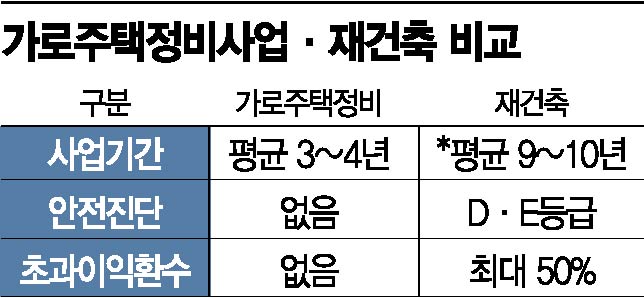
According to Seoul City on the 4th, as of June this year, there are 105 locations in the city where street housing maintenance projects are underway. Compared to 63 locations at the end of June last year, this is an increase of more than 40 sites. The street housing maintenance project is a project that improves the residential environment by renovating old houses in small-scale district units. Procedures such as safety inspections, designation of maintenance districts, and formation of promotion committees are omitted, making it simpler and shorter in duration than general reconstruction. If a certain percentage of public rental housing is supplied, the project can avoid the application of the price ceiling system. It is also exempt from the excess profit recovery system.
In particular, the project is expanding mainly in the Gangnam area, where supply is insufficient. In the so-called Gangnam 4 districts?Gangnam, Seocho, Songpa, and Gangdong-gu?39 locations, accounting for 38% of the total, are pursuing street housing maintenance projects. Gangdong-gu has the highest number with 12 sites, followed by Seocho-gu (10 sites), Songpa-gu (9 sites), and Gangnam-gu (8 sites).
The active progress of street housing maintenance projects is also attributed to Seoul City’s expansion of incentives. Earlier in 2018, Seoul City raised the floor limit in the Type 2 general residential area to a maximum of 15 floors and relaxed the maximum floors to within 10 floors for areas below 7 floors.
The government’s expansion of the project implementation area last month has further energized the initiative. On the 16th of last month, the Ministry of Land, Infrastructure and Transport announced a legislative notice for the revision of the Enforcement Decree and Enforcement Rules of the Special Act on Vacant Houses and Small-scale Housing Maintenance, expanding the possible implementation area for street housing maintenance projects from the existing 10,000㎡ to 20,000㎡.
However, the prevailing opinion is that small-scale maintenance projects alone cannot completely solve the supply problem. Because the project scale is small, even if developed, the increase in the number of households is minimal. There are also considerable concerns that investments in infrastructure such as parks, various community facilities, and roads are not made, leaving the existing deteriorated residential environments as they are.
Song Seung-hyun, CEO of Urban and Economy, said, “In some areas where reconstruction or redevelopment is difficult to pursue, it can improve the residential environment, but it is difficult to see it as a fundamental solution to the housing shortage problem,” adding, “Rather than simply rushing to increase supply volume, we need to seek ways to qualitatively improve the residential environment, including surrounding infrastructure.”
© The Asia Business Daily(www.asiae.co.kr). All rights reserved.
![Clutching a Stolen Dior Bag, Saying "I Hate Being Poor but Real"... The Grotesque Con of a "Human Knockoff" [Slate]](https://cwcontent.asiae.co.kr/asiaresize/183/2026021902243444107_1771435474.jpg)















