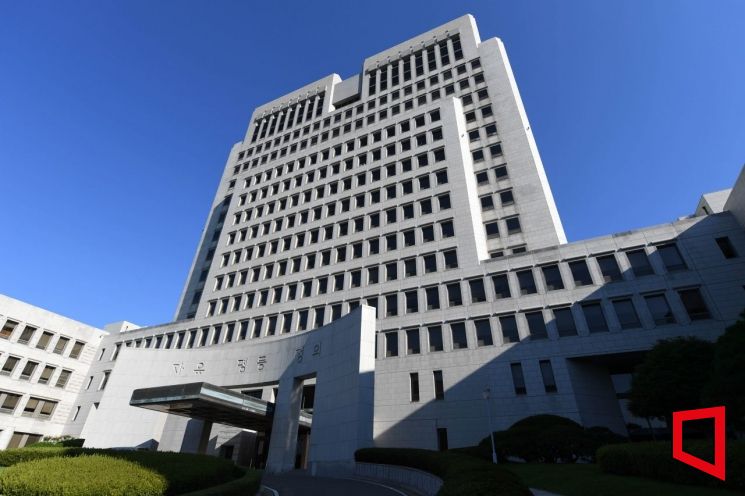
 Supreme Court, Seocho-gu, Seoul. Photo by Mun Ho-nam munonam@
[Asia Economy Reporter Kim Daehyun] The Supreme Court has ruled that a tenant cannot immediately terminate a lease contract simply because the landlord proposed different conditions instead of the construction specified in the special terms of the lease agreement.
On the 4th, the Supreme Court's 3rd Division (Presiding Justice Kim Jaehyung) announced that it overturned the lower court's ruling in favor of tenant A in the appeal case against landlord B regarding the return of the deposit and remanded the case to the Suwon District Court.
Previously, A and B entered into an officetel lease contract in March 2016. The contract included a special clause stating that the floor heating construction must be completed before the final payment date. About 10 days later, B cited the enforcement ordinance of the Building Act, which prohibits floor heating such as hot water ondol in officetels with an exclusive area exceeding 85㎡, and proposed to A to install carpet or electric panel floor heating instead.
In response, A sent a text message asking, "So, the floor heating ultimately cannot be done?" and, receiving no immediate reply from B, sent a certified letter on the same day demanding termination of the lease contract. Meanwhile, B argued that "it was only a proposal of an alternative" and that the contract termination was unlawful.
Article 544 of the current Civil Act (Delay in Performance and Termination) stipulates that "if one party fails to perform their obligation, the other party may set a reasonable period for performance and demand performance; if the obligation is not performed within that period, the contract may be terminated." If the obligor expresses an intention to refuse performance, the obligee may terminate the contract immediately without setting a period.
The first and second trials ruled in favor of the plaintiff. The first trial court stated, "B explained to A the illegality and difficulties of the floor heating construction and continuously persuaded that the construction was impossible and only other methods were possible," and "Considering that B did not respond despite confirming A's message, it appears that B expressed an intention to refuse performance of the floor heating construction."
However, the Supreme Court ruled that "it cannot be concluded that an intention to refuse performance was clearly expressed" and ordered a retrial and reconsideration of the case. The court stated, "Although B emphasized the illegality and difficulties of the construction and proposed alternatives, it is difficult to find any direct expression of refusal."
Furthermore, the court pointed out, "There may have been unavoidable circumstances preventing an immediate response during the short time between A's message and the termination notice, and B is not obligated to respond immediately," and "The lower court erred in its legal interpretation regarding refusal of performance, which affected the judgment."
© The Asia Business Daily(www.asiae.co.kr). All rights reserved.
![Clutching a Stolen Dior Bag, Saying "I Hate Being Poor but Real"... The Grotesque Con of a "Human Knockoff" [Slate]](https://cwcontent.asiae.co.kr/asiaresize/183/2026021902243444107_1771435474.jpg)















