Ryu Hun KIST Principal Researcher and Others
Elucidation of Disease Mechanism Caused by Mitochondrial Dysfunction in Neurons
Expected to Lead to New Therapeutic Strategies
[Asia Economy Reporter Kim Bong-su] Domestic researchers have uncovered the mechanism behind brain cell damage in patients with Huntington's disease, a type of degenerative brain disorder for which there is no treatment. This is being hailed as a breakthrough toward developing new therapies.
The Korea Institute of Science and Technology (KIST) announced on the 3rd that it discovered the mechanism of nerve cell damage by studying pathological phenomena in brain tissues of Huntington's disease patients. Unlike previous studies based on animal and cell models, this research reexamines pathological phenomena observed in patient brain tissues, and the institute explained that it is expected to aid in developing new treatment strategies for Huntington's disease.
Huntington's disease is an autosomal dominant inherited disorder that typically manifests around the ages of 30 to 40 and leads to death within 15 years. It is a tragic disease with no cure, characterized by personality changes, dementia, and distinctive involuntary movements (chorea). There are about 2,000 patients in South Korea. The mutant Huntingtin gene produces the Huntingtin protein, which destroys nerve cells in the striatum region of the brain, causing uncontrollable movements of the arms and legs. However, the exact mechanism by which the Huntingtin protein damages striatal nerve cells has not been elucidated.
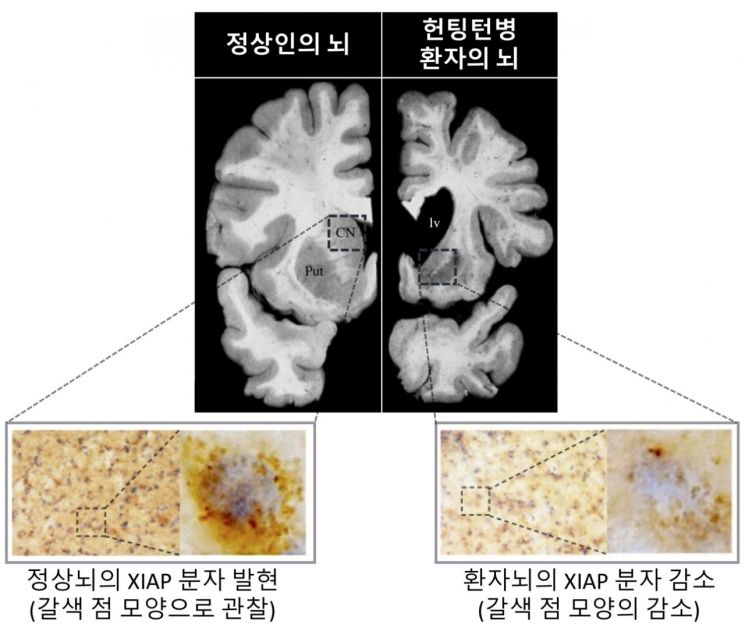
A joint research team composed of Dr. Ryu Hoon, principal researcher at KIST Brain Science Institute, Professor Lee Jeong-hee of Boston University School of Medicine, and Professor Seo Hye-myung of Hanyang University Department of Molecular Life Sciences discovered through experiments on brain tissues of Huntington's disease patients, mouse models, and cell models that the XIAP protein, which inhibits nerve cell death, is not normally expressed, leading to mitochondrial dysfunction.
Under normal conditions, the XIAP protein reduces cell damage by degrading the p53 molecule involved in cell death through autophagy. However, in Huntington's disease, decreased expression of XIAP protein reduces the degradation of p53 molecules, increasing their activity and causing abnormal cell damage. The research team confirmed that the increased p53 molecules move to the mitochondria of nerve cells and trigger cell damage, providing detailed information on the previously unexplained mechanism of nerve cell damage in Huntington's disease and its pathological basis for treatment.
Dr. Hyun Seung-jae of KIST said, "In Huntington's disease, nerve cell damage occurs due to XIAP molecule dysfunction and p53 molecule activation. By regulating this mechanism, we can propose new treatment strategies for Huntington's disease. Since this new pathological mechanism was discovered in brain tissues of Huntington's patients rather than mouse models, it brings us closer to understanding the cause of the disease and developing treatments. We also expect it to help in understanding the pathological mechanisms of other degenerative brain diseases such as dementia or Parkinson's disease."
The research results were published in the latest issue of the international journal Progress in Neurobiology [IF: 11.685, JCR: 5.3%].
© The Asia Business Daily(www.asiae.co.kr). All rights reserved.
![Clutching a Stolen Dior Bag, Saying "I Hate Being Poor but Real"... The Grotesque Con of a "Human Knockoff" [Slate]](https://cwcontent.asiae.co.kr/asiaresize/183/2026021902243444107_1771435474.jpg)















