[Asia Economy reporters Inho Yoo and Jieun Lee] Although the restoration of communication lines is creating an atmosphere for inter-Korean dialogue, the United States plans to make "urging the implementation of North Korea resolutions" a key agenda item at the ASEAN-related virtual ministerial meetings. In contrast to the South Korean government's dilemma over North Korea's demand to halt the South Korea-U.S. joint military exercises, the U.S. continues to pressure North Korea consistently, revealing a temperature gap between the two allies.
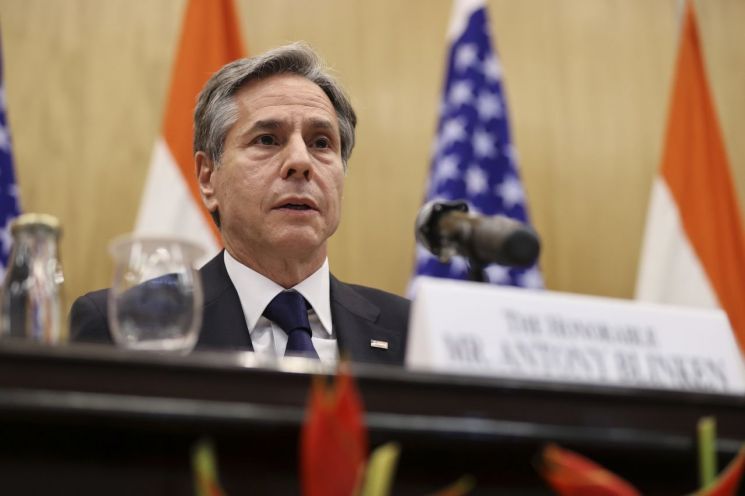
Ned Price, spokesperson for the U.S. Department of State, stated at a press briefing on the 2nd (local time) that Secretary of State Antony Blinken will attend five virtual ministerial meetings related to ASEAN this week and urge ASEAN member countries to fully implement the UN Security Council resolutions on North Korea.
Although Price's remarks were not a direct response to the demand to cancel the exercises, they are interpreted as sending a message to North Korea to engage in dialogue unconditionally through the principle of enforcing sanctions. On the 1st, Kim Yo-jong, vice director of the North Korean Workers' Party, demanded the complete cancellation of the South Korea-U.S. joint military exercises, stating that they "could further darken the future of inter-Korean relations."
The U.S. side has stated that "the joint exercises are a decision made by South Korea and the U.S., and any decision will be made by mutual agreement." However, they have left room for the possibility that the exercises may be adjusted not due to North Korean pressure but in accordance with COVID-19 guidelines.
Meanwhile, the South Korean government, which was trying to improve inter-Korean relations through the restoration of communication lines, appears to be in a difficult position. While the Blue House only stated the general position that "South Korea and the U.S. are consulting," the Ministry of Unification said on the 2nd that "the South Korea-U.S. joint exercises should not become a trigger for military tension on the Korean Peninsula." Public opinion within the ruling party is also divided between pushing forward with or postponing the joint exercises.
Experts point out that this stems from the difference between the South Korean government, which has little time left in its term and seeks immediate improvement in inter-Korean relations, and the U.S., which has relatively more time. Shim Beom-cheol, head of the Foreign and Security Center at the Korea Institute for Industrial Economics and Trade, analyzed, "The tight schedule of the Moon administration, which has little time left in office, creates differences in the priority of North Korea policy. North Korea and the U.S. negotiate with leisure to maximize their interests, but the Moon administration has only nine months left and tries to achieve some results."
Meanwhile, Foreign Minister Chung Eui-yong will attend ASEAN-related foreign minister meetings held from today until the 6th to discuss various regional agendas with ASEAN countries. In particular, the ASEAN Regional Forum (ARF) foreign ministerial meeting on the 6th is attracting attention as North Korea may attend. North Korea did not participate for two consecutive years until last year, but Kang Il An, North Korea's ambassador to Indonesia and representative to ASEAN, attended the ARF preparatory meeting held last month, making the attendance of North Korean Foreign Minister Ri Son-gwon quite possible.
© The Asia Business Daily(www.asiae.co.kr). All rights reserved.
![Clutching a Stolen Dior Bag, Saying "I Hate Being Poor but Real"... The Grotesque Con of a "Human Knockoff" [Slate]](https://cwcontent.asiae.co.kr/asiaresize/183/2026021902243444107_1771435474.jpg)
















