Green Cross Labcell and Green Cross Cell Pursue Merger:
Synergy of NK and T Cell Therapies
Research Workforce Reaches Global Cell Therapy Standards
Scale of Stock Purchase Rights Is Key;
Merger at Risk If Exceeding 150 Billion KRW
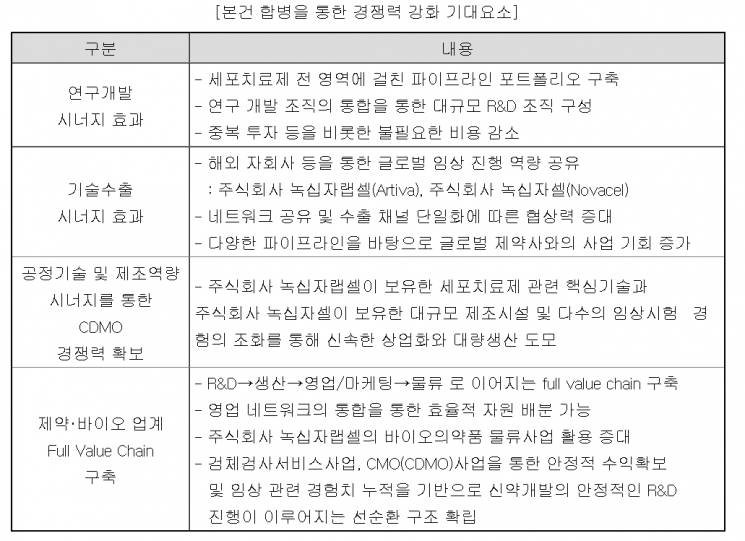
[Asia Economy, Reporter Park Hyungsoo] GC Green Cross is pursuing a merger of its affiliates to secure a leading position in the rapidly growing cell therapy market. The plan is to maximize synergy by merging Green Cross Labcell, which possesses research and development (R&D) capabilities and process technology for cell therapies, with Green Cross Cell, which has manufacturing capabilities. However, as the share prices of Green Cross Labcell and Green Cross Cell are below the stock purchase request price, a significant outflow of cash is expected.
According to the Financial Supervisory Service on August 3, shareholders of Green Cross Labcell and Green Cross Cell who wish to exercise their stock purchase rights must submit their opposition to the merger between August 27 and September 13. The shareholders’ meeting to approve the merger is scheduled for September 13. The stock purchase rights can be exercised between September 13 and October 5. Green Cross explained that if the total amount of shares subject to stock purchase rights exercised by shareholders of Green Cross Labcell or Green Cross Cell exceeds 150 billion KRW, the merger agreement may be canceled. The purchase prices per share are 103,244 KRW for Green Cross Labcell and 41,163 KRW for Green Cross Cell. As of the closing on August 2, Green Cross Labcell and Green Cross Cell shares were trading at 98,500 KRW and 39,700 KRW, respectively.
Green Cross Labcell was established in 2011 through a spin-off, after acquiring the cell therapy business from Green Cross. Green Cross and Green Cross Holdings hold 38.7% and 9.3% stakes, respectively. The core research focus of GC Green Cross Labcell is immune cell therapies utilizing natural killer (NK) cells.
NK cell therapies are emerging as an alternative to address the limitations of chimeric antigen receptor T-cell (CAR-T) therapies, which use autologous cells, including their restricted application range, high treatment costs, and severe side effects. Competition among multinational pharmaceutical companies to secure NK cell therapy pipelines is intensifying. Over the past two years, there has been a series of licensing agreements and mergers and acquisitions (M&A) related to NK cell therapies.
Green Cross Labcell has secured large-scale cultivation and cryopreservation technologies for the commercialization of NK cell therapies. After obtaining umbilical cord blood from a U.S. cord blood bank, it isolates and cultivates master NK cell lines. By stimulating NK cells at specific times with self-developed feeder cells-which secrete substances necessary for NK cell activation and growth-and blood, it is possible to cultivate large quantities of high-purity NK cells in a short period.
Green Cross Cell received product approval for Immuncell-LC as an anti-cancer agent for liver cancer from the Ministry of Food and Drug Safety in 2007. Demand for Immuncell-LC is increasing as adjuvant therapy for patients who have confirmed tumor removal after hepatocellular carcinoma resection. The cell therapy Immuncell-LC has demonstrated, through large-scale Phase 3 clinical trials, its effectiveness in reducing recurrence and increasing survival rates in liver cancer.
Since its approval in Korea, approximately 49,200 packs of Immuncell-LC have been sold cumulatively. Green Cross Cell operates a cell center capable of producing 18,000 packs of Immuncell-LC annually. The company possesses extensive experience and know-how in cell therapy manufacturing.
Heo Hyemin, a researcher at Kiwoom Securities, stated, "Through the merger, it will be possible to utilize both innate immunity NK cells, which provide initial defense, and adaptive immunity T cells, which specifically remember and powerfully eliminate antigens." She added, "This will broaden the application of cell therapies, enabling the elimination of cancer from multiple angles and suppressing recurrence and metastasis."
She continued, "The number of researchers will increase to a level comparable to leading global cell therapy developers," and added, "While the average number of researchers at global companies is about 114, the merged entity will have around 120 researchers."
The likelihood of technology transfer for the pipelines held by the merged entity is also expected to increase. Green Cross Labcell has experience in conducting clinical trials in the United States and transferring technology to Merck through its affiliate Artiva. Green Cross Cell owns Novacell, a subsidiary capable of developing, manufacturing, and distributing products overseas. With these overseas business capabilities, the company is expected to accelerate U.S. market entry and technology transfer for future pipeline developments.
Prior to the merger, GC Green Cross Holdings decided to convert 14 billion KRW worth of Green Cross Cell convertible bonds (CB), acquired through the exercise of a call option in 2019, into common shares. The conversion price is 39,550 KRW, resulting in the acquisition of approximately 354,000 additional shares. Including the existing 588,882 Green Cross Cell shares, the shareholding ratio will rise to 7.23%. For each Green Cross Cell share, 0.4 shares of the merged entity will be allotted.
© The Asia Business Daily(www.asiae.co.kr). All rights reserved.
![Clutching a Stolen Dior Bag, Saying "I Hate Being Poor but Real"... The Grotesque Con of a "Human Knockoff" [Slate]](https://cwcontent.asiae.co.kr/asiaresize/183/2026021902243444107_1771435474.jpg)















