Landlord-affiliated Savings Banks' H1 Net Profit Up 15.3% to 55.7 Billion KRW
Financial Authorities: "Managing Expansion via Regulatory Arbitrage Between Banks and Non-Banks"
Industry: "Must Comply with Authorities' Orders... Growth Difficult in H2"
[Asia Economy Reporter Song Seung-seop] Savings banks under financial holding companies seem unable to smile despite favorable first-half performance. This is because financial authorities are signaling regulations on household loans in the savings bank sector. There are concerns that linked loan operations with affiliated commercial banks may also face setbacks.
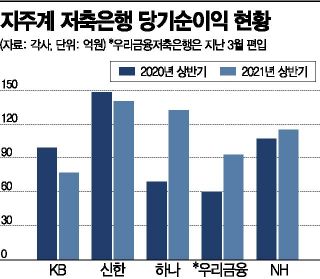
According to the financial industry on the 2nd, the net profit of savings banks owned by the five major financial holding companies?KB, Shinhan, Hana, Woori, and NH Nonghyup?reached 55.7 billion KRW in the first half of this year. This is a 15.3% (7.4 billion KRW) increase from 48.3 billion KRW during the same period last year.
Hana Savings Bank’s net profit during this period increased by 91.3% (6.3 billion KRW) to 13.2 billion KRW. This was the result of actively increasing corporate customer loans in the first half. Woori Financial Savings Bank, incorporated in March, also saw its net profit rise 55% (3.3 billion KRW) from 6 billion KRW to 9.3 billion KRW. NH Savings Bank also saw a slight increase from 10.7 billion KRW to 11.5 billion KRW.
Although KB Savings Bank and Shinhan Savings Bank’s net profits decreased by 22.2% and 5.4% to 7.7 billion KRW and 14 billion KRW respectively, other indicators were generally favorable. KB Savings Bank’s total assets increased by 7.958 trillion KRW (51.3%) to 23.458 trillion KRW compared to 15.5 trillion KRW in the first half of last year. Shinhan Savings Bank’s assets also grew by 25.5% (4.713 trillion KRW) to 23.135 trillion KRW. Return on assets (ROA) and return on equity (ROE) also improved.
Financial Authorities Announce Secondary Financial Regulation... Business Environment in the Second Half 'Gloomy'
Nevertheless, the outlook for the second half is bleak according to views inside and outside the industry. Financial authorities plan to strongly curb the increase in household loans in the secondary financial sector, focusing on savings banks. The Financial Supervisory Service already recommended at the end of May that the savings bank sector limit household loan growth to 21.1%, the same level as last year. On the 28th of last month, Financial Services Commission Chairman Eun Sung-soo personally declared at the Government Seoul Office, "We will thoroughly manage household loans in the secondary financial sector."
In particular, financial authorities have consistently pointed out the regulatory arbitrage of savings banks. Currently, commercial banks face strengthened regulations limiting the Debt Service Ratio (DSR) to 40%, but savings banks still have a 60% limit. If additional funds are needed after obtaining a mortgage loan from a commercial bank, borrowers can borrow more from savings banks. Savings banks under financial holding companies have used this to recruit borrowers in connection with affiliated commercial banks.
Financial authorities perceive this business method as a side effect of the ‘balloon effect.’ Do Gyu-sang, Vice Chairman of the Financial Services Commission, recently warned at the household debt risk management task force (TF), "We are closely monitoring behaviors that attempt external expansion by exploiting regulatory arbitrage between banks and non-banks." Recently, the Financial Supervisory Service has even demanded submission of household debt statistical data, making it inevitable that linked loan operations will face difficulties.
A representative of a holding company-affiliated savings bank said, "We have no choice but to operate in line with the financial authorities’ total volume regulation," adding, "Since the budget related to operations, including advertising expenses, has also been cut, it will be difficult to grow more aggressively than in the first half."
© The Asia Business Daily(www.asiae.co.kr). All rights reserved.
![Clutching a Stolen Dior Bag, Saying "I Hate Being Poor but Real"... The Grotesque Con of a "Human Knockoff" [Slate]](https://cwcontent.asiae.co.kr/asiaresize/183/2026021902243444107_1771435474.jpg)















