[Asia Economy Reporter Kim Heung-soon] U.S. comprehensive semiconductor company Intel has expressed its ambition to surpass leading foundry (semiconductor contract manufacturing) companies such as Taiwan's TSMC and Samsung Electronics within four years. In response, TSMC, under the approval of Taiwanese authorities, has countered by planning to establish a cutting-edge 2-nanometer (nm = one billionth of a meter) chip factory using ultra-fine process technology. Samsung Electronics, which has been focusing on chasing industry leader TSMC, now feels pressured by Intel's aggressive moves as well.
According to industry sources on the 31st, Intel recently unveiled a roadmap to expand its foundry business by 2025 during a technology briefing. Pat Gelsinger, Intel's Chief Executive Officer (CEO), stated that Intel aims to reclaim the top position in the foundry industry by 2025 and introduced semiconductor manufacturing technologies that Intel will develop over the next four years.
Intel Declares the 'Angstrom' Era
Plans Collaboration with Samsung's Major Clients
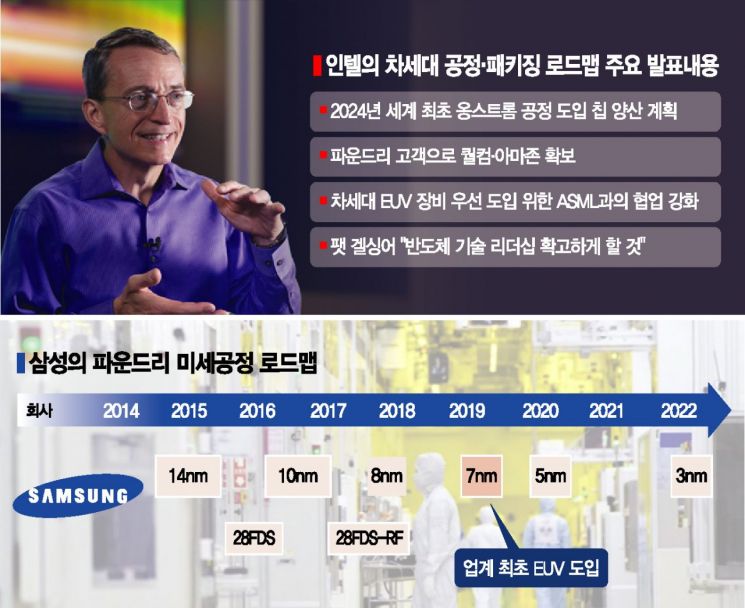
First, Intel announced that it will begin mass production of the world's first Angstrom process, Intel 20A, starting in 2024, and in 2025, it will produce products using the more advanced Intel 18A process. An Angstrom is 0.1 nm in size, and 20A corresponds to the current industry standard 2 nm process. Subsequently, Intel plans to implement an ultra-fine process of 1.8 nm. To achieve this, Intel revealed plans to collaborate with Dutch semiconductor equipment manufacturer ASML to introduce next-generation extreme ultraviolet (EUV) lithography equipment ahead of others.
Intel also introduced that it will collaborate with Qualcomm, a major client of Samsung Electronics, using the 20A process technology. Qualcomm is a U.S.-based fabless company specializing in semiconductor design and is the world's number one in this field. Additionally, Intel mentioned that it has attracted Amazon as a client in the packaging (semiconductor post-processing) sector.
Furthermore, Intel decided to change its product naming system to compete with marketing methods of companies like TSMC and Samsung Electronics. This decision was made based on the judgment that Intel's product competitiveness suffered due to leading competitors naming their products differently from Intel's approach.
TSMC Responds Within a Day
Samsung Electronics Under Pressure
Just one day after Intel announced its intention to take the lead in chip production, on the 28th, foreign media reported that Taiwanese authorities approved TSMC's plan to establish a 2 nm chip factory. This opens the way to start construction early next year and begin installing production facilities by 2023. This can be seen as a counterattack to Intel's declaration of pursuing ultra-fine process technology below 2 nm.
This development poses a threat to Samsung Electronics, which is seeking to expand its market share in the foundry market based on advanced process competitiveness. Both competitors are receiving full support from their respective governments, adding to the pressure. Intel, following support from the U.S. Biden administration, is currently discussing subsidies with the European Union (EU) for building semiconductor factories in Europe.
Samsung Electronics is currently experiencing delays in related investments such as new and expanded semiconductor factories in the U.S., compounded by the absence of its top executive. Samsung Electronics Vice Chairman Lee Jae-yong, who is currently imprisoned, met the parole eligibility requirement of over 60% of his total sentence as of the 26th and is reportedly included in the list for parole review scheduled by the Ministry of Justice on August 15. In the business community, voices are emerging that a pardon, rather than parole, is necessary to allow him to actively engage in management activities without restrictions such as overseas travel.
An industry insider commented, "If Intel enters the competition with ultra-fine process technology, it can receive support from domestic fabless companies that account for more than 50% of the global market, which could affect Samsung Electronics' market share." The insider added, "Samsung Electronics also needs bold investment and swift execution to avoid falling behind in the leadership competition between TSMC and Intel."
© The Asia Business Daily(www.asiae.co.kr). All rights reserved.
![Clutching a Stolen Dior Bag, Saying "I Hate Being Poor but Real"... The Grotesque Con of a "Human Knockoff" [Slate]](https://cwcontent.asiae.co.kr/asiaresize/183/2026021902243444107_1771435474.jpg)
















