Korea Transportation Safety Authority Introduces Car Self-Inspection Methods to Check Before Long-Distance Travel
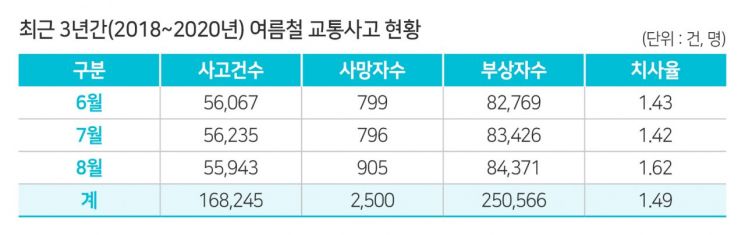
[Asia Economy Reporter Kangwook Cho] Over the past three years, the fatality rate of traffic accidents (number of deaths per 100 traffic accidents) during the month of August has been higher than that of the entire summer season.
According to an analysis by the Korea Transportation Safety Authority of summer traffic accidents over the past three years, the fatality rate in August was 1.62 deaths, approximately 8.7% higher than the overall summer period rate of 1.49 deaths.
The average number of daily traffic accidents in August was about 602, resulting in 10 deaths and 907 injuries.
Especially this summer, with the ongoing heatwave, if you are planning long-distance trips such as car camping or camping, vehicle inspection and safe driving are not optional but essential.
Accordingly, the Authority introduced a self-inspection method for vehicles for travelers using private cars during the peak summer vacation season and urged the practice of safe driving.
During heatwaves, to ensure vehicle safety, it is necessary to check the air conditioner, coolant, brake oil, tires, and other components before departure.
During long-distance travel, as the time spent inside the vehicle increases, the air quality inside the vehicle deteriorates, and moisture and dust caused by temperature differences inside and outside the vehicle create an environment for mold growth, leading to unpleasant odors.
Turning off the air conditioner and allowing only air intake 2 to 3 minutes before arriving at the destination helps evaporate moisture and prevent bacterial growth. It is recommended to replace the air conditioner filter once or twice a year.
Coolant is a liquid that cools the engine's heat. If the amount is below the standard or the coolant circulation system does not operate smoothly, overheating symptoms may occur.
Overheating is a condition where the engine becomes excessively hot, which can cause serious damage to the car engine. To prevent this, check the coolant level before departure.
Also, frequent brake use due to traffic congestion during the vacation season generates friction heat, which can cause vapor lock, making normal braking difficult. Vapor lock occurs when brake fluid containing moisture boils, creating bubbles in the brake line, preventing hydraulic pressure from being properly transmitted even when the pedal is pressed.
To prevent this, brake oil should be replaced (or inspected) every 2 years or every 40,000 km driven. Especially when driving on long downhill slopes, it is advisable to use a low gear (engine brake).
Tires are also greatly affected by heat, and heat generated by friction with the road surface increases the likelihood of tire wear and deformation.
To cool the tires, it is recommended to take a 10-minute break every 2 hours of driving, and inflating tires about 10% more during highway driving can also help.
In preparation for typhoons and heavy rain, tires, wipers, and lighting devices should also be inspected.
If water does not drain between the tires and the road, hydroplaning can occur, causing the vehicle to skid and fail to stop at the desired location during braking, which may lead to accidents. Therefore, tire tread depth should be maintained at 1.6mm or more.
The braking distance can differ by up to 1.7 times depending on tire wear, so tires should be replaced if wear is severe. On rainy roads, reduce speed by 20% compared to normal and maintain a safe distance between vehicles at least twice as much to ensure safety.
If the windshield wipers are worn out or malfunctioning, it can cause significant visibility problems.
To prevent this, it is necessary to check whether the wipers operate normally. This can be confirmed by spraying washer fluid and checking if streaks remain or if the windshield is cleaned well.
During heavy rain at night, visibility is more difficult than during the day, so before departure, check the operation of headlights, hazard lights, side marker lights, and tail lights to ensure safety.
An official from the Authority stated, “This summer continues with scorching heat above 30°C, and accidents sometimes occur due to high temperatures inside enclosed vehicles, so it is necessary to check not only the vehicle’s condition but also the temperature inside the vehicle.” He added, “Leaving children inside a vehicle even briefly during a heatwave is strictly prohibited, and caution is needed as carbonated drinks or lighters can explode due to increased pressure from the hot vehicle interior.”
© The Asia Business Daily(www.asiae.co.kr). All rights reserved.
![Clutching a Stolen Dior Bag, Saying "I Hate Being Poor but Real"... The Grotesque Con of a "Human Knockoff" [Slate]](https://cwcontent.asiae.co.kr/asiaresize/183/2026021902243444107_1771435474.jpg)















