BOK: "During the 1st to 3rd COVID-19 waves, consumption dropped by over 20%"
Reviving private consumption faces inevitable shock in Q3
Consumption patterns adapt to COVID-19... E-commerce increases
COVID-19 affected industries narrow, rise in non-face-to-face consumption is positive
[Asia Economy, Reporter Kim Eunbyeol] Since the beginning of this month, with corporate sentiment declining following consumption, the possibility of economic contraction due to the 4th wave of COVID-19 is increasing. Thanks to export and domestic demand recovery until the first half of this year, the pace of economic recovery was faster than expected, but the impact of the COVID-19 resurgence lends credibility to analyses that the pattern of the 1st to 3rd COVID-19 waves since last year will be repeated. As the COVID-19 pandemic shows a trend of increasing confirmed cases and longer durations over time, there are calls for policies that support affected industries while enabling coexistence with COVID-19.
BOK: "During the 1st to 3rd waves, consumption dropped by over 20%"
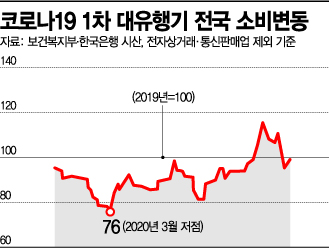
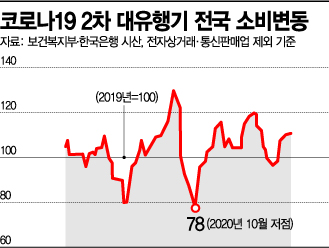
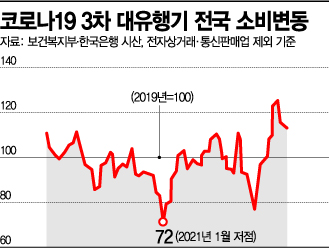
According to the Bank of Korea (BOK) on the 30th, analysis of economic indicator patterns from last year through early this year after the COVID-19 pandemic revealed a common phenomenon of ‘decline in sentiment indicators → consumption shock.’ Nationwide consumption dropped by more than 20% during the pandemic periods.
This was confirmed in the report titled ‘Key Characteristics of Consumption Changes by COVID-19 Spread Stages in the Busan Region’ by BOK researchers Cha Jun-yeol and Cho Soo-hyun, released on the 30th. Using 2019 consumption levels as 100, the nationwide consumption low point during the 1st wave (February 18 to May 5, 2020) fell to 76. Consumption dropped by more than 20% compared to pre-COVID-19 levels during the 1st wave. The low point during the 2nd wave (August 12 to November 12, 2020) was 78, and during the 3rd wave (November 13, 2020 to February 28, 2021), it plunged to 72. Consumption decline was led by sectors vulnerable to infectious diseases such as face-to-face services, outing-related goods, and large retail stores. The decrease was especially significant in travel and transportation, accommodation and food services, and culture and entertainment.
Considering past trends, it is inferred that private consumption in the third quarter of this year, when the 4th wave is fully underway, is likely to slow due to strengthened social distancing measures. Park Yang-su, Director of the Economic Statistics Bureau at BOK, said at a press briefing after the Q2 GDP announcement, "So far, it aligns with the initial growth forecast," but added, "The future path will be determined by how the 4th wave of COVID-19 unfolds."

Consumption Patterns Adapt to COVID-19... E-commerce Increases
However, it was also commonly observed that the range of affected industries has been narrowing as the COVID-19 pandemic continues. This is why the government and BOK expect the consumption shock to be less severe than in previous waves. A BOK official said, "During the 1st wave, public fear was high, leading to almost complete avoidance of external activities including lodging, restaurants, beauty salons, and academies, resulting in a rapid consumption shock." He added, "But recently, even with record-high confirmed cases, most people are observed to continue activities while wearing masks." Except for the food and accommodation sectors, most consumption shocks are expected to be less severe compared to the 1st to 3rd waves. Consumption patterns have shifted from dining out to groceries, and from outings to furniture and interior goods.
The method of generating sales online is also a clear change in industries after COVID-19. Education consumption sharply declined during the 1st wave but maintained pre-crisis levels from the 2nd wave onward. Researcher Cha stated, "Economic agents may have adapted institutionally, technologically, and psychologically to the infectious disease crisis, reducing vulnerability in education consumption." According to the Ministry of Education, the proportion of real-time interactive remote classes rose from 14.8% in the first semester of last year to 55.7% in the second semester, and further to 77.6% in the first semester of this year.
However, even with consumption recovery, the speed varied by industry. The researchers noted that in the Busan region, outing-related goods consumption and face-to-face services experienced significant shocks but recovered to pre-crisis levels in the late stage. In contrast, face-to-face consumption remained below pre-crisis levels until the end of the pandemic period. Particularly, travel and transportation stayed more than 10% below pre-crisis levels throughout the pandemic. This indicates that the persistence of shocks differed by industry.
As the COVID-19 situation is expected to continue, there are calls for the government to provide precise support to affected industries and help adapt to the ‘With COVID’ era. Researcher Cha advised, "As seen in education, it is desirable to assist transitions to non-face-to-face industries to reduce consumption sensitivity to infectious diseases in the mid to long term." He cited improving online platform accessibility for offline-centered small business owners and SMEs as a representative example of supporting entry into e-commerce.
© The Asia Business Daily(www.asiae.co.kr). All rights reserved.



















