35% Allocation to Individuals
Market Cap 33 Trillion Won Despite Stock Price Drop...Overvaluation Controversy
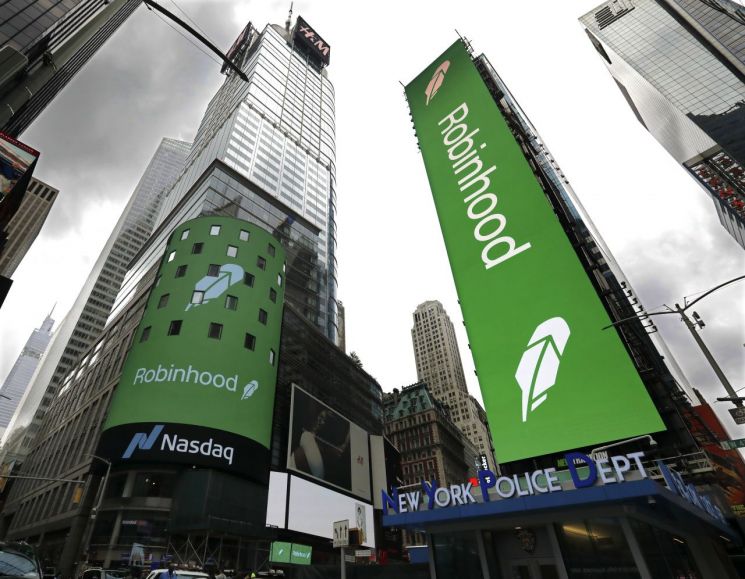
[Asia Economy New York=Special Correspondent Baek Jong-min] Robinhood, the securities trading app that led the boom in stock investment among individual investors in the U.S., lost face in its first trading session after going public.
On the 29th (local time), Robinhood, which started trading at the IPO price of $38 on the Nasdaq market, closed down 8.37% at $34.82. At one point during the session, Robinhood's stock price dropped as much as 10%. Individual investors who bought Robinhood shares with high expectations suffered immediate losses.
Unlike a typical initial public offering (IPO), Robinhood allocated 35% of the newly issued shares to its users. U.S. companies usually allocate shares only to institutional investors during an IPO, so this was a contrasting choice.
Vladimir Tenev, co-founder of Robinhood, said, "It’s fantastic to be going public after six years," but the market reaction leaned more toward skepticism than favor.
Robinhood’s lackluster performance was anticipated even in the pricing of the IPO. The IPO price was set at the bottom of the expected range of $38 to $42, at $38. This was interpreted as a sign that investor demand was not strong.
The decline in Robinhood’s stock price is unusual even amid this year’s U.S. stock market IPO boom. Bloomberg reported that Robinhood, which raised $2.1 billion, had the weakest start among 51 companies that conducted IPOs of larger scale.
The Wall Street Journal noted that Facebook, which allocated 25% of shares to individuals during its IPO, also saw its stock price plunge immediately after listing and took a year to recover its IPO price.
Conflicts arising from Robinhood’s restrictions on individual investors’ trading during the early-year surge in GameStop stock and regulatory concerns over its business model of generating revenue by selling customers’ trading data are also considered risk factors.
Despite the stock price decline, Robinhood’s market capitalization reached $29 billion (33 trillion won). CNN reported that Robinhood recorded a higher corporate value than major companies such as Nasdaq, Southwest Airlines, and Kroger.
© The Asia Business Daily(www.asiae.co.kr). All rights reserved.
![Clutching a Stolen Dior Bag, Saying "I Hate Being Poor but Real"... The Grotesque Con of a "Human Knockoff" [Slate]](https://cwcontent.asiae.co.kr/asiaresize/183/2026021902243444107_1771435474.jpg)











