Real Estate Board Survey: Fourth Week of July, Capital Region at 0.36% Same as Last Week
Capital Region Jeonse Prices Rise from 0.25% to 0.28%
Seoul Jeonse Prices Record Highest Increase in One Year
[Asia Economy Reporter Jo Gang-wook] Despite the government's repeated 'peak warnings,' the nationwide apartment prices continue to rise. In the metropolitan area, the level remained the same as last week, which was the highest in nine years. Meanwhile, jeonse prices surged sharply due to reconstruction relocation demand combined with the moving season during school vacations, recording the highest increase rate in a year.
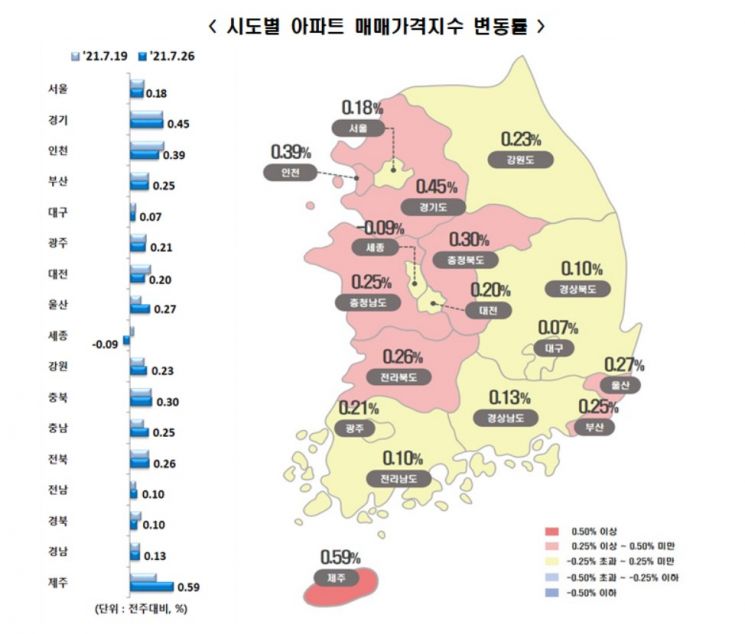
The Korea Real Estate Board announced on the 29th that the nationwide apartment sale prices rose by 0.27% in the fourth week of July (as of the 26th), maintaining the same rate of increase as the previous week.
By region, apartment prices in the metropolitan area increased by 0.36%, matching last week's highest rise in nine years and two months since the Korea Real Estate Board began compiling weekly statistics in May 2012.
An official from the Korea Real Estate Board explained, "Despite a slowdown in transaction activities due to strengthened social distancing, continued heatwaves, and the arrival of the vacation season, prices rose due to demand for gap-filling in reconstruction complexes with redevelopment expectations and mid-to-low priced complexes."
In the metropolitan area, Seoul's price increase slightly decreased from 0.19% last week to 0.18% this week.
Gyeonggi Province saw an increase from 0.44% to 0.45%, while Incheon decreased from 0.46% to 0.39%.
Seoul apartment prices were driven by the 'Nodogang' area, as in the previous week. Nowon-gu maintained the highest increase in Seoul for 16 consecutive weeks with a 0.35% rise, the same as last week. Dobong-gu slightly decreased from 0.27% to 0.26%, and Gangbuk-gu from 0.18% to 0.17%.
Nowon-gu's rise was centered on small to medium-sized units in Sanggye, Hagye, and Gongneung-dong, where redevelopment expectations and undervaluation perceptions exist. Dobong-gu's increase was mainly in Chang and Ssangmun-dong, Jungnang-gu (0.19%) rose mainly in mid-to-low priced areas like Myeonmok and Sangbong-dong, and Mapo-gu (0.16%) increased mainly in Seongsan and Yonggang-dong.
The Gangnam 3 districts also led the overall housing price increase, centered on reconstruction complexes. Seocho-gu (0.19%) rose mainly in new buildings in Banpo-dong and reconstruction in Seocho-dong, Gangnam-gu (0.19%) in reconstruction complexes in Apgujeong and Daechi-dong, Songpa-gu (0.18%) in reconstruction complexes in Sincheon and Bangi-dong and popular complexes in Jamsil-dong, and Gangdong-gu (0.16%) mainly in Godeok, Amsa, and Myeongil-dong.
Additionally, Yeongdeungpo-gu (0.21%) rose mainly in Dangsan and Mullae-dong, and Gangseo-gu (0.21%) increased mainly in Magok district and mid-to-low priced areas in Banghwa and Gayang-dong.
In Gyeonggi Province, Gunpo-si (0.89%) rose mainly in newly built or semi-new buildings in Daeyami-dong, Osan-si (0.89%) in Jigot and Nueup-dong, Anseong-si (0.85%) in complexes priced below 100 million KRW, Anyang Dongan-gu (0.80%) in areas with good living conditions like Gwanyang and Bisan-dong, and Ansan Danwon-gu (0.75%) mainly in Seonbu-dong with reconstruction expectations.
In Incheon, areas with expectations for transportation improvements such as Ongnyeon and Cheonghak-dong rose, Seo-gu (0.45%) increased mainly in Gyeongseo, Geumgok, and Cheongna-dong with development prospects, Bupyeong-gu (0.42%) in Ilsin and Cheongcheon-dong, and Gyeyang-gu (0.34%) mainly in Dongyang and Gyulhyeon-dong with expectations for the 3rd new town development.
Among provincial metropolitan cities, Ulsan (0.15%→0.27%) increased its rise compared to the previous week, while Daejeon (0.28%→0.20%), Gwangju (0.22%→0.21%), and Daegu (0.08%→0.07%) saw a decrease in the rate of increase. Busan (0.25%→0.25%) remained flat.
Seoul's apartment jeonse prices rose by 0.16%, increasing the rate of rise compared to last week (0.15%). This is the highest increase rate in about a year since the first week of August last year (0.17%), right after the new lease law was implemented.
Yangcheon-gu, which has the Mokdong school district, recorded the highest increase rate, expanding from 0.24% to 0.29%. It was followed by Nowon, Dongjak, Seocho-gu (0.23%), Songpa-gu (0.22%), Gwanak-gu (0.21%), and Yeongdeungpo-gu (0.18%).
Jeonse prices in the metropolitan area also increased from 0.25% to 0.28%, marking the highest rise in six years and three months since the third week of April 2015 (0.30%).
Gyeonggi Province expanded its rise from 0.29% to 0.35%, mainly in mid-to-low priced apartments in Siheung-si (0.82%), Gunpo-si (0.65%), and Pyeongtaek-si (0.62%). On the other hand, Seongnam Bundang-gu (-0.12%→-0.17%) saw a wider decline due to the move-in effect in Pangyo Daechang district.
Incheon reduced its rise from 0.35% to 0.29%. Daejeon (0.27%→0.29%), Ulsan (0.17%→0.26%), and Busan (0.13%→0.19%) expanded their rise, while Daegu (0.09%→0.07%) and Gwangju (0.14%→0.12%) saw a decrease. Sejong City saw a wider decline from -0.03% to -0.09% due to an increase in new move-in volumes.
The Korea Real Estate Board stated, "Due to the withdrawal of the two-year residency requirement for reconstruction, some areas in Seoul saw an increase in listings, maintaining or reducing the rate of price increase. However, in other regions, jeonse prices rose sharply due to moving demand during the vacation season and a decrease in newly completed housing supply."
© The Asia Business Daily(www.asiae.co.kr). All rights reserved.
![Clutching a Stolen Dior Bag, Saying "I Hate Being Poor but Real"... The Grotesque Con of a "Human Knockoff" [Slate]](https://cwcontent.asiae.co.kr/asiaresize/183/2026021902243444107_1771435474.jpg)















