Powell "Knows How to Handle Delta Variant, Limited Impact on US Economy"
Tapering Condition Set on Employment Recovery
Simultaneous Reduction of Treasury and MBS Purchases Expected
Government and Bank of Korea "Market Impact Limited"
Prepared for Risks of Early Implementation Concerns
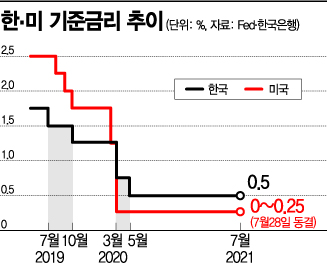
[Asia Economy New York=Correspondent Baek Jong-min, Reporter Jang Se-hee] The U.S. Federal Reserve (Fed) has finally signaled an exit from the emergency monetary policies introduced to overcome COVID-19. While the dominant expectation is that tapering (reduction of asset purchases) will be implemented in January next year, some even predict an announcement as early as September. This situation is analyzed as reflecting the fact that the U.S. economy is recovering rapidly despite the spread of the COVID-19 Delta variant.
Our government and the Bank of Korea have assessed that the risks from the Fed’s policy shift are not significant, but have begun seeking countermeasures for potential impacts on our financial markets and household debt.
◆ Powell: "Delta variant impact is not significant"= Fed Chair Powell emphasized on the 28th (local time) during a press conference that the Delta variant’s impact on the U.S. economy is not significant. He stated, "There have been waves of COVID-19 spread over the past year and a few months, but the impact on the economy has diminished," and added, "It seems we have learned how to deal with it (the virus)."
This aligns with the earlier Fed statement that "substantial further progress toward the goals for tapering decisions has been made," which was interpreted as the Fed’s optimism about the U.S. economic recovery. Regarding this, the Associated Press reported that "the Fed dismissed concerns about the spread of the Delta variant."
Powell’s condition for tapering is employment recovery. While the June Consumer Price Index (CPI) rose by as much as 5.4%, sustaining inflation concerns, employment recovery remains slow.
Most local investment banks predicted a December announcement of tapering with implementation in January next year based on the statement and Powell’s press conference, but there are differing opinions. Some suggested that tapering could be announced in November. Citigroup analyzed that the phrase "coming meetings" in the statement was used in the past when decisions were made quickly, warning that "tapering could be announced at the September FOMC meeting."
Regarding the method of tapering, some guidelines have emerged despite timing uncertainties. Powell revealed that there is low support among committee members for reducing mortgage-backed securities (MBS) purchases before Treasury securities. This indicates a preference for reducing Treasury and MBS purchases simultaneously rather than cutting MBS purchases first, which have been criticized for driving up real estate prices.
Powell also said, "Once the tapering decision is made, the pace could accelerate," hinting at a possibility of a swift end to asset purchases rather than gradual easing.
The Fed took 10 months to end asset purchases in 2014 and raised interest rates 14 months after ending asset purchases. Based on this, an interest rate hike could be expected around 2023. The Fed officials’ dot plot from June also forecasted rate hikes in 2023.
◆ "In line with expectations... Preparing for early implementation"= The government and the Bank of Korea evaluated the Fed’s tapering discussions as having "limited market impact," but cautioned to "pay attention to financial imbalance risks given concerns about early implementation." On the 29th, Lee Eok-won, First Vice Minister of Strategy and Finance, held a macroeconomic and financial meeting at the Seoul Banking Hall and said, "The FOMC results largely align with market expectations."
However, the government is focusing on the possibility that if the U.S. implements tapering within this year, the timing of interest rate hikes could be brought forward. This is because the deepening of domestic financial imbalances could emerge as another risk. Vice Minister Lee specifically mentioned household debt, stating, "We will check whether each financial institution complies with their household loan operation plans and introduce countercyclical capital buffers for the household sector in the fourth quarter" as a response measure.
The Bank of Korea also held a situation review meeting chaired by Deputy Governor Lee Seung-heon on the same day and assessed the results as consistent with market expectations. The Bank of Korea’s New York office conveyed Wall Street’s reaction, including that "tapering could be officially announced in September."
Experts believe that South Korea can proceed with the planned interest rate hikes in the second half of the year. Professor Ahn Dong-hyun of Seoul National University’s Department of Economics said, "When raising rates, there tends to be a decision based on the pace of economic recovery in each country," adding, "If inflation intensifies in the U.S., it could exert upward pressure on interest rates."
© The Asia Business Daily(www.asiae.co.kr). All rights reserved.
![Clutching a Stolen Dior Bag, Saying "I Hate Being Poor but Real"... The Grotesque Con of a "Human Knockoff" [Slate]](https://cwcontent.asiae.co.kr/asiaresize/183/2026021902243444107_1771435474.jpg)















