Ministry of Employment Announces Legislative Notice on 'Enforcement Decree and Enforcement Rules of the Labor Standards Act'
Victim Protection Missing in Internal Fact-Finding Investigation Period
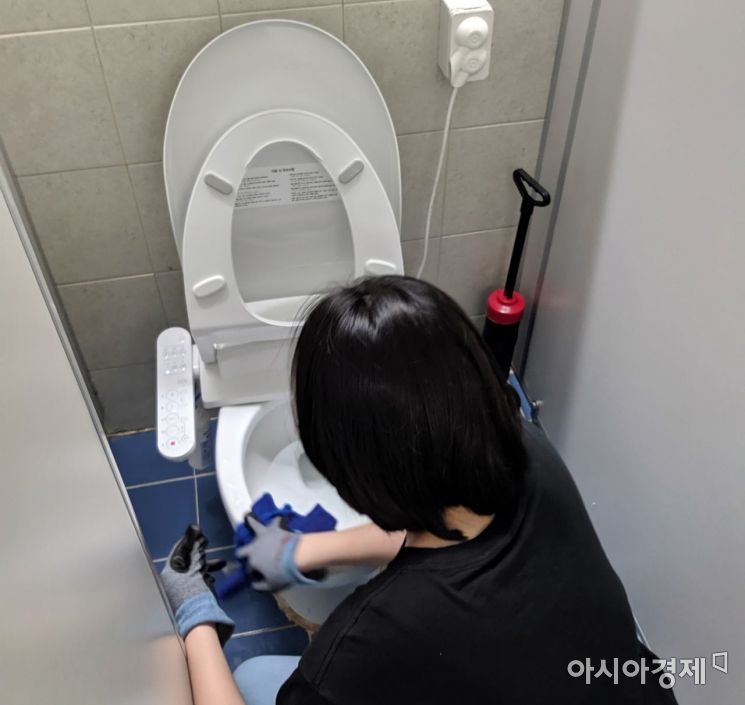
[Sejong=Asia Economy Reporter Moon Chaeseok] From now on, business owners and their relatives found guilty of workplace harassment will have to pay fines of up to 10 million KRW. The government has announced a legislative notice for the amended law amid social controversies, including cases where workers at major companies have taken extreme measures due to workplace harassment. However, provisions such as protecting workers within the reporting period were excluded from the fine imposition as they are not delegated to enforcement ordinances in the law.
The Ministry of Employment and Labor announced on the 29th that it will issue a legislative notice for the "Enforcement Decree and Enforcement Rules of the Labor Standards Act," which includes the regulatory system for workplace harassment, until September 7. This announcement refines the detailed matters delegated to the enforcement decree so that the law can be applied from October 14, six months after the law was amended on April 14.
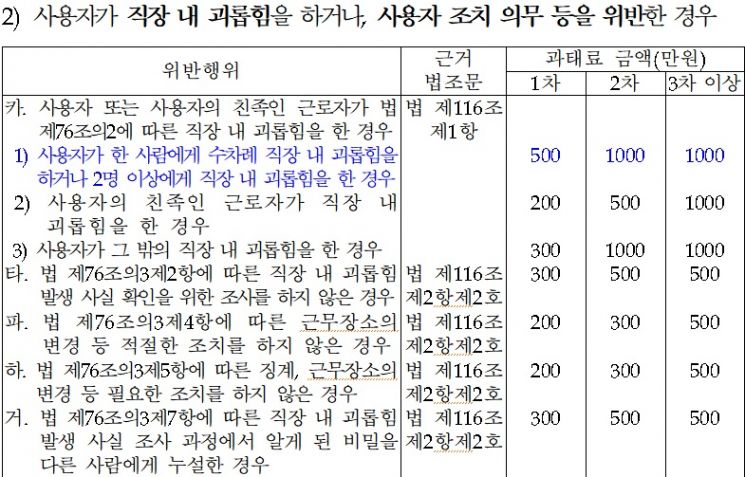
The core point is that fines have been established based on the number of violations when business owners, their spouses, blood relatives within the eighth degree, or relatives within the fourth degree commit workplace harassment and are caught. If an employer harasses one person multiple times or two or more people, fines of 5 million KRW (first violation), 10 million KRW (second violation), and 10 million KRW (third or more violations) will be imposed. If a relative of the employer harasses a worker, fines of 2 million KRW, 5 million KRW, and 10 million KRW will be imposed respectively.
When aware of workplace harassment, employers are obligated to take action, and failure to comply will also result in fines. If a fact-finding investigation is not conducted, fines of 3 million KRW, 5 million KRW, and 5 million KRW will be imposed, and if disciplinary actions or changes in work location are not taken, fines of 2 million KRW, 3 million KRW, and 5 million KRW will be imposed respectively.
Additionally, from November 19, fines will be imposed differentially based on the number of violations for ▲failure to provide wage statements ▲refusal to change work hours for pregnant workers, among others.
For pregnant workers, the total prescribed daily working hours (fixed daily working hours) must be maintained, but they can apply for adjustments to working hours for safety reasons. For example, changing commuting times from "9 AM to 5 PM" to "11 AM to 7 PM" to reduce contact in crowded areas is allowed. Exceptions allowing employers to change the working hours of pregnant workers are limited to ▲cases causing significant disruption to normal business operations ▲cases where there is a significant risk to the safety and health of the pregnant worker. If the employer refuses a pregnant worker's request to change working hours without these exceptions, a fine will be imposed.
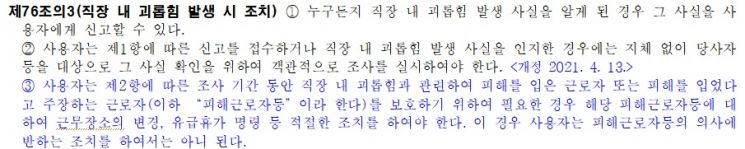 Provisions of the Labor Standards Act. (Source: Legislation Research Institute, National Law Information Center)
Although strengthened regulations on workplace harassment have been established, dissatisfaction remains in the labor sector. The provision in Article 76-3, Paragraph 3 of the Labor Standards Act, which mandates measures such as changing the work location or ordering paid leave for the victimized worker during internal investigations, was not included in this amendment. In other words, there is no regulatory system for the government to enforce such measures during workplace harassment investigations.
Aside from the enforcement decree amendment, complaints persist regarding the chronic blind spot in the Labor Standards Act concerning the protection of workers in workplaces with fewer than five employees. Workers in workplaces with fewer than five employees are not recognized as workers under Article 11 of the Labor Standards Act. In cases of workplace harassment in such workplaces, the only remedy is to report to the local labor office. However, since this is not a legal matter, the Ministry of Employment and Labor has no authority to issue corrective orders to employers and often resorts only to verbal guidance.
A worker A at a logistics company with three employees in the Chungcheong region said, "Not only do I suffer workplace harassment such as verbal abuse while working, but wages are often delayed by 2-3 days from the payment date, and weekend overtime for business meetings and drinking gatherings is frequent," adding, "Verbal guidance from the government has no effect, so I hope the Labor Standards Act is amended soon to apply to workplaces with one or more employees."
 Provisions of the Labor Standards Act. (Source: Legislation Research Institute, National Law Information Center)
Additionally, workers in workplaces with fewer than five employees are excluded from protections under laws such as substitute holidays, the Serious Accidents Punishment Act, and paid vaccine leave. Regarding this, Minister of Employment and Labor Ahn Kyung-duk stated at a press conference on the 30th of last month, "I think it is now time to consider applying the Labor Standards Act to workplaces with fewer than five employees."
According to the latest data from the 2019 Statistics Korea Survey on Business Labor Conditions, there are 2,146,000 workplaces with one or more employees and 18,744,000 workers. Among these, workplaces with fewer than five employees account for 1,320,000 (61.5%), and workers number 3,565,000 (19%). This means that one in five Korean workers is left in a labor law blind spot.
© The Asia Business Daily(www.asiae.co.kr). All rights reserved.
![Clutching a Stolen Dior Bag, Saying "I Hate Being Poor but Real"... The Grotesque Con of a "Human Knockoff" [Slate]](https://cwcontent.asiae.co.kr/asiaresize/183/2026021902243444107_1771435474.jpg)

















