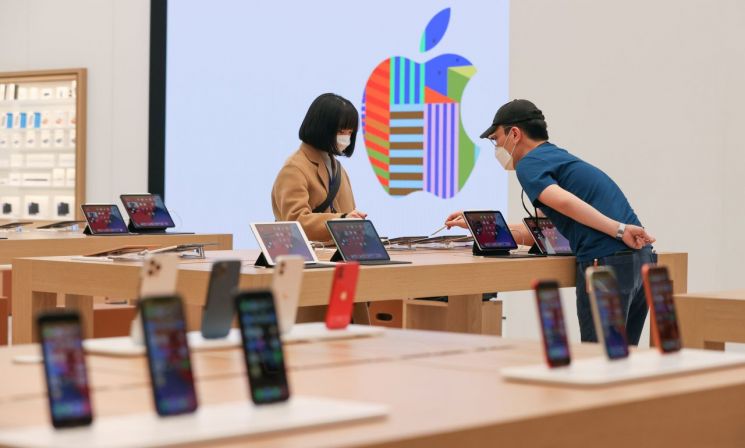
[Asia Economy Reporter Joselgina] Apple is accelerating its push into the Korean market, which is virtually considered "Samsung Electronics' home turf." Following its partnership with LG Electronics, which is officially withdrawing from the smartphone business, Apple is also preparing to open its third Apple Store in Korea. The company is rapidly expanding its own distribution network, previously seen as a weakness, aiming to fill the void left by LG Electronics. It is expected that the competitive landscape between Samsung Electronics and Apple in the domestic smartphone market will become clearer going forward.
◆Hiring Ahead of '3rd Store' Launch in Myeongdong
According to industry sources on the 28th, Apple Korea posted 12 job openings on the 27th for positions including Apple retail managers, senior managers, and store leaders.
Except for one, all positions are in the retail sector. These include store managers, specialists supporting store operations, and creatives who run educational programs. The job postings specify the work location as "Seoul, South Korea," indicating that these hires are likely for the third Apple Store currently being prepared for opening.
The Apple Store, a symbol of Apple and a landmark in each region, is not just a place to sell products but a flagship store where consumers can directly experience and interact with Apple products. In Korea, the first Apple Store, "Apple Garosugil," opened in late January 2018 in Sinsa-dong, Seoul, followed by the second store, "Apple Yeouido," which opened earlier this year.
The third Apple Store will be located in the Myeongdong Centerpoint Building, opposite the main branch of Lotte Department Store in Sogong-dong, Jung-gu, Seoul. The building is scheduled for completion on the 31st of next month. Considering the interior work period, the store is expected to open as early as this year or by early next year at the latest. It is also known that Apple is preparing a fourth store in Busan following Myeongdong. Additional hiring is expected to continue thereafter.
◆iPhone Sales at LG Best Shop... Expanding Distribution Network
Apple is intensifying efforts to expand its offline distribution network in Korea. Starting as early as next month, Apple iPhones are expected to be sold at LG Best Shop stores. After LG Electronics announced its withdrawal from the smartphone business, Apple has been steadily courting LG Best Shop, which operates over 400 stores nationwide, as a sales channel. Although resistance from small and medium-sized distributors had been an obstacle, this was resolved through a new win-win agreement.
On this day, the Korea Commission for Corporate Partnership confirmed that it recently signed a "win-win agreement for the sale of communication devices between large and small-medium enterprises" with the National Mobile Communication Distribution Association and Hi Plaza, the operator of LG Best Shop. Hi Plaza will sell other companies' mobile phones but will gradually expand sales while protecting the business areas of small and medium-sized enterprises and considering market conditions.
An LG Electronics official said, "Initially, sales will start at less than half of the stores, and the number of sales stores will be increased through mutual consultation," adding, "The timing for iPhone sales is expected to be around mid-next month, considering employee training."
This move is interpreted as an effort to expand Apple's offline distribution network in Korea, which has been considered a weakness. Industry insiders also analyze that after LG Electronics' withdrawal from the smartphone business, the company can strengthen its close relationship with Apple, a customer for displays and batteries.
◆Changed Apple Aiming for LG Phone's Vacant Spot
Apple, which once faced controversy over neglecting Korea, is now focusing on securing market share domestically, especially after launching its first 5G iPhone, the "iPhone 12," last year. This is interpreted as targeting the 5G smartphone market, which is expected to grow significantly.
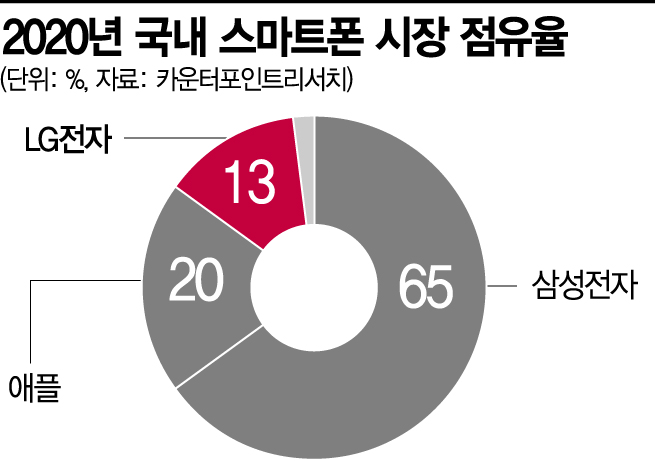
In the Korean market, known as the "graveyard of foreign phones," Apple is the only foreign company holding double-digit market share. If Apple captures the market share of LG Electronics, which is withdrawing from the smartphone business, it could set up a competitive landscape with Samsung Electronics. According to Counterpoint Research, last year’s domestic smartphone market share was Samsung Electronics (65%), Apple (20%), and LG Electronics (13%).
Apple’s earlier announcement of a program offering compensation for returning used LG smartphones in Korea and the U.S., where LG has a high market share, is also in the same context. An industry insider said, "Apple is aiming to fill LG Electronics' vacant spot," adding, "Apple's offensive against Samsung Electronics is expected to intensify domestically."
Samsung Electronics has not shown any particular reaction to the cooperation between LG Electronics and Apple but is visibly tense. Although it is analyzed that more demand will shift to Galaxy, which uses the same Android operating system, Apple’s aggressive moves could impact not only the smartphone market but also the overall home appliance market structure.
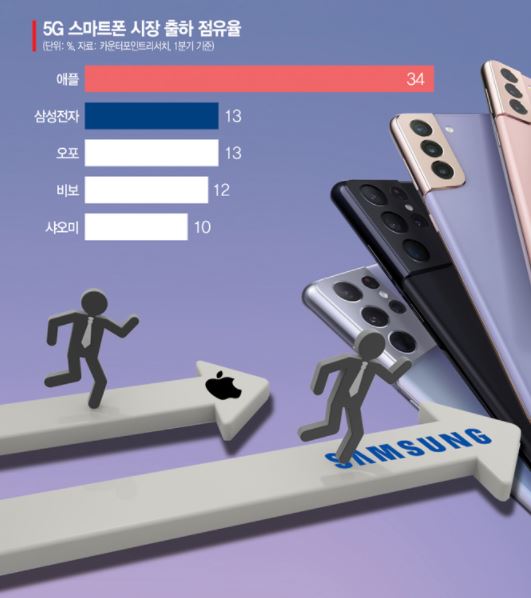
It is also painful for Samsung Electronics that it lost the global 5G smartphone market leadership to Apple after the launch of the iPhone 12.
Recently, the global smartphone market has rapidly shifted to 5G models. According to Counterpoint Research, in the first quarter, 5G smartphones accounted for 69% of total sales revenue in the global smartphone market. In terms of shipment volume, they accounted for 39%. Considering that in the first quarter of 2020, 5G smartphones accounted for only 17% of sales revenue and 7% of shipment volume, this is a rapid growth trend.
Apple ranked first in both sales revenue and shipment volume in the 5G smartphone market in the first quarter of this year. Apple's 5G smartphone market share in the first quarter was 34% by shipment volume and 53% by sales revenue. Samsung Electronics trailed significantly with 13% and 14%, respectively. Another industry insider emphasized the significance of the Korean market, saying, "Globally, 5G services are still limited, and Korea, as the first country to commercialize 5G with well-established infrastructure, is an important market for securing 5G leadership."
© The Asia Business Daily(www.asiae.co.kr). All rights reserved.



















