Announcement of Protection and Management Measures for Foreign Students in the 2nd Semester
14 Days Self-Quarantine, 3 PCR Tests Required
Encouraging Delayed Entry with Remote Classes in Home Country
[Asia Economy Reporter Han Jinju] The Ministry of Education will encourage foreign students coming from countries with variant virus outbreaks to enter the country after 70% of the entire population has received the first dose of vaccination in the second semester. Foreign students arriving from other countries must undergo 14 days of self-quarantine and take three PCR tests.
On the 28th, the Ministry of Education announced protection and management measures for foreign students in response to the spread of COVID-19 variant viruses for the second semester.
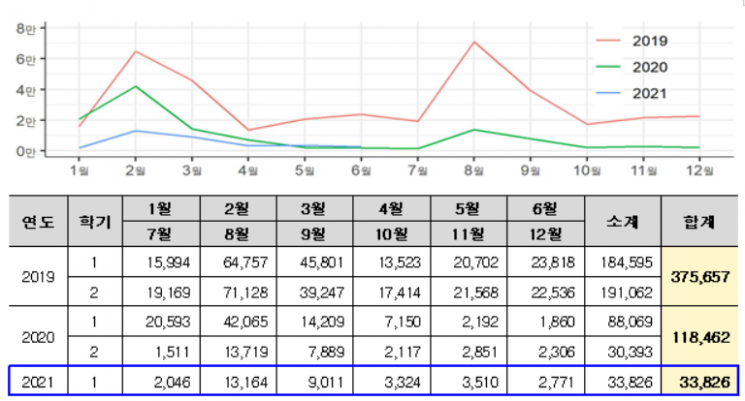
The number of foreign students who entered in the first semester was about 34,000, which is an 82% decrease compared to the first semester of 2019 (185,000), before the COVID-19 outbreak.
Among the 34,000 foreign students who entered from January to June this year, a total of 255 (excluding domestic infections) were confirmed positive. Thirty-three were detected during airport quarantine, and 222 were confirmed during the self-quarantine period after entry. There were no additional transmission cases on campus or in the local community due to dedicated transportation, strengthened COVID-19 testing, and on-site university support.
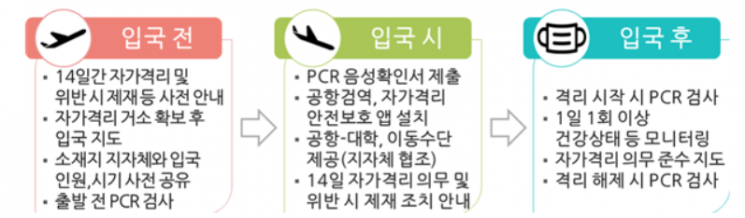
The Ministry of Education will continue the step-by-step protection and management measures at the entry stage, which began in February last year. Before entering, foreign students are guided on self-quarantine and academic schedules, and must take a COVID-19 (PCR) test in their home country before departure to confirm a negative result.
Upon entry, students submit a COVID-19 (PCR) negative certificate, install a self-quarantine app, receive guidance on quarantine rules at a dedicated booth for foreign students (jointly operated with Seoul City), and then move to their self-quarantine residence. Within one day of entry, a second PCR test is conducted at the local health center, and a third PCR test is performed before the end of the quarantine period; quarantine is lifted if the result is negative.
The Ministry of Education actively supports online classes in the students’ home countries if desired, and extends the special exemption for reporting non-entry of foreign students (allowing entry within three months of visa validity without visa cancellation). They plan to promote recognition of degrees in the respective countries for remote classes to encourage staggered entry times.
Protection and management for foreign students entering from variant virus outbreak countries will also be strengthened. Through remote classes and academic accommodations in their home countries, students will be encouraged to enter after 70% of the entire population has completed the first dose of vaccination.
As of August, the 26 countries with variant virus outbreaks include South Africa, Malawi, Botswana, Mozambique, Eswatini, Zimbabwe, Bangladesh, Brazil, Suriname, Paraguay, Chile, Uruguay, the Philippines, India, Indonesia, the United Arab Emirates, Uzbekistan, Vietnam, Nepal, Russia, Lebanon, Malaysia, Haiti, Angola, Kuwait, and Trinidad and Tobago.
Students who enter earlier due to academic schedules are recommended to self-quarantine for 14 days at off-campus self-quarantine facilities staffed by management personnel (temporary living facilities designated by local governments) or at school facilities (such as dormitories with separated movement paths).
Health status is monitored more than twice daily, and strengthened measures such as separating movement paths from students of other countries when moving to health centers are implemented. Support for labor costs for monitoring foreign students, quarantine supplies, and transportation costs is provided using the University Innovation Support Project and work-study scholarships (for work assistance).
Deputy Prime Minister and Minister of Education Yoo Eun-hye said, "I deeply thank universities and local governments that have worked hard to protect and manage foreign students for a year and a half since February last year, starting with Chinese students. Although the COVID-19 situation is serious due to variant viruses, I ask the government, universities, and local governments to continue their efforts so that academic operations at universities can proceed stably during the second semester this year."
© The Asia Business Daily(www.asiae.co.kr). All rights reserved.
![Clutching a Stolen Dior Bag, Saying "I Hate Being Poor but Real"... The Grotesque Con of a "Human Knockoff" [Slate]](https://cwcontent.asiae.co.kr/asiaresize/183/2026021902243444107_1771435474.jpg)
















