At KIAF Forum, Former Vice Chairman of KEC Kim Yong-geun: "Reconsideration Procedure Underway, Mandatory Administrative Act According to Relevant Law"
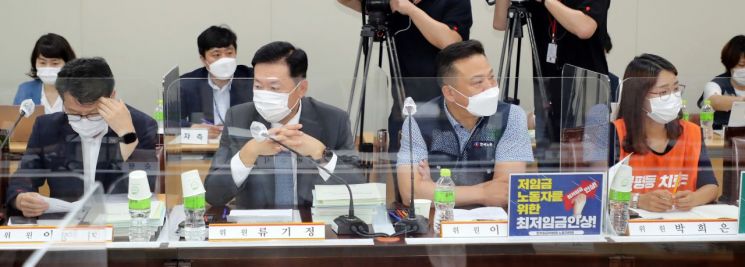
The industrial sector appealed to the Ministry of Employment and Labor to accept the objection submitted by the Korea Employers Federation regarding next year’s minimum wage increase proposal and adjust it to a realistic level. They argued that the Minimum Wage Commission’s decision lacks legality and legitimacy, and that the steep increases over several years have raised the minimum wage to a median wage level, making it an unbearable burden for real economy actors such as small business owners and small and medium enterprises (SMEs) suffering from COVID-19.
The Korea Industrial Alliance Forum (KIAF) held the 12th Industrial Development Forum and the 17th Automotive Industry Development Forum on the morning of the 28th under the theme “Directions for Developing Labor-Management Relations in Response to the 4th Industrial Revolution Era.” Considering the COVID-19 situation, the forum was conducted online.
During the forum, it was pointed out that the current domestic minimum wage has effectively risen to the median wage level. As of last year, the minimum wage was 61.3% of the median wage of all workers, exceeding the OECD average of 54.2% and even higher than the G7 average of 48%.
Furthermore, the monthly conversion of last year’s minimum wage was approximately 1.8 million KRW, which is not significantly different from the median value of about 1.85 million KRW for the subsistence living expenses of single, unmarried workers. Kim Yong-geun, former Senior Vice President of the Korea Employers Federation, stated, “Along with the minimum wage increase, the ‘multiplier butterfly effect’ that simultaneously raises other linked labor cost items such as bonuses and retirement pay is also at a world-class level.”
If next year’s minimum wage, decided at 9,160 KRW with a 5.1% increase compared to this year, is finalized without adjustment, the five-year minimum wage increase under the current administration will reach 2,690 KRW, the largest absolute increase ever. In comparison, the five-year minimum wage increases under the previous Lee Myung-bak administration (2008?2012) and Park Geun-hye administration (2013?2017) were 1,100 KRW and 1,890 KRW, respectively.
The problem is that such a high increase rate is an unbearable level for real economy actors such as small business owners and SMEs. High increases have continued even before the current administration, and the COVID-19 pandemic has added another variable since last year. According to the Korea Employers Federation, the rate of workers earning below the minimum wage was 15.6% last year, the second highest since 2001. In the accommodation and food service sectors, which were hit hardest by COVID-19, this rate approached 42.6%.
In particular, since the Minimum Wage Commission’s decision has lost legality and legitimacy, there are calls for the Minister of Employment and Labor to request a reconsideration. Although it is an independent permanent body, it is playing a role in passing unofficial government guidelines, and the basis for the minimum wage decision is said to be arbitrarily pieced together. For example, the Minimum Wage Commission cited economic growth rate forecasts (4.0%), consumer price inflation forecasts (1.8%), and employment increase rate forecasts (0.7%) as grounds for next year’s minimum wage increase rate, but these do not align with previous standards or the current Minimum Wage Act’s stipulated decision criteria (such as workers’ living expenses, wages of similar workers, labor productivity, and income distribution ratio).
The Korea Employers Federation submitted an objection to the Ministry of Employment and Labor on the 23rd regarding the 2022 minimum wage proposal based on these grounds. The current Minimum Wage Act allows worker and employer representatives to file objections to the Minister of Employment and Labor within 10 days of the minimum wage announcement, and if the minister recognizes the reasons, must request a reconsideration from the Minimum Wage Commission within 20 days. However, since the introduction of the minimum wage system in 1988, a reconsideration has never been conducted.
Former Vice President Kim said, “Due to the excessive increase under the current administration, Korea’s minimum wage has become the highest among competing countries, exceeding companies’ wage-paying capacity and painfully pressuring corporate management and the national economy.” He added, “Considering the obsolescence, irrationality, and political dependency of the Minimum Wage Commission, the excessive minimum wage level, and the crisis situation caused by COVID-19, it is a mandatory administrative act under the Minimum Wage Act for the government to accept the business community’s objection and proceed with the reconsideration process this time.”
Meanwhile, the forum also called for improvements in related laws and systems as traditional labor-management relations are disappearing due to the 4th Industrial Revolution. Jeong Man-gi, chairman of KIAF, said, “In response to the industrial paradigm shift, it is necessary to innovate labor-management relations toward diversification, autonomy, and flexibility.” He added, “Along with this, in new industrial fields, a policy environment should be created where private sector creativity can be actively exercised through the introduction of autonomous or negative regulations.”
© The Asia Business Daily(www.asiae.co.kr). All rights reserved.
![Clutching a Stolen Dior Bag, Saying "I Hate Being Poor but Real"... The Grotesque Con of a "Human Knockoff" [Slate]](https://cwcontent.asiae.co.kr/asiaresize/183/2026021902243444107_1771435474.jpg)















